
You just brought your puppy home, and now you’re staring at a vet bill or a bottle of dewormer wondering: am I doing this right? Maybe you noticed something unsettling in your puppy’s stool, or your breeder mentioned “the first deworming” and you’re not sure what happens next. If you’re worried you’ve already missed a dose, or you’re not sure when the next one is due, you’re in the right place.
This guide walks you through exactly when puppies need to be dewormed, why the schedule is so frequent early on, and what happens once your puppy grows into an adult dog. Parasites are just one of several common puppy diseases new owners should watch for during the first few months.
Medical Disclaimer: This article is for general educational purposes only and is not a substitute for professional veterinary advice. Deworming schedules can vary based on your puppy’s health, environment, and local parasite risks. Always consult your veterinarian before starting or changing any deworming routine.
How Often Should Puppies Be Dewormed: Quick Answer
Most puppies are first dewormed at about 2 weeks of age and treated again every 2 weeks during early puppyhood. The exact stopping point depends on the deworming product, when regular broad-spectrum parasite prevention begins, the puppy’s weaning status, and veterinary advice. Many puppies receive treatments at 2, 4, 6, and 8 weeks, followed by monthly parasite prevention. Some puppies may need additional treatments beyond 8 weeks, especially when parasite risk is high.
Just Got an 8-Week-Old Puppy? Here’s What to Do
If you recently brought home an 8-week-old puppy, don’t automatically give another dewormer just because you’re unsure of the schedule.
First, ask the breeder, shelter, or previous owner for the puppy’s medical records. Look for:
- The date of each previous deworming treatment.
- The name or active ingredient of the product used.
- The puppy’s weight when the medication was given.
- Any fecal test results.
- The date of the puppy’s last veterinary examination.
It’s also worth checking where your puppy stands on their vaccination schedule at the same time, since deworming and vaccines are usually tracked together on the same vet record.
If the records show that the puppy was dewormed at 2, 4, 6, and 8 weeks, your veterinarian may recommend moving to an appropriate monthly parasite preventive rather than continuing the exact same dewormer every two weeks.
If the records are missing or incomplete, don’t guess the dose or repeat medication unnecessarily. Have your veterinarian review the puppy’s history, current weight, and parasite risk and decide what should happen next.
What if I missed a dose?
A missed dose doesn’t necessarily mean you need to start the entire schedule over. The correct next step depends on how late the dose is, which parasite is being treated, what product was used, and whether your puppy is already receiving monthly parasite prevention.
Instead of giving an extra dose on your own, contact your veterinarian and ask when the next treatment should be given.
Why Puppies Need to Be Dewormed So Often
It might seem excessive to deworm a puppy every two weeks, but there’s a real reason behind it. Most puppies are born with intestinal parasites, even if the mother was dewormed during pregnancy. Roundworm larvae can lie dormant in a mother dog’s tissue and reactivate during pregnancy or nursing, passing to puppies through the placenta or through her milk.
Because of this, a puppy can test negative for worms one week and pick up a new infestation the next, especially while parasites are cycling through different life stages in the intestines. A single treatment may not eliminate every stage of a parasite’s life cycle, and puppies can also become re-infected after treatment. This is why repeat treatments and ongoing parasite prevention are commonly recommended during puppyhood. The exact number and timing of treatments depend on the parasite and medication being used. That’s why the schedule repeats every two weeks in the early months rather than being a one-time treatment.

Puppy Deworming Schedule by Age
Here is the general schedule most veterinarians follow. Your vet may adjust it based on your puppy’s weight, breed, or where you live.
| Puppy Age | Typical Deworming Guidance | What Owners Should Do |
|---|---|---|
| 2 weeks | First deworming | Puppies are commonly started on parasite treatment at this age |
| 4 weeks | Repeat treatment | Continue the early puppy schedule |
| 6 weeks | Repeat treatment | Follow the product and veterinarian’s instructions |
| 8 weeks | Repeat treatment or transition to preventive | Ask for the puppy’s complete deworming record |
| 10 to 12 weeks | May need additional treatment | Depends on the puppy’s previous treatments, product, weaning status, and parasite risk |
| Up to 6 months | Often monthly parasite control | Continue the veterinarian-recommended preventive program |
| Adult | Year-round parasite prevention | Frequency depends on the product and the dog’s individual risk |
Important: There isn’t one universal deworming schedule for every puppy. Veterinary guidelines differ slightly depending on parasite risk, local conditions, the puppy’s history, and the preventive product being used. Your veterinarian may recommend additional treatment after 8 weeks or a different schedule based on your puppy’s individual needs.
What Types of Worms Are Puppies Dewormed For?
Deworming medication for puppies typically targets several common intestinal parasites at once:
- Roundworms — the most common parasite in puppies, often passed from mother to pup
- Hookworms — can cause anemia, especially dangerous in young puppies
- Whipworms — harder to detect and may need a specific dewormer
- Tapeworms — usually linked to fleas, so flea control matters too
Heartworm is a separate parasite spread by mosquitoes, not treated by standard intestinal dewormers. AAHA says heartworm prevention should start as early as the product label allows, usually around 4 to 8 weeks, rather than waiting until 6 months.
Heartworm is different from intestinal worms. It is spread by mosquitoes and requires a preventive medication specifically labeled for heartworm protection. Puppies can generally begin heartworm prevention when they reach the minimum age and weight specified by the product label, often during early puppyhood. Your veterinarian can recommend the appropriate product and explain when testing is needed. Your veterinarian can choose a product based on your puppy’s age, weight, parasite exposure, local risks, and previous treatment history.
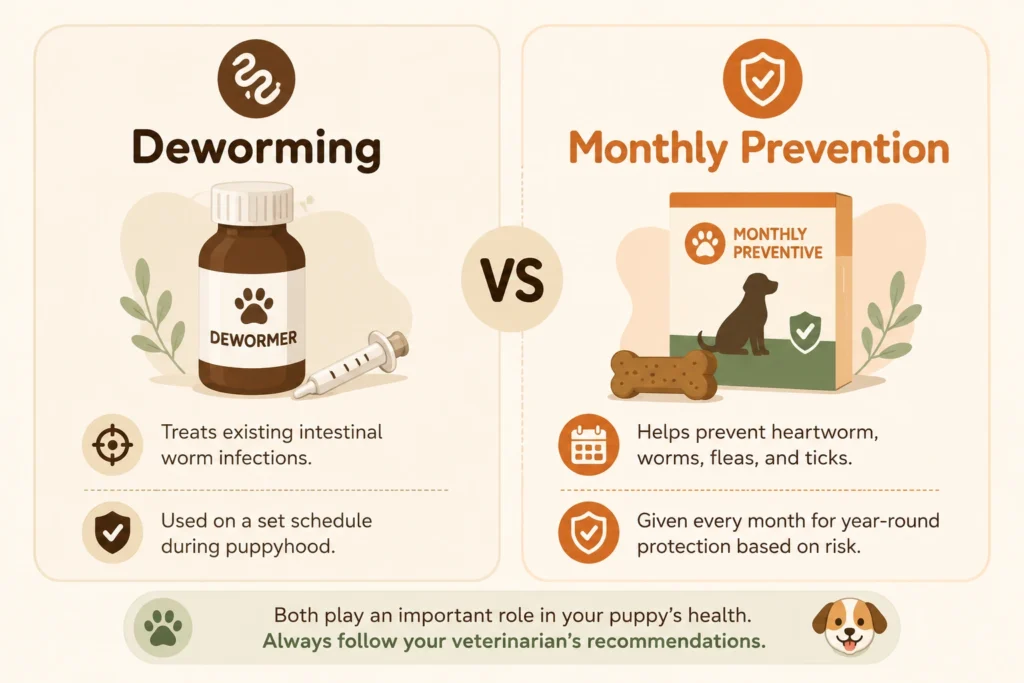
Deworming vs. Monthly Parasite Prevention: What’s the Difference?
Deworming and parasite prevention are related, but they aren’t always the same thing.
Deworming usually refers to treating an existing intestinal parasite infection with a medication that targets specific worms.
Monthly parasite prevention is an ongoing preventive program designed to reduce the risk of certain parasites. Depending on the product, it may protect against heartworm, roundworms, hookworms, fleas, ticks, or other parasites.
Not every dewormer treats every type of worm, and not every monthly preventive covers every parasite. That’s why choosing a product based only on its brand name can be confusing.

Signs Your Puppy May Have Worms
Even with a deworming schedule in place, it helps to know the warning signs, since no schedule is 100% foolproof against environmental reinfection.
- A pot-bellied or bloated appearance despite normal eating
- Visible worms or rice-like segments in stool
- Diarrhea, sometimes with mucus or blood
- Vomiting, occasionally with worms present
- Dull coat or slow weight gain
- Lethargy or low energy
If you notice any of these signs, contact your veterinarian rather than waiting for the next scheduled dose. Some worms, especially hookworms, can become dangerous quickly in very young puppies. Keep in mind some puppies with diarrhea but otherwise acting normal still need a vet check, since mild symptoms don’t rule out parasites.
What to Do If You See Worms in Your Puppy’s Stool
Seeing something unusual in your puppy’s stool can be alarming, but the appearance can provide useful clues.
Long, pale, spaghetti-like worms can be consistent with roundworms. Small, flat segments that look similar to grains of rice can occur with tapeworms. However, not everything that looks like a worm is actually a parasite.
If you see something unusual:
- Take a clear photo if possible.
- Save a fresh stool sample if your veterinarian recommends bringing one.
- Note when you first noticed it.
- Tell your veterinarian when the puppy was last dewormed and which product was used.
- Don’t give an additional dewormer simply because you saw a worm.
Different parasites require different medications, and some infections need follow-up testing or treatment. Young puppies with heavy hookworm infections can become seriously ill, so weakness, pale gums, bloody diarrhea, repeated vomiting, or severe lethargy should be treated as reasons to seek veterinary care promptly.
When Should You Call the Vet Immediately?
Knowing how to tell if a puppy is sick means contacting a veterinarian promptly if your puppy has severe or bloody diarrhea, repeated vomiting, extreme weakness, pale gums, collapse, significant dehydration, or refuses food and water. Heavy hookworm infections can be particularly dangerous in young puppies
How Deworming Is Given
Deworming medication comes in a few common forms:
- Liquid oral dewormer — common for very young puppies, easy to dose by weight
- Chewable tablets — often used from 8 weeks onward
- Topical treatments — applied to the skin, sometimes combined with flea prevention
Dosage is almost always based on your puppy’s current weight, not a flat amount. This is one of the biggest reasons to have your vet weigh your puppy at each visit rather than guessing the dose yourself.
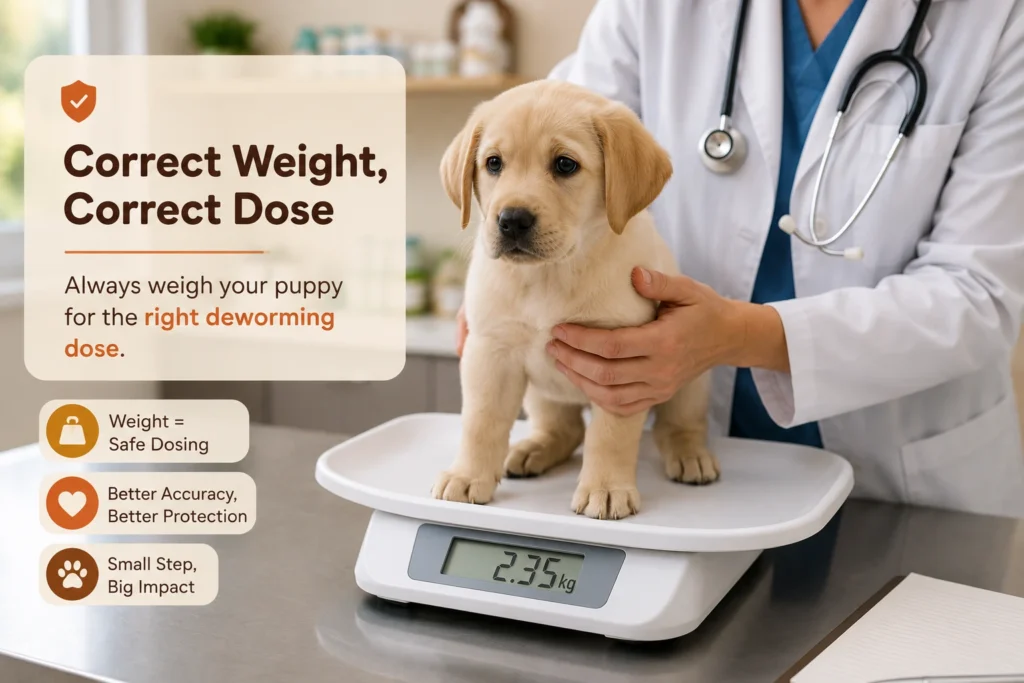
Why Your Puppy’s Weight and Product Matter.
Puppy dewormers aren’t interchangeable. The appropriate medication and dose depend on the puppy’s current weight, age, the parasite being treated, and the specific product’s label. Two puppies of the same age may need different amounts because their body weights can be very different.
Never combine multiple deworming products unless your veterinarian tells you to. Check the active ingredients before giving a second parasite medication, because some products overlap in what they treat.
Expert Tips for Staying on Schedule
- Keep a written log. A simple note on your phone with dates and doses prevents accidental double-dosing or missed doses.
- Bring records to every vet visit. If you adopted your puppy, ask the shelter or breeder for exact deworming dates rather than assuming a schedule.
- Don’t skip the fecal test. A fecal exam can catch a parasite that a routine dewormer didn’t fully clear.
- Clean up promptly. Picking up stool quickly in your yard reduces the chance of reinfection from parasite eggs in the soil.
- Talk to your vet before switching products. Not every dewormer treats every type of worm, so switching brands without guidance can leave gaps in protection.
Ask about fecal testing during your puppy’s first year. CAPC recommends testing puppies more frequently than adult dogs, with intestinal parasite testing at least four times during the first year and additional testing based on health, lifestyle, and previous infection history.
Can Puppy Worms Affect People?
Some intestinal parasites found in puppies can also affect people. Roundworms and hookworms are examples of parasites with zoonotic potential.
The good news is that simple hygiene habits can reduce the risk:
- Pick up puppy stool promptly.
- Wash your hands after handling dog waste.
- Don’t allow children to play in areas contaminated with dog feces.
- Keep the puppy’s living area clean.
- Follow your veterinarian’s parasite prevention and testing recommendations.
Regular parasite control protects more than your puppy. It also helps reduce contamination of the home and environment.
Common Mistakes Puppy Owners Make
Mistake 1: Stopping After One Dose
Many new owners assume one deworming treatment is enough because the puppy “seems fine.” Since a single dose doesn’t kill eggs or migrating larvae, stopping early allows the parasite cycle to continue. Stick to the full every-2-week schedule through 12 weeks.
Mistake 2: Using the Wrong Dosage
Estimating a dose based on age instead of weight is a common error. Puppies of the same age can vary widely in size, and giving too little under-treats the infestation while too much can cause stomach upset. Always confirm dosage with your vet or the product label based on current weight.
Mistake 3: Ignoring Reinfection Risk
Puppies who play in soil, parks, or areas other dogs use can pick up new eggs shortly after treatment. Owners sometimes assume a clean fecal test means they’re done for good, when ongoing prevention is what actually keeps a puppy protected.
Mistake 4: Skipping Deworming Because the Puppy Looks Healthy
A puppy can carry a significant worm burden without showing obvious symptoms, especially in the early stages. Waiting for visible signs before treating means the infestation has already had time to affect your puppy’s digestion and nutrient absorption.
Puppy Deworming Checklist
Use this simple checklist to stay organized:
- Find out when your puppy was last dewormed.
- Write down the medication or active ingredient used.
- Record your puppy’s current weight.
- Ask your veterinarian when the next treatment is due.
- Ask whether your puppy needs a fecal examination.
- Start the recommended heartworm prevention when your puppy is old and heavy enough for the chosen product.
- Ask about flea and tick prevention if your puppy is old enough.
- Pick up stool promptly from the yard.
- Keep a record of every parasite treatment.
- Contact your veterinarian if your puppy develops severe diarrhea, vomiting, weakness, pale gums, or other concerning symptoms.
Puppy Deworming: What Should You Do Next?
My puppy is under 8 weeks old:
Ask the breeder or veterinarian about the treatments already given and follow the recommended early puppy schedule.
My puppy is around 8 weeks old:
Get the complete deworming record and have your veterinarian confirm the next treatment and preventive plan.
My puppy is 10 to 12 weeks old:
Don’t assume the puppy automatically needs another dose. Check the previous treatments and ask whether your puppy should continue treatment or transition to ongoing parasite prevention.
I don’t know when my puppy was last dewormed:
Don’t guess or give multiple products. Contact your veterinarian with your puppy’s age and current weight.
I can see worms in the stool:
Take a photo or save a fresh sample if your veterinarian requests it, and arrange a veterinary evaluation.
My puppy is weak, pale, vomiting repeatedly, or has bloody diarrhea:
Seek veterinary care promptly.
Frequently Asked Questions
Can I deworm my puppy myself without a vet?
Over-the-counter dewormers exist, but it’s best to have your vet confirm the type of parasite and correct dosage first, especially for very young or small-breed puppies where dosing errors carry more risk.
What happens if I miss a scheduled deworming?
Don’t automatically double the next dose or give an extra dose without checking the product instructions or asking your veterinarian. The best next step depends on how late the treatment is, which medication was used, and whether your puppy is already receiving ongoing parasite prevention. If you’re unsure, give your veterinarian the date of the last treatment and the product name so they can tell you when the next dose is appropriate.
Is it normal to see worms in my puppy’s stool after deworming?
Yes, seeing dead or paralyzed worms in the stool shortly after treatment is common and is actually a sign the medication is working.
Do indoor puppies still need to be dewormed on schedule?
Yes. Most puppies are infected before birth or through nursing, so exposure isn’t limited to outdoor environments. Indoor puppies still need the full schedule.
How much does puppy deworming cost?
Cost varies by location and product, but routine puppy deworming is generally one of the more affordable parts of early veterinary care. Ask your vet’s office for exact pricing in your area.
Can adult dogs get worms even with monthly prevention?
It’s possible, though less common. Monthly preventives significantly reduce risk, but annual fecal exams are still recommended to catch anything that slips through.
Is deworming the same as heartworm prevention?
No. Standard deworming treats intestinal parasites, while heartworm prevention targets a separate parasite spread by mosquito bites. Many monthly preventives combine both, but they aren’t automatically the same product.
When can I stop deworming my puppy every two weeks?
Once your puppy reaches 12 weeks old, most vets shift to a monthly schedule rather than every two weeks, continuing monthly protection through adulthood.
Conclusion
Deworming feels like a lot to keep track of in those first few months, but the pattern is simple once you see it laid out: every two weeks from 2 to 12 weeks old, then monthly through 6 months, then an ongoing monthly or vet-guided schedule as an adult. Missing a dose here and there isn’t the end of the world, but staying consistent is what actually protects your puppy’s digestion, growth, and overall health during the stage when they’re most vulnerable.
If you’re not sure where your puppy currently stands in this schedule, your next step is simple: call your vet, confirm the last deworming date, and get the next one on the calendar today.
Sources.
- Companion Animal Parasite Council, Ascarid Guidelines
- Companion Animal Parasite Council, General Guidelines for Dogs and Cats
- AAHA Canine Life Stage Guidelines
- ESCCAP, Scheme for Individual Deworming of Dogs

Muzammil Khan is a certified canine behaviorist and the founder of Puppywhisper. With 8+ years of experience in positive reinforcement training, Muzammil has helped over 1,000 puppies transition smoothly into their new homes. All health advice is reviewed in collaboration with licensed veterinarians.