Introduction
Your puppy bolts for the door every time it opens. He jumps out of his “sit” the second you turn your back. You’ve tried saying “stay” a dozen times, but he just doesn’t seem to get it and now you’re wondering if he ever will.
Here’s the good news: teaching a puppy to stay isn’t about repeating a word louder or longer. It’s about building the skill in small, honest steps your puppy can actually succeed at. Most owners rush this command, and that’s exactly why it falls apart in real life at the front door, at the vet, or when guests walk in.
This guide breaks the process down into a system that works, starting today, even if your puppy has never held a stay for more than two seconds.
Safety Reminder
Stay is an important safety skill, but no puppy should be trusted off leash near roads or other dangerous areas until they have months of reliable practice. Always use a leash when safety depends on your puppy remaining in place.
How to Teach a Puppy to Stay: Quick Answer
To teach a puppy to stay, start with your puppy in a sit or down position, say “stay” once, wait 1–2 seconds, then reward before your puppy moves. Gradually increase the time, then the distance, and finally add distractions one variable at a time. Most puppies can hold a reliable 30-second stay within 1–2 weeks of short daily sessions.
Why “Stay” Matters More Than Most Puppy Owners Realize
“Stay” isn’t just a party trick. It’s a safety command. A dog who reliably stays won’t dart into traffic when the front door opens, won’t jump on a frightened visitor, and can wait calmly at the vet or groomer without added stress.
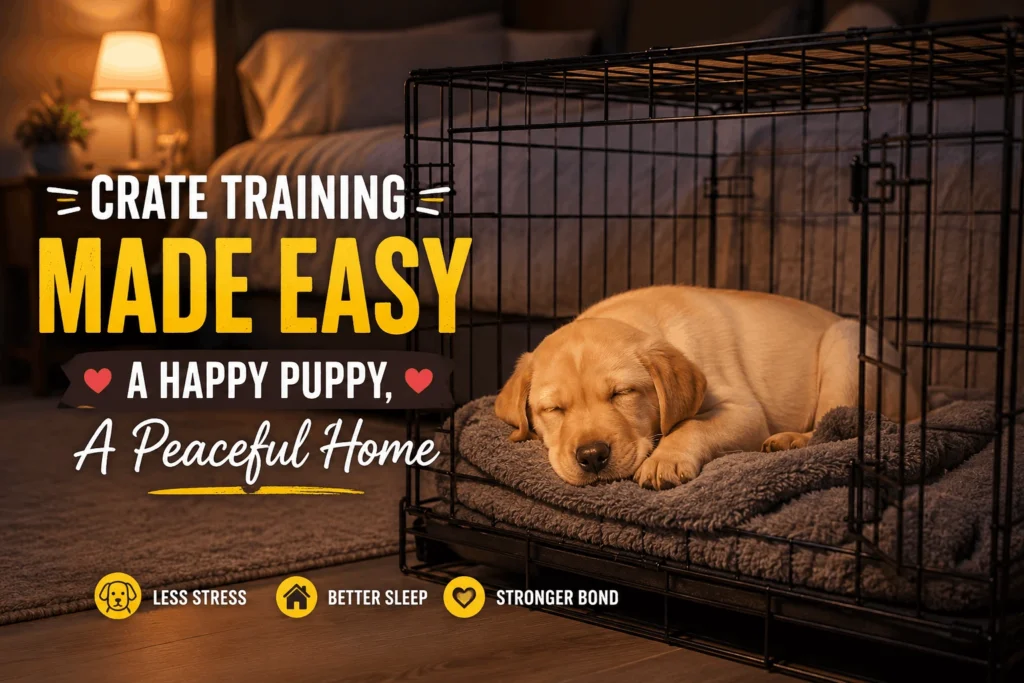
It also builds something bigger: self-control. A puppy who learns to pause and wait even when excited is easier to live with in almost every other situation, from mealtime to walks. That same self-control tends to carry over into other routines too, like settling calmly during crate training at night.
When to Start Training “Stay”
Puppies can start learning stay as early as 8 weeks old, but keep expectations realistic. At this age, a 2–3 second stay is a genuine win. Most puppies aren’t developmentally ready for longer stays (30+ seconds, or stays with real distractions) until they’re 4–6 months old. The American Kennel Club echoes this same principle building basic cues gradually, in small steps, is what makes them stick. For a full breakdown of what to expect at each stage, see our puppy training schedule by age.
If your puppy is younger than 8 weeks or hasn’t mastered a basic sit yet, start there first. Stay builds on top of sit or down trying to teach both at once usually confuses puppies rather than speeding things up.
What You’ll Need
- A quiet, low-distraction room (living room or hallway)
- Small, soft training treats (pea-sized, easy to chew fast)
- A clicker (optional, but helpful for precise timing)
- 5–10 minutes, 2–3 times per day
- Patience this is a marathon skill, not a one-session trick
Before You Start
This answers another user intent and reduces training mistakes.
Example:
Before You Begin Stay Training
For the best results, make sure your puppy is:
- Calm rather than overly excited.
- Slightly hungry so treats are motivating.
- In a quiet room with few distractions.
- Comfortable wearing their regular collar or harness.
Avoid practicing when your puppy is zooming around, overly tired, or needs a potty break. A puppy that’s uncomfortable or distracted will struggle to learn.
| Stay | Wait |
|---|---|
| Dog holds position until released | Dog pauses briefly |
| Used for longer durations | Used for short pauses |
| Better for visitors, grooming, vet visits | Better for doors and crossings |
| Formal obedience cue | Casual everyday cue |
Best Rewards for Stay Training
People search this often.
Example:
Best Rewards for Teaching Stay
High value treats make learning much easier. Good options include:
- Small pieces of cooked chicken.
- Freeze dried liver treats.
- Cheese cubes (in moderation).
- Soft commercial training treats.
Keep rewards pea sized so your puppy doesn’t spend more time chewing than training.
Signs You’re Moving Too Fast
Slow down if your puppy:
- Breaks the stay more than twice in a session.
- Starts whining or barking.
- Repeatedly lies down when asked to sit.
- Looks away and loses focus.
- Stops taking treats.
When this happens, simply make the exercise easier and let your puppy succeed again.
Do Some Breeds Learn Stay Faster?
Yes. Every puppy learns at their own pace.
Some breeds, such as Border Collies and Labrador Retrievers, often learn impulse control more quickly because they’re highly motivated to work with people.
Independent breeds, such as Beagles or Huskies, may need more repetitions and higher value rewards. Focus on consistency instead of comparing your puppy with others.
How to Teach a Puppy to Stay: Step-by-Step
Step 1: Master the Sit First
Before adding “stay,” your puppy should reliably sit on command in a quiet room. If sit is still shaky, spend a few more days reinforcing it before moving on. This same small-steps approach is what makes other basics click too our guide on how to potty train a puppy uses the exact same method.
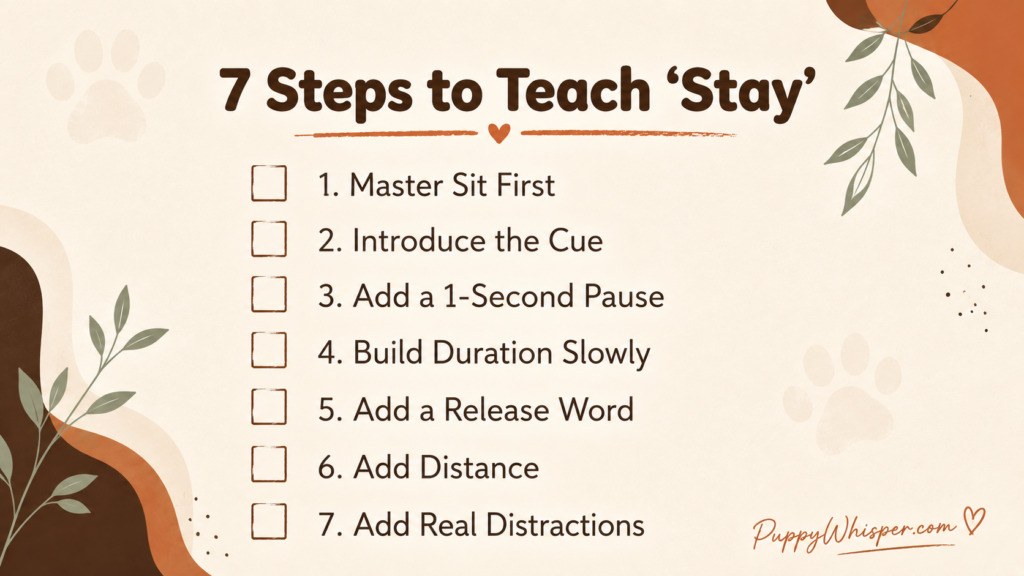
Step 2: Introduce the Cue With Zero Delay
Ask your puppy to sit. The moment they’re sitting, say “stay” in a calm, clear voice, and immediately reward with a treat even though no time has passed yet. This teaches your puppy that the word “stay” itself is a good thing, not a warning. If your puppy tends to nip or mouth your hand during treat delivery, our puppy biting training tips guide can help you manage that alongside stay training.
Step 3: Add a One-Second Pause
Say “stay,” wait exactly one second, then reward before your puppy has a chance to move. If your puppy breaks position, that’s not defiance it means the step was too hard. Go back to zero delay and try again.
Step 4: Build Duration Slowly
Increase the wait time gradually: 2 seconds, then 5, then 10, then 20. Add only a few seconds at a time. A useful rule many trainers follow: increase duration by no more than 25–50% per session, and if your puppy fails twice in a row, drop back to the last successful time.
Step 5: Release With a Clear Word
Always end the stay with a release word like “okay” or “free,” said before your puppy moves on their own. This teaches your puppy that they, not you, don’t decide when the stay ends which is the entire point of the command.
Step 6: Add Distance (Not Distractions Yet)
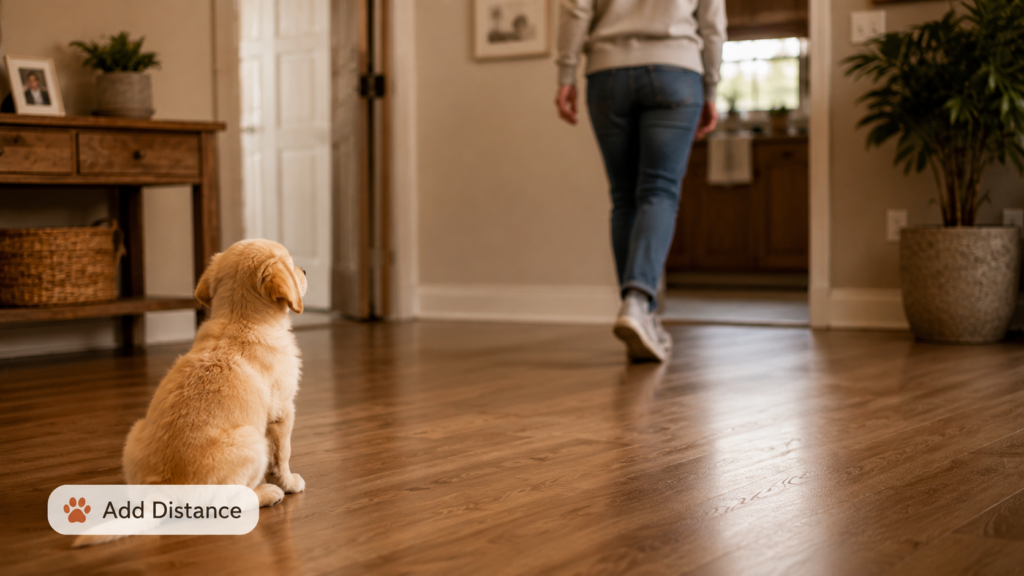
Once your puppy holds a 20–30 second stay reliably, start taking one small step back before returning to reward. Increase distance in small increments one step, then two, then a few feet always returning to your puppy to deliver the treat rather than calling them to you.
Step 7: Layer in Real-World Distractions
Only after distance is solid, introduce distractions: a family member walking by, a toy on the floor, the doorbell ringing. Practice in short bursts, and if your puppy breaks the stay, it means you moved too fast dial back the distraction level, not the puppy’s effort.
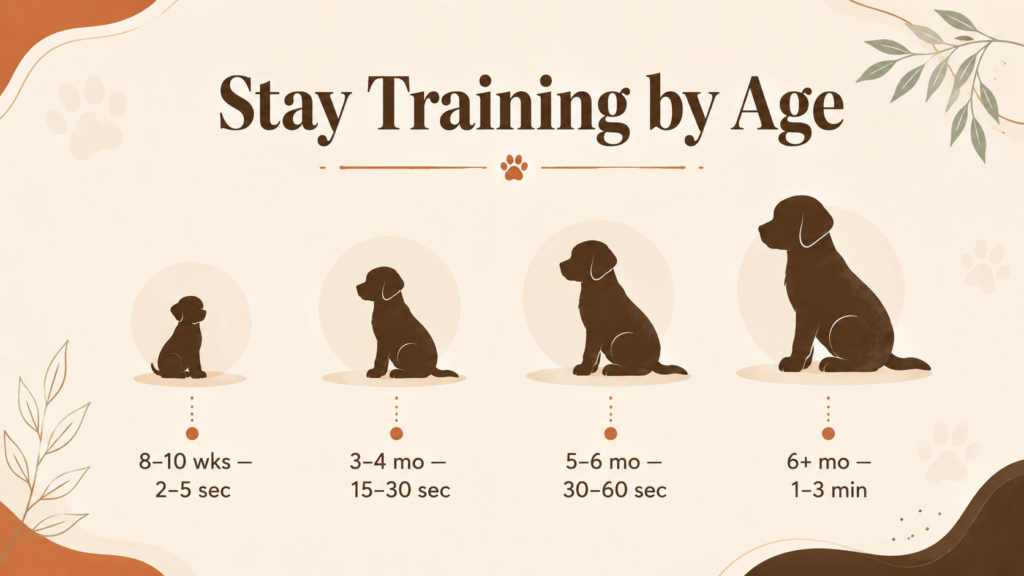
Common “Stay” Training Timeline
| Puppy Age | Realistic Stay Goal |
|---|---|
| 8–10 weeks | 2–5 seconds, no distance |
| 3–4 months | 15–30 seconds, a few feet of distance |
| 5–6 months | 30–60 seconds, mild distractions |
| 6+ months | 1–3 minutes, real-world distractions |
These are general guidelines every puppy learns at a different pace, and breed, temperament, and consistency of practice all play a role.
Expert Tips for Faster, Stronger Results
- Train before meals, not after. A slightly hungry puppy is more motivated to work for treats.
- Keep sessions short. Five focused minutes beat thirty minutes of a distracted puppy.
- Reward the stillness, not just the sit. Reward while your puppy is calm and still holding position, not after they’ve already started to shift.
- Practice in multiple rooms. Puppies don’t generalize well a stay learned in the kitchen doesn’t automatically transfer to the backyard.
- End every session on a win. Finish with an easy repetition your puppy can succeed at, so training always feels rewarding.
Common Mistakes Puppy Owners Make (and How to Fix Them)
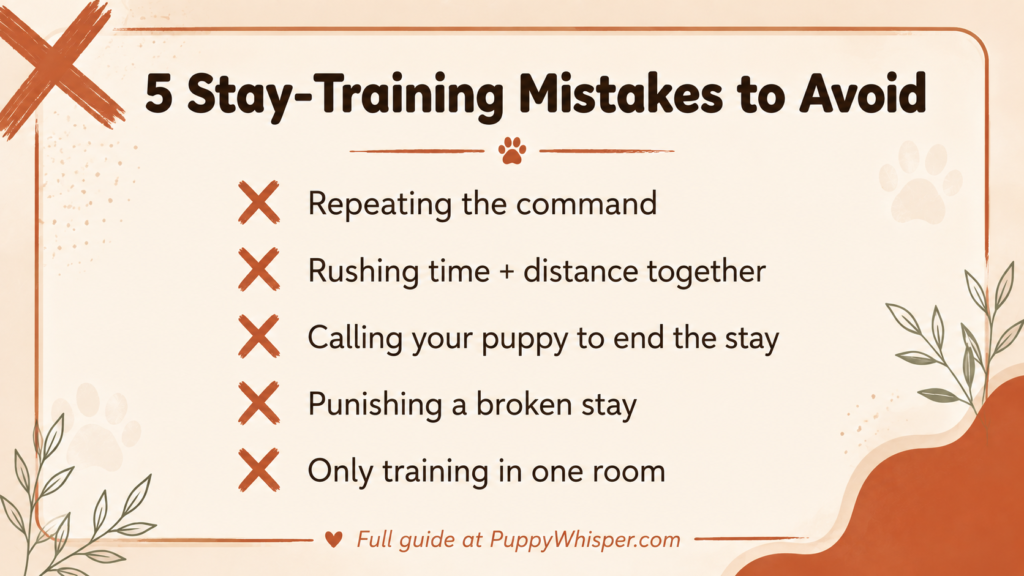
Mistake 1: Repeating the command over and over. Saying “stay, stay, stay” teaches your puppy to ignore the first few repetitions. Say it once, and if your puppy moves, simply reset and try a shorter stay.
Mistake 2: Increasing time and distance at the same time. This is the single biggest reason stay training stalls. Always change one variable time, distance, or distraction at a time.
Mistake 3: Calling the puppy to you to end the stay. This teaches your puppy that stay actually means “wait until you get called,” which quietly undermines the command. Return to your puppy to reward instead.
Mistake 4: Punishing a broken stay. If your puppy breaks position, that’s feedback that the step was too difficult not a behavior problem. Adjust your training plan, not your tone.
Mistake 5: Only practicing in one location. A stay that only works in your living room isn’t a reliable stay. Practice in the yard, on walks, and near the front door once the basics are solid.
| Problem | Likely Cause | Solution |
|---|---|---|
| Puppy stands up immediately | Duration increased too quickly | Return to 1 to 2 second stays |
| Puppy follows you | Distance added too early | Reward before stepping away |
| Puppy ignores cue | Too many distractions | Train in a quieter location |
| Puppy only stays with treats visible | Treat is acting as a lure | Hide treats until after success |
During puppy training, it’s completely normal to have days where your puppy seems to forget everything they’ve learned. This often happens during adolescence or after training in a new environment. Staying consistent and returning to easier steps usually restores progress quickly.
Frequently Asked Questions
How long does it take to teach a puppy to stay?
Most puppies can learn a basic 10–20 second stay within 1–2 weeks of short daily practice. A fully reliable stay with distance and distractions can take several months, especially in younger puppies.
Why won’t my puppy stay even for a few seconds?
This usually means the previous step (sit, or a shorter stay) hasn’t been fully reinforced yet. Go back to the last point where your puppy succeeded consistently and rebuild from there.
What’s the difference between “stay” and “wait”?
Many trainers use “stay” for a fixed position until released, and “wait” for a more casual pause (like before crossing a threshold). You can use either consistency matters more than the specific word.
Can I use a clicker to teach stay?
Yes. A clicker can help mark the exact moment your puppy is doing the behavior correctly, which can speed up learning, especially for precise duration training.
Should I use a hand signal along with the word “stay”?
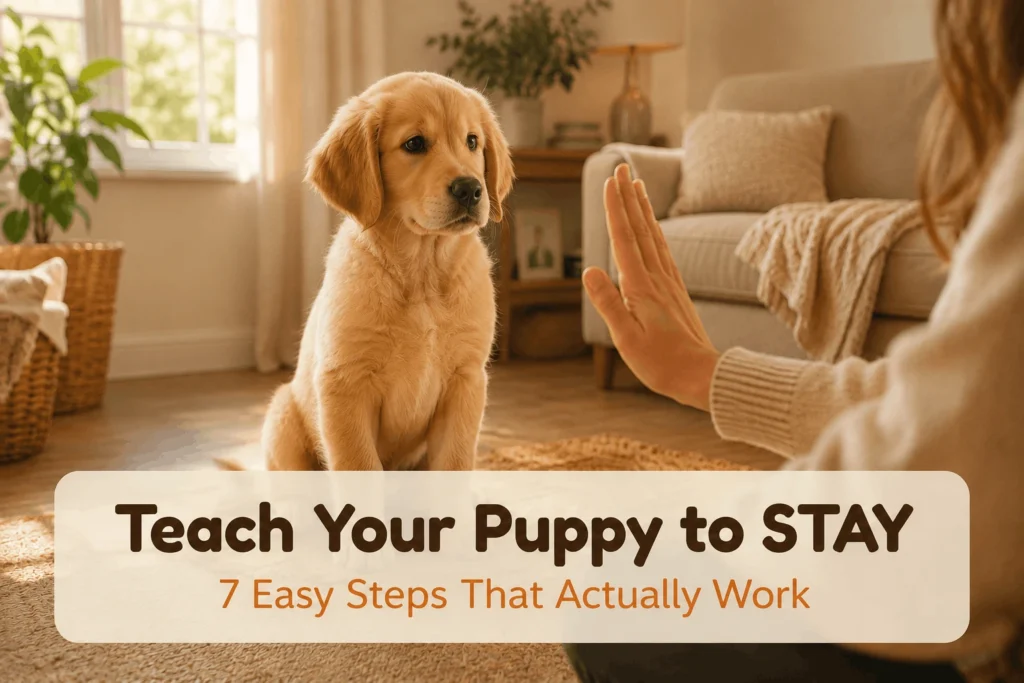
Yes an open palm facing the puppy is a common, effective signal. Dogs often read body language faster than verbal cues, so pairing both can strengthen the command.
My puppy stays but only when I’m holding a treat. What am I doing wrong?
This usually means treats were shown before the behavior rather than delivered after. Keep treats out of sight during the stay itself, and only reveal them as the reward once your puppy has held position.
Is it normal for puppies to regress on stay after a growth spurt or new environment?
Yes, this is common. Adolescence and new environments can temporarily affect focus and impulse control. Simply return to an easier version of the exercise and rebuild gradually.
When should I talk to a professional trainer instead of doing this alone?
If your puppy shows signs of anxiety, reactivity, or you’re not seeing any progress after several weeks of consistent practice, a certified professional trainer can help identify what’s holding your puppy back.
Conclusion
Teaching a puppy to stay isn’t about a magic cue it’s about breaking the skill into pieces small enough for your puppy to succeed at every single time. Start with zero delay, build duration before distance, add distractions last, and always end sessions on a win.
Next step: Grab a handful of treats right now and run three short “zero-delay” reps with your puppy today that one small rep is the first real building block of a reliable stay.
References
Recommended sources:
- American Kennel Club
- American Veterinary Medical Association
- Association of Professional Dog Trainers

Muzammil Khan is a certified canine behaviorist and the founder of Puppywhisper. With 8+ years of experience in positive reinforcement training, Muzammil has helped over 1,000 puppies transition smoothly into their new homes. All health advice is reviewed in collaboration with licensed veterinarians.