Introduction
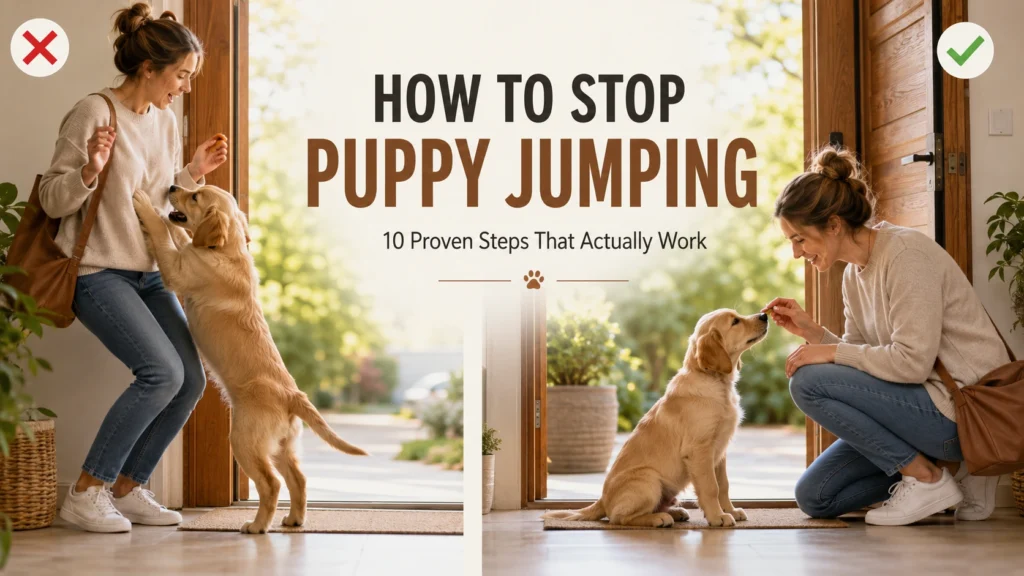
How to stop puppy jumping is one of the most common challenges new dog owners face. You walk through the front door after work, and within seconds your puppy launches into the air, paws on your chest, tail wagging so hard their whole body wiggles.
At first, it’s adorable.
But as your puppy grows, those playful jumps can quickly become a problem. Muddy paw prints on clean clothes, scratched arms, frightened children, and even elderly family members losing their balance are all common reasons owners look for ways to stop puppy jumping before it becomes a lasting habit.
If you’ve already tried saying “No,” pushing your puppy away, or turning your back, you may have noticed that the behaviour keeps coming back. That’s because jumping isn’t usually a sign that your puppy is stubborn or trying to dominate you. In most cases, it’s a natural greeting behaviour that has been unintentionally rewarded over time. Dogs repeat behaviours that consistently earn attention, whether that attention is positive or negative.
The good news is that jumping is one of the easiest puppy behaviours to change when you understand why it happens and teach your puppy a more appropriate way to greet people. Using positive reinforcement, consistent training, and clear household rules, most puppies can learn calm greetings that last into adulthood.
In this complete guide, you’ll learn:
- Why puppies jump on people.
- Whether jumping is normal or a behaviour problem.
- Why some breeds jump more than others.
- How excitement, fear, anxiety, and overarousal can look similar.
- What accidentally reinforces jumping.
- How reward-based puppy training changes the behaviour for the long term.
- A step-by-step training plan that works at home, with visitors, and in real-world situations.
Whether you have an energetic Labrador Retriever, a playful Golden Retriever, a clever Border Collie, or a mixed-breed puppy, the techniques in this guide are designed to help you build calm, polite greeting manners through modern, science-based training. If you’re just getting started, pairing this with a full puppy training schedule by age will help you know exactly what to teach and when.
How to Stop Puppy Jumping: Quick Answer
The fastest way to stop puppy jumping is to remove all attention the moment your puppy jumps and immediately reward calm greetings with all four paws on the floor. Teach an alternative behaviour, such as “Sit,” before greetings, practise with family members first, and stay consistent with every person your puppy meets. Most puppies show noticeable improvement within one to three weeks of daily practice, although distractions like visitors and exciting environments usually take longer to master.
Why Puppies Jump on People
One of the biggest misconceptions about puppy behaviour is that jumping is an act of dominance or disobedience.
In reality, jumping is usually a social greeting.
Dogs naturally investigate faces because that’s where they gather the most information. Your eyes, voice, facial expressions, and scent all communicate important social signals to your puppy.
When your puppy jumps, they’re often trying to get closer to you, not challenge you.
Think about what usually happens after a puppy jumps:
- You look at them.
- You speak to them.
- You pet them.
- You laugh.
- You gently push them away.
- You tell them “Off.”
- Other people react with excitement.
From your perspective, you’re trying to stop the behaviour.
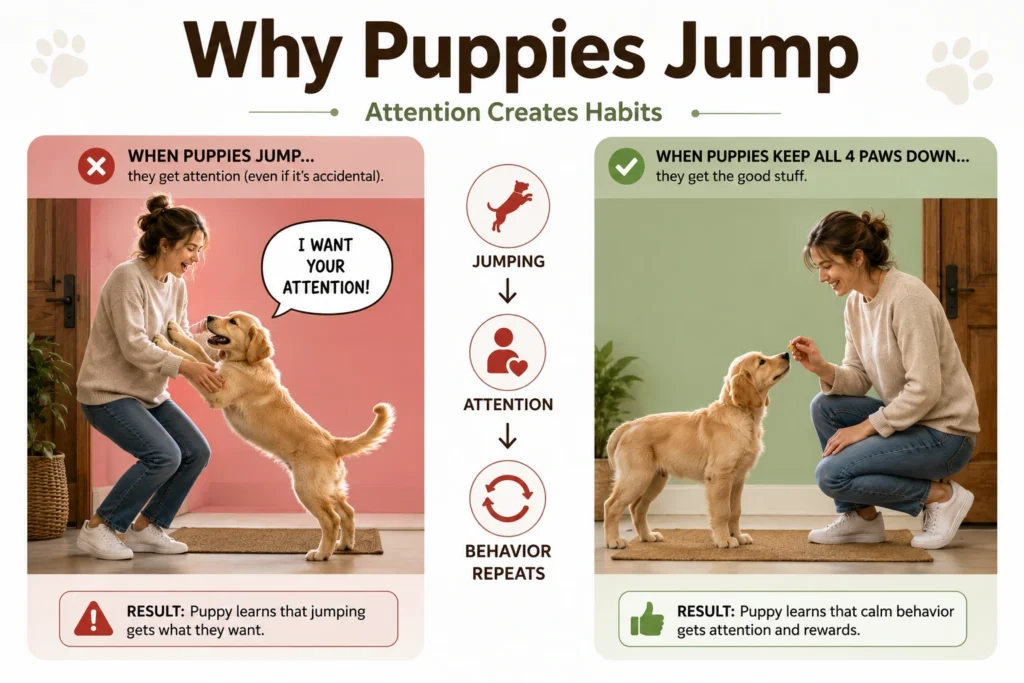
From your puppy’s perspective, jumping successfully got your attention.
Dogs learn through consequences. If a behavior repeatedly earns something valuable, such as attention, play, food, or affection, they’re likely to repeat it. Research on companion dog behavior has found that owner attention commonly maintains jumping behavior, even when the owner believes they’re discouraging it.
Is Puppy Jumping Normal?
Yes.
Jumping is a completely normal behavior in young puppies.
It becomes a problem only when it is repeatedly reinforced.
Puppies explore the world through movement, curiosity, and social interaction. They haven’t yet learned polite greeting manners or impulse control. That’s why many puppies greet people by:
- Jumping.
- Licking faces.
- Pawing at hands.
- Spinning in circles.
- Barking with excitement.
- Zooming around the room.
These behaviours don’t mean your puppy is “bad.”
They simply mean your puppy hasn’t learned a better greeting strategy yet.
The earlier you begin teaching calm greetings, the easier it is to replace jumping before it becomes a lifelong habit. Positive reinforcement training can begin as soon as your puppy comes home, using short, consistent sessions. It’s also common for these same high-energy weeks to bring nipping and mouthing, so if that’s part of your routine too, our puppy biting training tips guide pairs well with this one.
Puppy Development: Why Jumping Changes With Age
Understanding your puppy’s development helps you set realistic expectations.
8 to 12 Weeks
At this age, puppies are learning about their new environment.
Most jumping is playful curiosity.
Training should focus on:
- Building trust.
- Rewarding calm behaviour.
- Teaching simple cues like “Sit.”
- Preventing unwanted habits before they become routine.
This is usually the same stage most owners are also working on how to potty train a puppy, so juggling a few new habits at once is completely normal.
3 to 6 Months
This is when many owners notice jumping becoming more frequent.
Your puppy is:
- More energetic.
- More confident.
- Meeting new people.
- Learning which behaviours earn attention.
Without consistent training, jumping becomes part of your puppy’s greeting routine. This is also a good window to introduce leash training a puppy, since solid loose-leash skills make greetings far easier to manage once you’re outside the house.
6 to 18 Months
This is adolescence.
Many puppies suddenly seem to forget everything they’ve learned.
This temporary regression is completely normal.
Hormonal changes, increased confidence, and higher excitement levels can make jumping return even after weeks of progress.
Don’t assume the training has failed.
Stay consistent, and continue rewarding calm greetings. If evening settling has also gotten harder during this phase, revisiting your crate training a puppy at night routine can help restore some structure.
Excitement, Fear, Anxiety, or Aggression?
Not all jumping looks the same.
Understanding your puppy’s emotional state helps you choose the right training approach.
Excitement
Most common.
Signs include:
- Loose body.
- Wagging tail.
- Play bow.
- Bright eyes.
- Relaxed mouth.
- Happy vocalisations.
This is usually solved with impulse control and positive reinforcement.
Fear or Anxiety
Sometimes puppies jump because they’re uncertain or overwhelmed.
Watch for:
- Tucked tail.
- Ears pinned back.
- Lip licking.
- Yawning.
- Trembling.
- Avoiding eye contact.
If these signs accompany jumping, your puppy may need confidence-building and gradual exposure rather than simply practising greetings.
Aggression
Aggressive jumping is uncommon in puppies.
Warning signs include:
- Stiff body posture.
- Hard stare.
- Deep growling.
- Snapping.
- Lunging.
- Raised hackles.
If your puppy displays these behaviours, seek help from a qualified trainer or veterinary behaviour professional instead of relying on general greeting advice.
Why Some Puppies Jump More Than Others
Every puppy is an individual, but genetics and breed tendencies can influence energy levels and greeting style.
Highly social and energetic breeds often greet people enthusiastically, including:
- Labrador Retriever.
- Golden Retriever.
- Boxer.
- Border Collie.
- Australian Shepherd.
- Vizsla.
Lower-energy breeds may jump less frequently, but they still benefit from learning calm greeting habits.
The training process remains the same regardless of breed.
The difference is usually how much repetition and consistency are needed.
Why Ignoring Jumping Actually Works
Many owners worry that ignoring their puppy feels mean.
In reality, you’re communicating in a way your puppy understands.
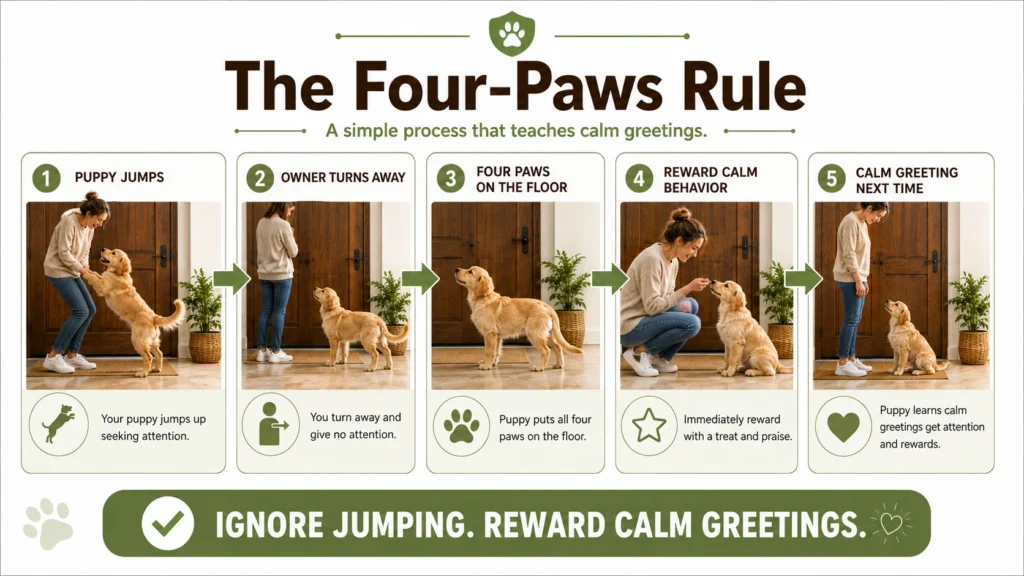
Imagine your puppy has learned this pattern:
Jump → Human pets me.
Your goal is to replace it with:
Four paws on the floor → Human pets me.
The behaviour that earns the reward becomes stronger over time.
Modern reward-based training focuses on teaching the behavior you want instead of punishing the behavior you don’t want. Consistently removing attention after jumping while immediately rewarding calm greetings is supported by current AKC training guidance and behavioral research.
What Accidentally Rewards Jumping?
Many loving owners unknowingly reinforce jumping dozens of times every week.
Common examples include:
- Petting your puppy while saying “Down.”
- Laughing when they jump.
- Holding their paws.
- Pushing them away.
- Talking excitedly.
- Letting them jump when you’re wearing old clothes but not when you’re dressed for work.
- Visitors encouraging jumping because they think it’s cute.
From your puppy’s perspective, all of these interactions can feel rewarding because they receive exactly what they wanted: your attention.
Consistency across every family member and visitor is one of the biggest predictors of success.
Signs Your Puppy Is Ready to Learn Better Greetings
Before moving into the practical training steps, make sure your puppy can already:
- Respond to their name most of the time.
- Take treats in a calm manner.
- Focus on you for a few seconds.
- Follow a simple cue like “Sit.”
- Recover quickly after excitement.
Don’t worry if your puppy isn’t perfect yet.
The training system in Part 2 is designed to build these skills gradually while replacing jumping with calm, polite greetings.
The Complete Puppy Jumping Training System
Now that you understand why puppies jump, it’s time to replace that behaviour with calm, polite greetings that last a lifetime.
This section walks you through the exact training process used by modern reward-based trainers. The goal isn’t simply to stop jumping. It’s to teach your puppy what to do instead, because dogs learn faster when they’re shown the correct behaviour rather than constantly being corrected. Positive reinforcement methods consistently recommend rewarding “four paws on the floor” and teaching an alternative greeting behaviour instead of punishing jumping.
Before You Start: Set Your Puppy Up for Success
Before beginning any training session, prepare your environment.
Have These Ready
- Small, soft training treats.
- A standard leash or lightweight house line.
- A quiet room with minimal distractions.
- Family members who understand the training rules.
- Five to ten minutes for practice.
Keep sessions short and enjoyable. Young puppies learn best through several brief training sessions each day rather than one long session.
The Golden Rule: Reward What You Want to See Again
Dogs repeat behaviours that earn rewards.
If jumping earns attention, your puppy will continue jumping.
If standing calmly earns attention, your puppy will begin offering calm greetings instead.
Your new training equation becomes:
Jumping = Nothing Happens
↓
Four paws on the floor = Rewards, praise, attention, treats and greetings
This simple change forms the foundation of behaviour modification.
Step 1: Stop Accidentally Rewarding Jumping
This is the most important step.
The instant your puppy jumps:
- Turn your body away.
- Fold your arms naturally.
- Avoid eye contact.
- Don’t speak.
- Don’t laugh.
- Don’t touch your puppy.
- Wait calmly.
Even saying “No” can reward attention-seeking puppies.
Remain completely neutral until all four paws return to the floor.
The moment your puppy lands…
Everything changes.
Step 2: Mark the Correct Behavior Immediately
Timing is everything.
The instant all four paws touch the floor:
Say
“Yes!”
or use your clicker.
Immediately reward.
This is called a marker.
A marker tells your puppy exactly which behaviour earned the reward.
Modern clicker and marker training works because the marker pinpoints the correct behaviour before the treat arrives. Trainers recommend rewarding within a few seconds so the puppy clearly associates the reward with keeping all four paws on the floor.
Example
Puppy jumps
↓
You ignore
↓
Puppy lands
↓
“Yes!”
↓
Treat
↓
Gentle praise
↓
Petting
Now your puppy starts thinking
Keeping my paws down makes wonderful things happen.
Step 3: Teach an Alternative Behavior (Sit Before Greetings)
Don’t simply stop jumping.
Replace it.
The easiest replacement is Sit.
A puppy cannot sit and jump at the same time.
Practice indoors first
Ask for:
Sit
↓
Reward
↓
Release
Repeat several times.
Once your puppy automatically sits for rewards, begin using it before greetings.
Example
Walk toward your puppy.
Ask
“Sit.”
Reward.
Walk away.
Repeat.
Soon your puppy begins offering a sit automatically whenever someone approaches.
This is called teaching an incompatible behaviour, because sitting naturally prevents jumping.
Step 4: Teach “Four Paws on the Floor”
Your puppy shouldn’t only sit.
Sometimes standing calmly is equally appropriate.
Practice rewarding whenever your puppy naturally has:
- Four paws on the floor.
- Relaxed body language.
- Loose tail wag.
- Eyes focused on you.
You don’t always have to ask for a command.
Capture calm behaviour whenever you see it.
Many trainers refer to this as capturing behaviour, where you reward behaviours your puppy offers naturally.
The more often calm greetings earn rewards…
The more often your puppy will choose them.
Step 5: Practice Low-Distraction Greetings
Start somewhere boring.
Not the front door.
Not visitors.
Not the dog park.
Instead practice inside your living room.
Walk away.
Walk back.
Reward.
Repeat.
Change directions.
Reward.
Walk around furniture.
Reward.
Keep your puppy successful.
This builds a long history of reinforcement before introducing excitement.
Step 6: Add Family Members
Once your puppy succeeds with you…
Bring in another family member.
Training protocol
Family member enters room.
↓
Puppy sits or keeps four paws down.
↓
Family member immediately greets puppy.
↓
If puppy jumps…
Greeting instantly stops.
↓
Wait.
↓
Four paws return.
↓
Greeting resumes.
Every family member must follow exactly the same rules.
One inconsistent greeting can undo dozens of successful repetitions.
Step 7: Train Door Greetings
The front door creates one of the highest excitement levels for puppies.
Instead of waiting until guests arrive…
Practice first.
Exercise
Walk to the door.
Open it.
Close it.
Reward calm behaviour.
Repeat.
Next…
Pretend someone knocked.
Reward.
Next…
Ask a family member to step outside.
Knock.
Enter.
Reward only calm greetings.
Increase excitement gradually.
Do not jump straight to a party with ten guests.
Step 8: Use Management While Learning
Training changes behaviour.
Management prevents mistakes.
Both are necessary.
Helpful management tools include:
- House leash.
- Baby gate.
- Exercise pen.
- Dog bed.
- Portable mat.
These tools don’t replace training.
They prevent your puppy from rehearsing unwanted behaviour while learning a new habit.
Teaching your puppy to go to a designated mat or bed can also help manage greetings by giving them a clear place to settle when visitors arrive.
Step 9: Train with Visitors
Visitors often accidentally reward jumping.
Before opening the door…
Brief your guests.
Tell them:
“Please ignore my puppy until all four paws are on the floor.”
Explain that they should:
- Avoid eye contact.
- Avoid petting.
- Avoid talking excitedly.
The instant your puppy remains calm…
Visitors may greet them.
Community experiences from puppy owners consistently show that training progresses much faster when every visitor follows the same greeting rules.
Step 10: Practice Outside the Home
Dogs don’t automatically generalise behaviours.
A puppy who behaves perfectly indoors may forget everything outside.
Practise in stages.
Stage 1
Quiet street.
Stage 2
Neighbour walking by.
Stage 3
Calm stranger.
Stage 4
Friendly child.
Stage 5
Pet-friendly shop.
Stage 6
Busy park.
Only increase difficulty after your puppy succeeds at the previous stage.
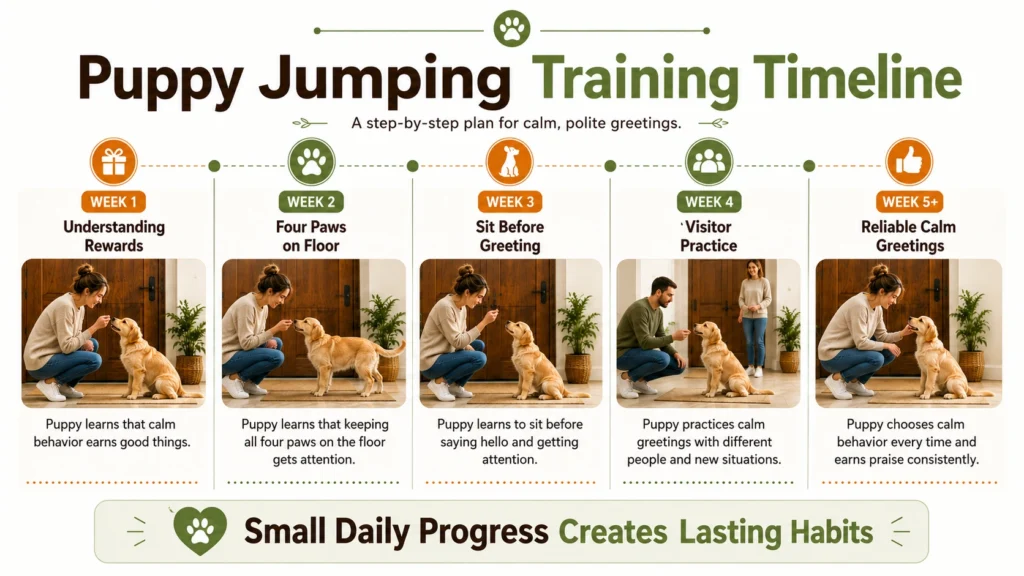
Training Timeline
| Week | Training Goal | Expected Progress |
|---|---|---|
| Week 1 | Learn four paws on the floor | Puppy begins understanding the reward pattern. |
| Week 2 | Sit before greetings | Jumping becomes less frequent with family members. |
| Week 3 | Visitor practice | Better self-control around familiar guests. |
| Week 4 | Outdoor greetings | Improved manners with strangers in quiet environments. |
| Weeks 5 to 8 | Real-life consistency | Calm greetings become the default in most situations. |
Every puppy learns at a different pace. High-energy breeds, adolescent puppies, or dogs with a long history of jumping may need additional practice.
Daily 10-Minute Training Routine
Minute 1 to 2
Practise “Sit.”
Minute 3 to 4
Reward calm standing.
Minute 5 to 6
Walk away and return.
Minute 7 to 8
Front door greeting practice.
Minute 9 to 10
Finish with play and praise.
Keeping training short helps maintain motivation and prevents frustration for both you and your puppy.
Troubleshooting Common Problems
My puppy ignores treats.
Use higher-value rewards such as small pieces of cooked chicken or cheese, and train before meals when your puppy is more interested in food.
My puppy jumps even more when I ignore them.
This temporary increase is common when a previously rewarded behaviour no longer works. Stay consistent and continue rewarding calm greetings.
My puppy only jumps on visitors.
Practise with friends and family who are willing to follow your training rules before expecting success with strangers.
My puppy jumps on children.
Children often move quickly and become excited, which can encourage jumping. Closely supervise interactions and teach children to stand still, fold their arms, and wait until all four paws are on the floor before greeting.
My puppy jumps during walks.
Create distance from approaching people, ask for a sit before greeting, and reward calm behaviour. If your puppy cannot stay calm, simply continue walking and try again later.
Signs Your Training Is Working
Look for these small wins:
- Your puppy pauses before jumping.
- Your puppy offers a sit without being asked.
- Greetings become calmer.
- Recovery after excitement becomes quicker.
- Visitors notice improved manners.
- Your puppy checks in with you for guidance.
- Jumping becomes less frequent and less intense.
Celebrate progress, not perfection.
Advanced Puppy Jumping Problems, Expert Advice, and Long-Term Success
By now, you’ve learned why puppies jump and exactly how to teach calm greetings.
This final section answers the questions that many owners still have after starting training. These are the situations where people often think, “My puppy is different,” when, in reality, they simply need a slightly different approach.
Modern, reward-based training focuses on preventing your puppy from rehearsing unwanted behaviour, rewarding calm alternatives, and gradually increasing distractions rather than relying on punishment or force.
My Puppy Still Jumps After Two Weeks. Is Something Wrong?
Probably not.
Learning is rarely a straight line.
Many puppies improve quickly during the first week, then suddenly seem to forget everything.
This is normal.
Dogs don’t learn in perfect progression.
Some days your puppy may greet everyone politely.
The next day they may jump on every visitor.
This doesn’t mean training has failed.
It means your puppy is still learning how to make good choices in increasingly exciting situations.
Continue rewarding:
- Four paws on the floor.
- Calm greetings.
- Sitting before attention.
- Looking at you instead of jumping.
Small improvements eventually become lasting habits.
My Puppy Jumps and Bites at the Same Time
Jumping and mouthing often happen together, especially between 8 weeks and 6 months.
Usually this is caused by:
- Overexcitement.
- Overtiredness.
- Frustration.
- Teething.
- Lack of impulse control.
Instead of trying to stop both behaviours separately:
Reduce excitement.
Ask for an easy behaviour like:
- Sit.
- Touch.
- Go to your mat.
Reward generously.
If biting becomes intense, calmly end the interaction for a short period before trying again.
Avoid rough play that encourages your puppy to chase hands or clothing.
My Puppy Only Jumps on Visitors
This is extremely common.
Why?
Because visitors are far more exciting than family members.
To solve it:
Before the door opens
- Put your puppy on a leash.
- Have treats ready.
- Ask for a sit.
Tell guests exactly what to do
Ask them to:
- Ignore jumping.
- Avoid eye contact.
- Wait for four paws on the floor.
- Reward calm greetings with gentle attention.
Consistency from visitors is just as important as consistency from you. Even one enthusiastic greeting can reinforce jumping and slow your puppy’s progress.
My Puppy Jumps on Children
Children move quickly.
They laugh.
They squeal.
They wave their arms.
To puppies…
That’s an invitation to play.
Never expect young children to train your puppy.
Instead:
- Supervise every interaction.
- Keep your puppy on a leash if needed.
- Teach children to stand still.
- Fold arms.
- Turn sideways.
- Wait until your puppy is calm.
Protecting both your puppy and the child should always come first.
My Puppy Jumps During Walks
Walks introduce dozens of exciting distractions.
Your puppy may jump because they:
- Want attention.
- Want to greet someone.
- Feel frustrated.
- Become overstimulated.
Instead of allowing greetings every time:
Practice this routine.
Person appears
↓
Ask for “Sit.”
↓
Reward.
↓
If your puppy remains calm…
Allow greeting.
↓
If your puppy jumps…
Walk away calmly.
Your puppy learns that polite greetings make people come closer.
Jumping makes people go away.
My Puppy Jumps on Other Dogs
Not every dog enjoys being greeted this way.
Repeated jumping can:
- Frustrate other dogs.
- Cause conflicts.
- Create bad social habits.
Teach your puppy to:
- Sit before greeting.
- Walk politely.
- Approach calmly.
If another dog seems uncomfortable, simply move on.
Quality social interactions are more valuable than frequent greetings.
Do Some Breeds Need More Training?
Yes, but not because they’re “bad.”
Some breeds naturally have:
- Higher energy.
- Stronger social drives.
- Greater athletic ability.
Examples include:
- Labrador Retriever.
- Golden Retriever.
- Boxer.
- Border Collie.
- Australian Shepherd.
- Vizsla.
- Belgian Malinois.
These breeds often need:
- More physical exercise.
- Mental enrichment.
- Short training sessions throughout the day.
- Consistent greeting practice.
The training method remains the same.
Only the amount of practice changes.
Common Myths About Puppy Jumping
Myth 1: “My puppy will grow out of it.”
Usually not.
Behaviours that earn rewards become habits.
Without training, jumping often becomes stronger as dogs grow larger.
Myth 2: “I should knee my puppy in the chest.”
No.
Pain-based techniques can create fear, anxiety, or confusion without teaching your puppy what to do instead. Modern veterinary and training guidance recommends reward-based alternatives over physical punishment.
Myth 3: “Saying ‘No’ is enough.”
Not usually.
Your puppy needs a clear replacement behaviour.
Teach:
- Sit.
- Four paws on the floor.
- Go to your mat.
These behaviours are easier for puppies to understand.
Myth 4: “My puppy is trying to dominate me.”
Current behavioural science does not support the idea that normal greeting jumps are attempts at dominance.
Most puppies jump because:
- They’re excited.
- They want attention.
- They haven’t learned another greeting behaviour yet.
Mistakes That Slow Progress
Avoid these common errors:
Inconsistent family rules.
Everyone should respond the same way every time.
Rewarding jumping “just this once.”
Dogs don’t understand exceptions like:
“It’s okay today because I’m wearing old clothes.”
Consistency is essential.
Training only inside.
Dogs don’t automatically apply behaviours to new places.
Practise:
- Home.
- Garden.
- Driveway.
- Quiet street.
- Park.
- Pet-friendly shops.
Sessions that are too long.
Aim for:
- Five to ten minutes.
- Two to four times daily.
Short, positive sessions improve learning.
Expecting perfection too soon.
Progress matters more than perfection.
Celebrate:
- One fewer jump.
- One extra sit.
- One calm greeting.
Those small wins build lasting habits.
When Should You Get Professional Help?
Most puppies improve with consistent home training.
However, contact a certified professional dog trainer or veterinary behaviourist if your puppy:
- Shows aggressive behaviour while jumping.
- Guards people or resources.
- Bites hard enough to break skin.
- Displays extreme fear.
- Cannot calm down despite weeks of consistent training.
- Has suddenly started jumping after a medical issue or injury.
Early professional support can prevent small behaviour problems from becoming more serious.
Frequently Asked Questions
At what age should I stop puppy jumping?
Start as soon as your puppy comes home, often around 8 weeks of age. Early training prevents unwanted habits from becoming established.
How long does it take to stop puppy jumping?
Many puppies improve within 1 to 3 weeks of consistent daily practice. Reliable greetings around visitors or in busy environments often take several more weeks.
Should I use a clicker?
Yes, if you’re comfortable using one. A clicker or a marker word like “Yes!” helps your puppy understand exactly which behavior earned the reward.
Should I use treats forever?
No.
As your puppy becomes more reliable, gradually replace food rewards with:
- Praise.
- Toys.
- Petting.
- Real-life rewards like greeting visitors.
Continue rewarding occasionally to maintain the behaviour.
Can older dogs learn not to jump?
Absolutely. Older dogs often need more repetition because the behavior has been practiced for longer, but the same reward-based principles still work.
Key Takeaways
Remember these five rules:
- Ignore jumping every single time.
- Reward all four paws on the floor immediately.
- Teach an alternative behaviour like “Sit.”
- Practice with gradually increasing distractions.
- Stay consistent across every family member and visitor.
These simple habits create polite greetings that last throughout your dog’s life.
Conclusion
Stopping puppy jumping isn’t about punishing excitement. It’s about teaching your puppy a better way to say hello.
Every calm greeting, every successful sit, and every moment your puppy keeps all four paws on the floor is a step toward a well-mannered adult dog.
Be patient with setbacks, stay consistent with your training, and remember that every family member and visitor plays a role in your puppy’s success. Over time, those small daily repetitions become lifelong habits.
With positive reinforcement, clear expectations, and plenty of practice, most puppies learn that calm greetings earn exactly what they want: your attention, affection, and trust.

Muzammil Khan is a certified canine behaviorist and the founder of Puppywhisper. With 8+ years of experience in positive reinforcement training, Muzammil has helped over 1,000 puppies transition smoothly into their new homes. All health advice is reviewed in collaboration with licensed veterinarians.