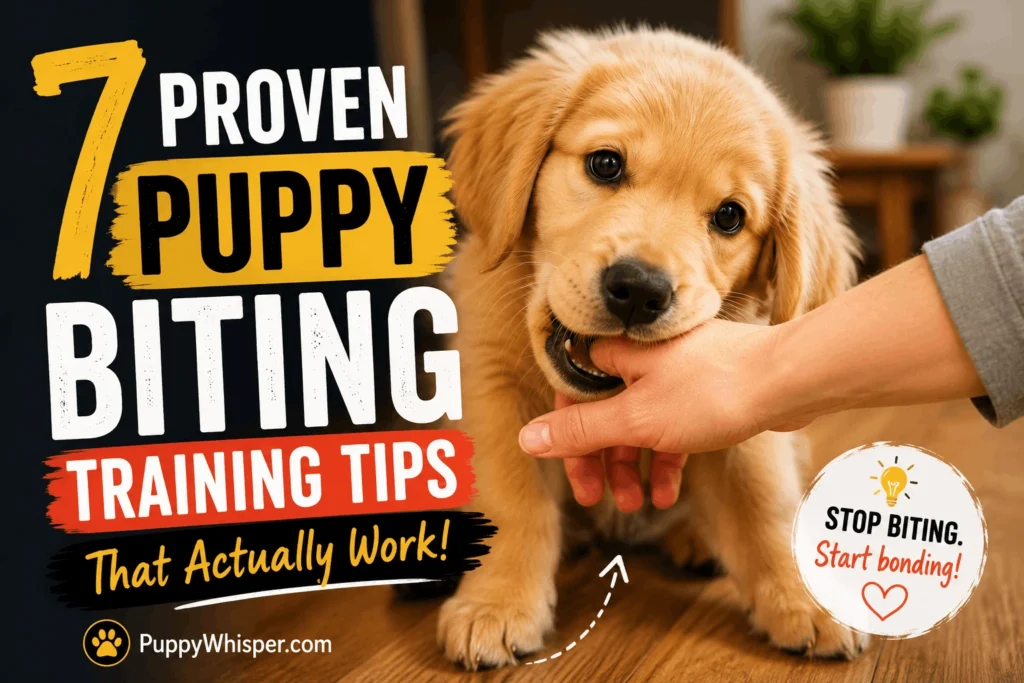
Those Little Teeth Are No Joke
Your puppy looks adorable until those tiny teeth clamp down on your hand for the fifth time today. Your fingers are scratched, your patience is thin, and you’re starting to wonder if something is wrong with your dog.
Nothing is wrong. Biting is one of the most natural puppy behaviors that exists. But natural doesn’t mean you have to live with it. With consistent training, most puppies learn to control their biting within a few weeks.
Here’s exactly what to do.
Quick Answer About Puppy Biting Training Tips
Puppies bite because they’re teething, exploring, or overstimulated during play. To stop it, teach bite inhibition using the yelp method, redirect biting to appropriate chew toys, and reward calm behavior consistently. Avoid rough play and physical punishment both make biting worse. With patience and a clear routine, most puppies significantly reduce biting by 4 to 5 months of age.
Why Puppies Bite (And Why It’s Normal)
Understanding the reason behind the behavior makes training far more effective.
Teething Discomfort
Between 3 and 6 months, puppies lose their baby teeth and grow adult ones. Their gums ache. Chewing and biting provide relief and your hand happens to be very convenient.
Play Behavior and Exploration
Before coming home with you, your puppy spent weeks wrestling with littermates. Biting was how they played. They haven’t learned yet that human skin is much more sensitive than puppy fur.
Overstimulation and Excitement
When puppies get overly excited during fetch, tug, or rough play their self-control drops fast. Biting often spikes during these moments, not because your puppy is aggressive, but because they’ve lost the ability to regulate themselves. Understanding the reason behind the behavior makes training far more effective, and canine behaviorists have studied this closely in AKC’s guide on puppy mouthing and bite inhibition.
When Biting Becomes a Real Problem
Most puppy biting is completely normal between 8 and 16 weeks. By 5 to 6 months, it should be decreasing noticeably as adult teeth settle in and training takes hold.
Watch for these warning signs that go beyond normal play biting:
- Biting that draws blood repeatedly
- Growling or snapping when you approach food, toys, or spaces
- Stiff body posture combined with biting
- Biting that escalates rather than responds to redirection
If you see these signs, consult a certified professional dog trainer (CPDT-KA) or your veterinarian. These behaviors can indicate fear, pain, or resource guarding each requiring a different approach than basic bite training.
7 Puppy Biting Training Tips That Work
Tip 1: Teach Bite Inhibition First
Bite inhibition is your puppy’s ability to control how hard they bite. It’s the most important skill to develop even more important than stopping biting entirely.
A puppy who has learned bite inhibition won’t cause serious injury if they bite in fear or pain later in life. Here’s how to build it:
- Let your puppy mouth your hand gently during play.
- The moment pressure increases, stop all movement and make a short, sharp sound “ouch” or “ow.”
- Withdraw your hand calmly. No jerking (that triggers more biting).
- Wait 15 to 30 seconds, then resume play.
- If biting continues, end the play session entirely.
You’re teaching them that hard biting = fun stops. Gentle contact = play continues.
Tip 2: Use the Yelp Method But Do It Right
The yelp method mimics how littermates communicate pain. When one puppy bites too hard, the other yelps and stops playing. You replicate this signal.
How to do it:
- Let out a high-pitched “Yip!” the moment biting gets too hard.
- Go still. Don’t pull away dramatically.
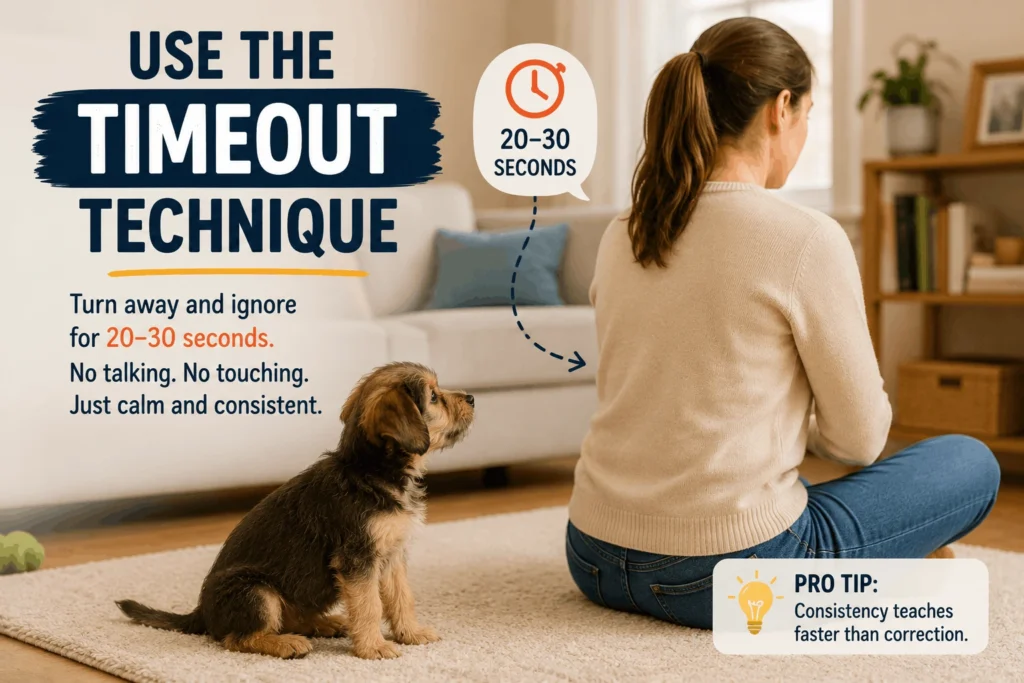
- Look away and ignore your puppy for 20 to 30 seconds.
- Resume interaction once your puppy has calmed down.
Important: This works better for some puppies than others. Some pups get more excited by the yelp. If your puppy ramps up after you yelp, skip to Tip 4 instead.
Tip 3: Redirect to a Chew Toy Immediately
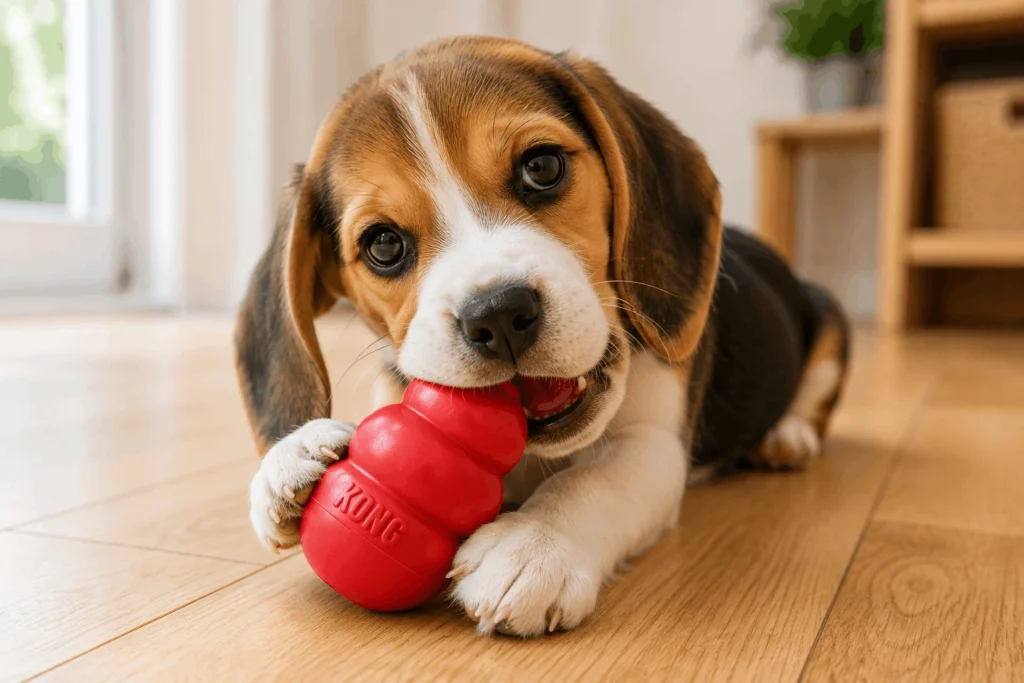
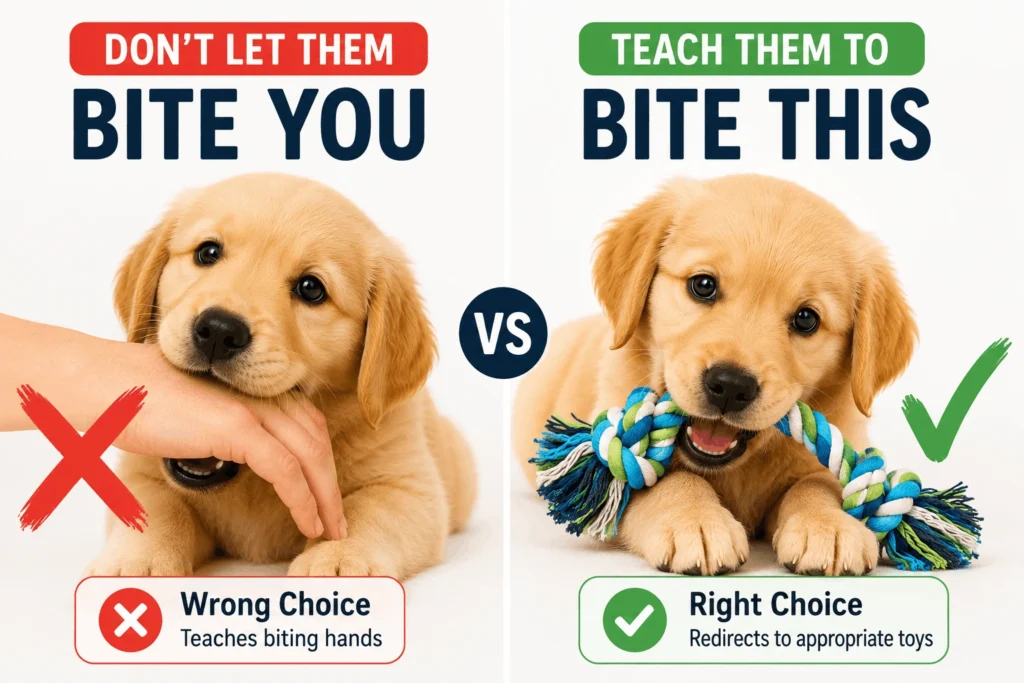
Keep a chew toy within arm’s reach at all times. The moment teeth touch skin, swap your hand for the toy.
Best redirection toys by age:
| Age | Recommended Toy Type |
|---|---|
| 8–12 weeks | Soft rubber toys (Kong Puppy) |
| 3–5 months | Nylabone Puppy teething rings |
| 5–6 months | Rope toys, durable rubber chews |
Be consistent. Every single time teeth touch skin, redirect. Inconsistency is the number one reason this step fails.
Tip 4: End Playtime When Biting Happens
If your puppy bites after redirection, calmly stand up, turn away, and stop all interaction for 30 to 60 seconds. No eye contact, no talking, no reaction.
This is a social timeout not punishment. You’re removing what your puppy wants most: your attention. Over time, your puppy connects biting with losing playtime, which is a powerful motivator to self-regulate.
This same withdrawal-of-attention approach is one of the most effective ways to stop puppy barking triggered by excitement or attention-seeking.
Tip 5: Reward Calm, Gentle Behavior
Most owners focus entirely on stopping bad behavior. The faster shortcut is rewarding good behavior in real time.
When your puppy plays with you gently soft mouth contact, licking instead of biting, or resting near you without jumping give immediate praise and a small treat.
Your puppy learns what earns attention and rewards. Make gentle behavior wildly worth it.
Tip 6: Socialize Your Puppy Consistently
Puppies who regularly interact with other vaccinated, well-behaved dogs learn bite inhibition naturally through play. Puppy classes and supervised playdates reinforce what you’re teaching at home.
The socialization window closes around 14 to 16 weeks, so early, positive exposure matters enormously. Ask your vet when it’s safe to start group puppy classes based on your vaccination schedule.
Puppy classes are also a great place to practice basic leash training a puppy skills, since most sessions require your pup to walk calmly on a leash around other dogs.
Tip 7: Keep Training Sessions Short and Consistent
Five to ten minutes of focused training, two to three times per day, beats a single 45-minute session every few days. Puppies have short attention spans. Short, frequent repetitions build habits faster.
Set a phone reminder if you need to. Consistency over intensity is what creates lasting change.
Consistency is the key to every type of puppy training not just biting. If you haven’t started yet, our step-by-step guide on how to potty train a puppy will help you build the same consistent habits from day one.
Common Mistakes Puppy Owners Make
- Rough play with hands. Using your hands as toys teaches your puppy that hands are for biting. Always use toys during play.
- Inconsistency across family members. If one person allows biting “because it’s cute,” your puppy receives a mixed message. Everyone in the household must apply the same rules.
- Physical punishment. Hitting, flicking noses, or holding mouths shut can trigger fear and defensiveness making biting worse and damaging your relationship with your dog.
- Yelling or reacting dramatically. Loud reactions often excite puppies more. Stay calm, stay neutral, and let consequences do the teaching.
- Giving up too early. Bite training takes weeks, not days. Results are gradual. A puppy who bit 30 times a day biting only 8 times is progress even if it doesn’t feel like it yet.
Expert Tips for Faster Results
- Exercise before training. A tired puppy bites less. A 10-minute walk or play session before a training session reduces overexcitement significantly. Not sure when to fit training into your day? A structured puppy training schedule takes the guesswork out and keeps your sessions consistent without overwhelming your pup.
- Watch for overstimulation signals. Whale eye, tucked tail, rapid movements, and frantic energy are signs your puppy is about to lose self-control. End the session before biting escalates.
- Freeze instead of pulling away. Movement triggers prey drive. When your puppy bites, go completely still. Most puppies release when the “prey” stops moving.
- Use a tether during busy times. When you can’t supervise closely cooking, on calls tether your puppy near you with a safe chew toy. This prevents biting practice from happening when you’re distracted.
If you can’t supervise closely, tethering works well alongside crate training a puppy at night to prevent biting practice from happening when you’re distracted.
Frequently Asked Questions
Why does my puppy bite so much?
Puppies bite for three main reasons: teething discomfort, play behavior carried over from their littermates, and overstimulation. It’s developmentally normal behavior that decreases with consistent training.
At what age do puppies stop biting?
Most puppies show a noticeable reduction in biting by 4 to 5 months, when adult teeth finish coming in and training takes effect. Some puppies need training reinforcement until 6 to 7 months.
Does the yelp method work for stopping puppy biting?
It works well for many puppies but not all. Some puppies become more excited by the yelp. If your puppy escalates after you yelp, switch to calmly withdrawing attention instead.
Should I punish my puppy for biting?
No. Physical punishment or harsh corrections can increase fear-based biting and damage trust. Positive redirection and removing attention are far more effective and safer.
What are the best toys to redirect puppy biting?
Kong Puppy rubber toys, Nylabone teething rings, and rope toys appropriate for your puppy’s size and age are reliable options. Rotate toys to keep your puppy interested.
How long does puppy biting training take?
With daily consistency, most owners see real improvement in 2 to 4 weeks. Full bite inhibition develops over several months as your puppy matures.
You Can Stop the Biting — Here’s What to Do Next
Puppy biting feels overwhelming when you’re in the middle of it. But every consistent correction, every calm redirection, and every reward for gentle behavior adds up faster than you expect.
Start with bite inhibition and redirection. Add short training sessions daily. Keep every family member consistent. And be patient you’re teaching a very young animal a skill that takes real time to stick.
Your puppy isn’t trying to hurt you. They’re just learning. And now, so are you.
Affiliate Disclosure: This article contains affiliate links. If you purchase through our links, we may earn a small commission at no extra cost to you. We only recommend products we genuinely trust for puppies.

Muzammil Khan is a certified canine behaviorist and the founder of Puppywhisper. With 8+ years of experience in positive reinforcement training, Muzammil has helped over 1,000 puppies transition smoothly into their new homes. All health advice is reviewed in collaboration with licensed veterinarians.