Introduction
Bringing home a new puppy is exciting, but it can also feel overwhelming. One day your puppy seems to understand where to go potty, and the next day they’re having accidents in the house. They might happily come when called in your living room but completely ignore you outside. If this sounds familiar, you’re not doing anything wrong.
The biggest mistake many new puppy owners make is expecting their puppy to learn everything at once. In reality, puppies develop quickly during their first year, and each stage comes with different learning abilities, attention spans, and behavioural changes. A training method that works for a 6-month-old puppy simply won’t work the same way for an 8-week-old puppy.
The key to success isn’t teaching more. It’s teaching the right skill at the right age.
This age-by-age puppy training guide will show you exactly what to focus on from 8 weeks to 12 months. You’ll learn which commands to introduce, how long training sessions should last, and what milestones your puppy should reach during each stage of development. The schedule is flexible enough for any breed while following modern, reward-based training methods recommended by veterinarians and professional trainers. Positive reinforcement and early socialisation are widely recognised as the safest and most effective approach for raising a confident, well-mannered dog.
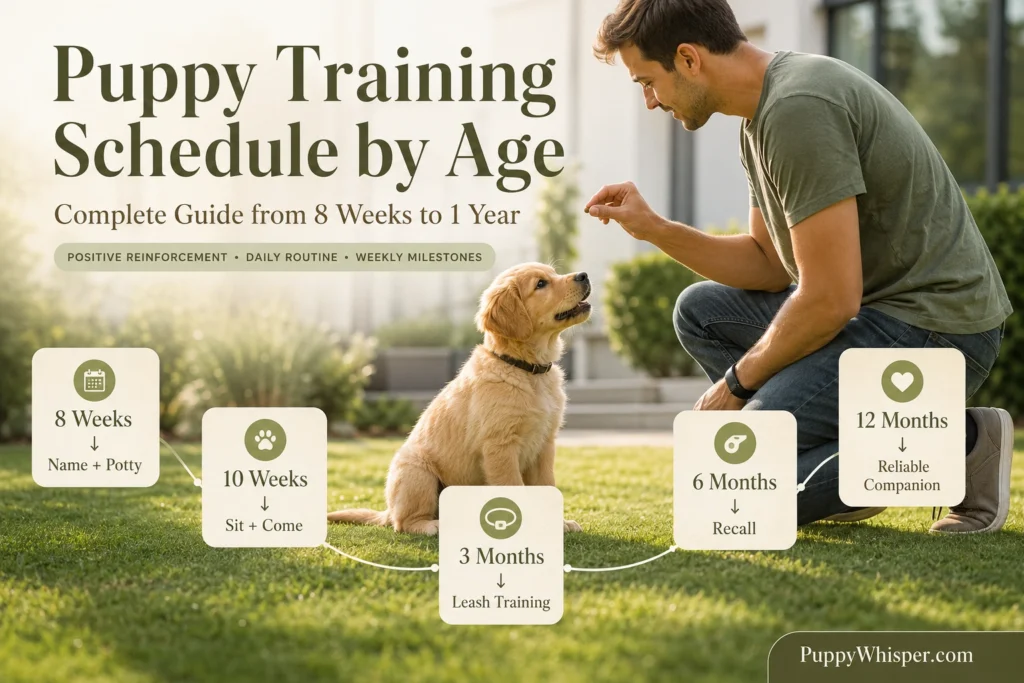
Quick Answer How Puppy Training Schedule by Age
A puppy training schedule by age should match your puppy’s physical and mental development rather than their calendar age alone.
Here’s a quick overview:
| Puppy Age | Primary Focus | Daily Training Time |
|---|---|---|
| 8 to 10 weeks | Name recognition, potty training, crate training, handling | 3 to 5 minutes, 5 to 8 sessions |
| 10 to 12 weeks | Sit, come, bite inhibition, settle | 3 to 5 minutes, 4 to 6 sessions |
| 3 to 4 months | Loose-leash walking, leave it, down, socialisation | 5 to 10 minutes, 3 to 5 sessions |
| 4 to 6 months | Recall, impulse control, greeting manners | 10 minutes, 2 to 4 sessions |
| 6 to 12 months | Reliable obedience in real-world environments | 10 to 15 minutes, 2 to 3 sessions |
Remember: Several short training sessions each day are far more effective than one long session. Puppies learn best through repetition, consistency, and positive experiences.
Puppy Training Timeline at a Glance
| Age | What to Teach | Main Goal |
|---|---|---|
| Week 8 | Name, potty routine, crate comfort | Build trust |
| Week 9 | Follow the treat, gentle handling | Confidence |
| Week 10 | Sit, attention, recall indoors | Communication |
| Week 11 | Bite inhibition, settle on a mat | Self-control |
| Week 12 | Leash introduction, leave it | Foundation obedience |
| 3 to 4 months | Down, stay, loose-leash walking | Impulse control |
| 4 to 6 months | Recall outdoors, wait, greeting manners | Reliability |
| 6 to 12 months | Proof commands everywhere | Real-world obedience |
Before You Start Training
Before teaching your puppy any commands, set realistic expectations.
Your puppy isn’t being stubborn if they forget a cue they knew yesterday. Their brain is still developing, and learning happens gradually through repetition. Even well-trained puppies have setbacks during teething, growth spurts, and adolescence.
Keep these principles in mind:
- Use positive reinforcement with treats, praise, or toys.
- Keep training fun and end each session while your puppy is still interested.
- Focus on one new skill at a time.
- Practise in quiet environments before adding distractions.
- Be patient. Progress isn’t always linear.
Most importantly, don’t compare your puppy to dogs you see online. Every breed and every individual puppy develops at a different pace. Use this schedule as a guide, not a strict deadline.
What You’ll Learn in This Guide
In the next sections, we’ll cover:
- A detailed week-by-week training plan from 8 to 12 weeks.
- Monthly training milestones from 3 months to 1 year.
- Sample daily puppy training schedules.
- Socialisation checklists.
- Common mistakes that slow progress.
- Expert tips for faster, stress-free learning.
- Printable progress checklists to help you stay on track.
Following a structured schedule won’t just teach your puppy commands. It will build confidence, strengthen your bond, and create habits that last a lifetime.
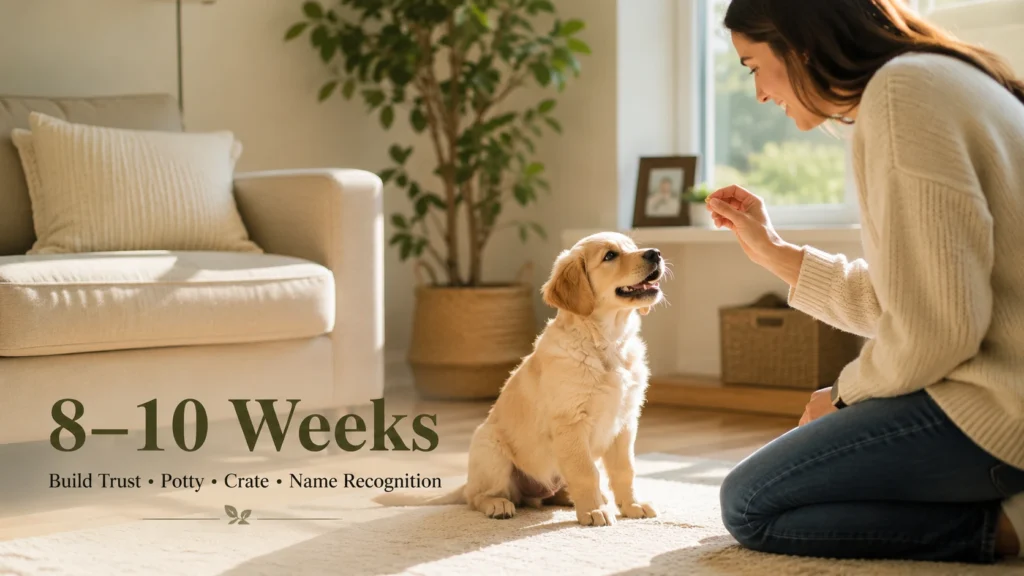
8 to 10 Weeks Old, Building Trust, Routine, and Confidence
At 8 weeks old, your puppy has just entered a completely new world. They’ve left their mother and littermates, moved into an unfamiliar home, and are learning who they can trust. While many owners immediately focus on teaching commands, the first priority should actually be helping your puppy feel safe and confident.
Professional trainers agree that the foundation of good behaviour starts with relationship building and structure. A puppy that feels secure is far more likely to learn new skills and recover quickly from unfamiliar experiences.
Instead of aiming for perfect obedience, think of these first two weeks as laying the groundwork for everything your puppy will learn later.
Development Milestones at 8 to 10 Weeks
During this stage, your puppy is:
- Learning their daily routine.
- Forming a strong bond with their family.
- Beginning to recognise their name.
- Developing bladder and bowel control.
- Experiencing an important socialisation period where positive experiences shape future behaviour.
- Able to focus for only 2 to 5 minutes at a time.
This isn’t the time to expect long “stay” commands or perfect leash walking. Your goal is to help your puppy understand that listening to you is rewarding and that the world is a safe place to explore.
Your Main Training Priorities
Focus on just a handful of essential life skills.
1. Name Recognition
Your puppy’s name is the most important cue they’ll ever learn.
Every time they hear it, they should think:
“Something good is about to happen.”
How to teach it
- Wait until your puppy isn’t looking at you.
- Say their name once in a cheerful voice.
- The moment they look at you, say “Yes!” or click if you use a clicker.
- Reward immediately with a small treat.
Repeat five to ten times throughout the day.
Avoid repeating their name over and over if they don’t respond. Instead, move closer or make a fun noise, then reward when they engage.
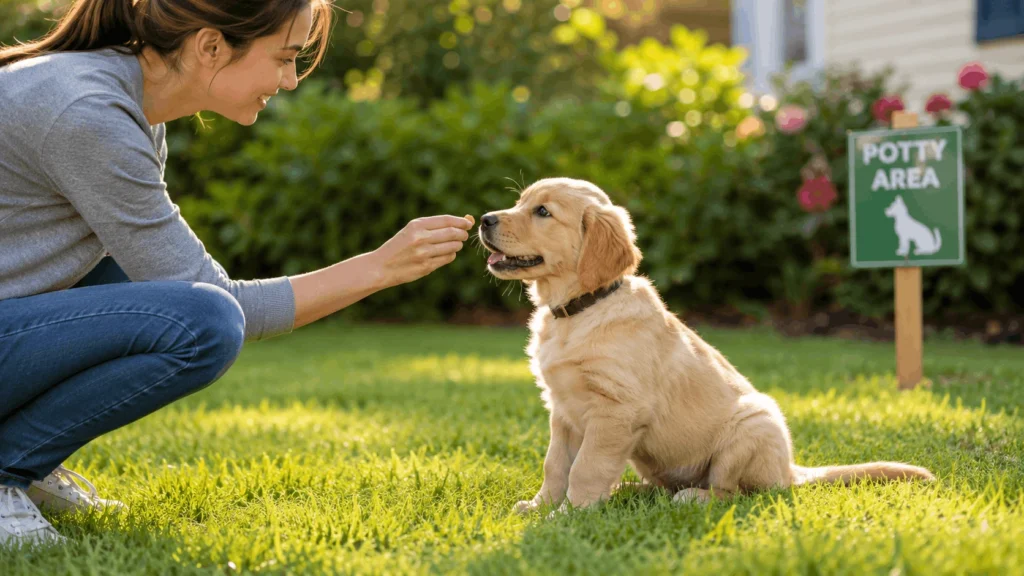
2. Potty Training
House training starts the day your puppy comes home.
Young puppies have very little bladder control, so accidents are normal. Success comes from preventing mistakes rather than correcting them afterward.
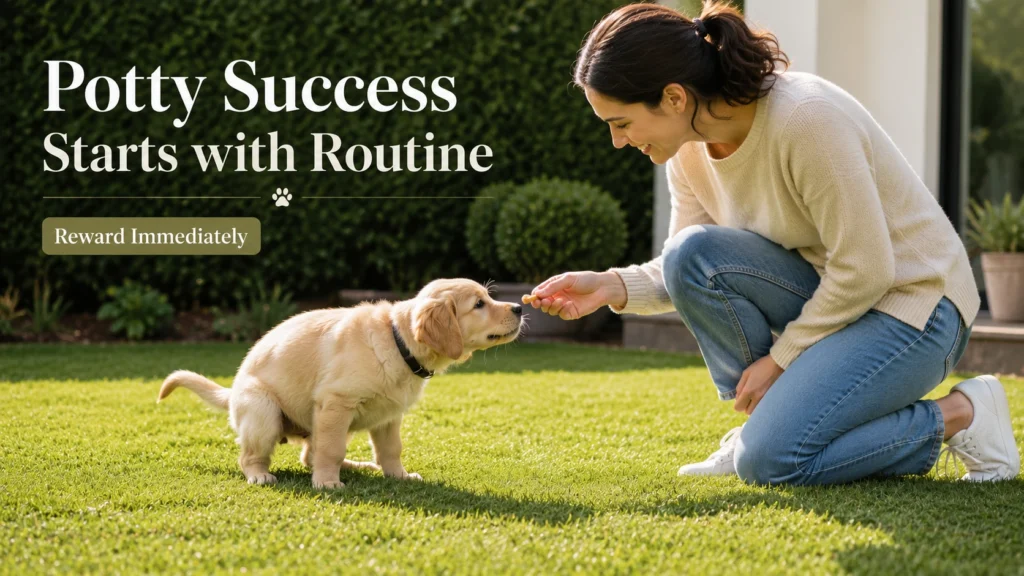
Take your puppy outside:
- Immediately after waking up.
- Within 5 to 10 minutes after eating.
- After drinking.
- After play sessions.
- Before bedtime.
- At least every 30 to 60 minutes while they’re awake.
When they toilet in the right place:
- Praise calmly.
- Reward immediately.
- Return indoors after they’ve finished.
Avoid punishment for accidents. Instead, quietly clean the area with an enzymatic cleaner and focus on improving your routine. Consistency is much more effective than scolding. For a complete routine covering every stage of this process, see our full puppy potty training guide.
3. Crate Training
A crate should feel like your puppy’s bedroom, never a place for punishment.
When introduced correctly, it helps with:
- House training.
- Preventing destructive chewing.
- Safe travel.
- Rest and recovery.
- Building independence.
Make the crate inviting
- Feed meals inside.
- Toss treats into the crate throughout the day.
- Place soft bedding inside if your puppy doesn’t chew it.
- Leave the door open during the first few days.
- Encourage voluntary entry instead of forcing your puppy inside.
If your puppy cries, wait for a brief pause before opening the door so they don’t learn that crying always leads to release. If nighttime settling is a struggle, a dedicated crate training at night routine can help your puppy sleep through without constant whining within the first week or two.
4. Gentle Handling Exercises
Future grooming and veterinary visits become much easier when puppies learn that being handled is normal.
Spend one or two minutes each day gently touching:
- Paws.
- Ears.
- Mouth.
- Tail.
- Collar.
- Chest.
Reward calm behaviour after each touch.
Keep every session short and positive.
5. Building Confidence Through Safe Socialization
Many owners think socialisation simply means meeting other dogs.
In reality, it’s about helping your puppy feel comfortable around everyday sights, sounds, people, and environments. The most important socialisation window occurs before about 16 weeks of age, making these early experiences especially valuable.
Safe experiences to introduce
- Men and women.
- Children (under close supervision).
- Hats and umbrellas.
- Vacuum cleaner (from a distance).
- Doorbell sounds.
- Different floor surfaces.
- Grass.
- Carpet.
- Tile.
- Wooden floors.
- Car rides.
- Friendly visitors.
- Gentle household noises.
Keep every new experience positive.
If your puppy seems worried, increase the distance from the trigger and reward calm behaviour instead of forcing interaction.
Vaccination note: Follow your veterinarian’s advice about where it’s safe to take your puppy before their vaccination series is complete. Many puppies can still safely experience the world through controlled outings, carrying them in public places, or meeting healthy, vaccinated dogs in low-risk settings.
Sample Daily Training Schedule (8 to 10 Weeks)
| Time | Activity |
|---|---|
| 7:00 AM | Potty break |
| 7:15 AM | Breakfast |
| 7:30 AM | Name game (2 to 3 minutes) |
| 8:00 AM | Nap |
| 10:00 AM | Potty break |
| 10:10 AM | Gentle handling practice |
| 12:00 PM | Lunch |
| 12:15 PM | Crate training with treats |
| Afternoon | Safe socialisation and short play sessions |
| Evening | Potty break, calm play, short training session |
| Before bed | Final potty trip and bedtime in the crate |
Remember that puppies this age sleep 16 to 20 hours a day, so don’t worry if your puppy spends more time resting than training. Sleep is essential for healthy brain development and learning.
Weekly Goal Checklist (8 to 10 Weeks)
By the end of this stage, most puppies should be making progress toward these milestones:
- □ Responds to their name most of the time indoors.
- □ Begins following a predictable potty routine.
- □ Enters the crate willingly for meals and treats.
- □ Accepts gentle handling of paws and ears.
- □ Recovers quickly after hearing everyday household sounds.
- □ Looks at you for rewards and guidance.
- □ Enjoys several short training sessions each day.
Don’t worry if your puppy hasn’t mastered every item. Every breed and individual develops at a different pace. The goal isn’t perfection. It’s creating positive habits that make the next stage of training much easier.
10 to 12 Weeks Old, Teaching First Commands and Building Self-Control
By 10 to 12 weeks, your puppy has started to settle into your home. They recognize familiar faces, understand parts of their daily routine, and are becoming more curious about the world around them.
This is one of the best stages to introduce simple obedience because your puppy is eager to learn, highly motivated by food and praise, and still in the critical socialization period. It’s also common for puppies to start using their voice more to get attention around this age, so it’s worth getting ahead of the habit early with our guide on how to stop excessive puppy barking. The goal isn’t perfect behavior. It’s helping your puppy discover that listening to you is rewarding and fun. Positive reinforcement and continued socialization remain the priority at this age.
Development Milestones at 10 to 12 Weeks
At this age, most puppies are:
- Becoming more confident at home.
- Learning household rules.
- Beginning to teethe, so chewing increases.
- Able to concentrate for about 3 to 5 minutes.
- More interested in exploring people, places, and sounds.
- Ready to learn simple cues using rewards.
Don’t be surprised if your puppy seems confident one day and cautious the next. Around this age, some puppies experience a temporary fear period where unfamiliar objects or noises seem more intimidating. The American Kennel Club explains this stage in more detail, including why it happens and how to support your puppy through it. Keep new experiences positive and never force your puppy to investigate something that worries them.
Your Main Training Priorities
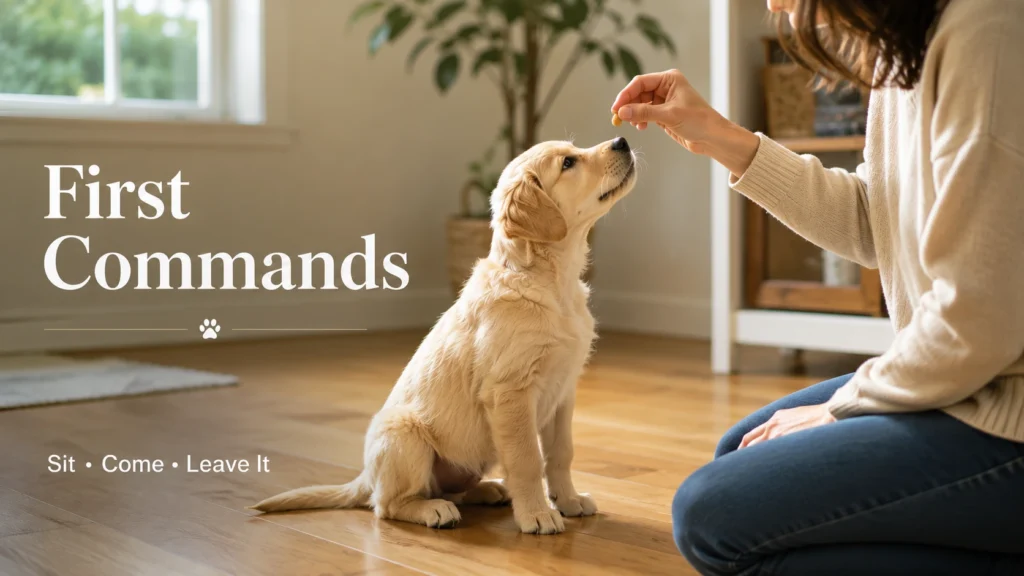
1. Teach “Sit”
“Sit” is often the first formal cue because it’s easy for puppies to understand and encourages impulse control.
Instead of pushing your puppy into position, let them discover the behaviour naturally.
How to teach it
- Hold a treat just above your puppy’s nose.
- Slowly move it backward toward their ears.
- As their head follows the treat, their bottom will naturally touch the floor.
- The moment they sit, say “Yes!” and reward.
After several successful repetitions, begin saying “Sit” just before moving the treat.
Training goal
Your puppy should willingly sit when lured and begin connecting the word with the action.
2. Strengthen Recall (“Come”)
A reliable recall can become one of the most important safety skills your dog ever learns.
Start indoors where there are very few distractions.
How to practice
- Move a few steps away.
- Cheerfully say your puppy’s name followed by “Come!”
- Reward generously when they reach you.
- Celebrate every success with praise and treats.
Never call your puppy to punish them, trim their nails, or end playtime. You want “Come” to always predict something positive.
3. Introduce “Leave It”
Puppies explore the world with their mouths.
Teaching “Leave It” early can prevent them from picking up dangerous objects later.
Simple exercise
- Hold a treat in your closed hand.
- Let your puppy sniff and investigate.
- The moment they stop trying to get it, mark the behaviour and reward with a different treat from your other hand.
Gradually increase the challenge over several days.
4. Build Bite Inhibition
Puppies naturally mouth and nip during play, especially while teething.
Your goal isn’t to stop all mouthing immediately. Instead, teach your puppy that human skin is delicate.
If your puppy bites too hard:
- Calmly stop playing.
- Stand up or turn away for a few seconds.
- Resume play once they’re calm.
- Offer an appropriate chew toy if needed.
Consistent redirection works much better than yelling or physical corrections. If nipping is still frequent despite this approach, our puppy biting training tips break down additional techniques for particularly mouthy puppies.
5. Introduce Loose-Leash Walking
Many owners wait until outdoor walks begin, but leash skills can start indoors.
Attach a lightweight leash for a few minutes while your puppy explores.
Reward them whenever they choose to walk beside you.
Don’t pull your puppy forward or drag them.
The objective is simply helping them become comfortable wearing the leash before expecting proper walking. Once your puppy is ready to move on to actual walks, our guide to leash training a puppy covers how to build on this foundation without pulling becoming a habit.
6. Continue Socialization
Your puppy’s socialisation window is still open, making this an ideal time to introduce new experiences safely.
Aim for calm, positive exposure to:
- People wearing hats or sunglasses.
- Bicycles.
- Umbrellas.
- Wheelchairs.
- Household appliances.
- Different weather conditions.
- Friendly, vaccinated dogs.
- Veterinary clinics.
- Grooming tools.
- Car journeys.
Quality matters more than quantity.
A few enjoyable experiences are much more valuable than overwhelming your puppy with too much at once.
Sample Daily Training Schedule (10 to 12 Weeks)
| Time | Activity |
|---|---|
| 7:00 AM | Potty break |
| 7:15 AM | Breakfast |
| 7:30 AM | Sit practice (3 minutes) |
| 9:00 AM | Nap |
| 10:30 AM | Recall game indoors |
| 12:00 PM | Lunch |
| 12:20 PM | Short leash introduction |
| Afternoon | Socialisation outing or new experience |
| Evening | Leave It game and calm play |
| Before bed | Potty break and quiet crate time |
Keep the routine flexible.
If your puppy seems tired or distracted, end the session and try again later.
Weekly Goal Checklist (10 to 12 Weeks)
By the end of this stage, your puppy should be making progress toward these goals:
- Responds to their name consistently indoors.
- Follows a regular potty routine with fewer accidents.
- Sits with a food lure.
- Comes when called in a quiet room.
- Begins understanding “Leave It.”
- Accepts wearing a leash and collar comfortably.
- Greets new people with growing confidence.
- Is comfortable with gentle handling and grooming.
Remember that every puppy learns at a different pace. A Golden Retriever, Border Collie, French Bulldog, or mixed-breed puppy may all reach these milestones slightly differently. Focus on steady improvement rather than perfection.
Common Mistakes to Avoid at This Age
- Teaching too many commands at once.
Choose one or two new skills each week. Puppies learn faster when they aren’t overwhelmed. - Repeating commands over and over.
Say the cue once, then help your puppy succeed instead of repeating the word several times. - Training when your puppy is overtired.
Young puppies need plenty of sleep. A tired puppy often struggles to focus and may become mouthy or frustrated. - Skipping socialization because of vaccinations.
Talk to your veterinarian about safe ways to socialize your puppy. Controlled outings, puppy classes that follow health protocols, and meeting healthy vaccinated dogs can provide valuable experiences while reducing risk.
Puppy Training Schedule for 3 to 4 Months, Building Reliable Obedience and Everyday Manners
By the time your puppy reaches 3 to 4 months old (12 to 16 weeks), you’ll probably notice a big change. They can concentrate for longer, have more energy, and are eager to explore everything around them. This is an exciting stage because many of the foundations you’ve built during the first month at home begin to come together.
However, this is also when many owners accidentally create bad habits. Puppies start pulling on the leash, jumping on visitors, chewing furniture during teething, or ignoring commands once they’re outside.
The good news is that these behaviours are completely normal.
Your puppy isn’t trying to be stubborn. They’re learning how to make choices while living in a world that’s suddenly full of exciting distractions. Your job is to guide those choices with consistent, reward-based training rather than expecting perfect obedience. Trainers generally recommend gradually increasing the difficulty by adding distance, duration, and distractions while keeping sessions positive and manageable.
Development Milestones at 3 to 4 Months
During this stage, most puppies:
- Can focus for 5 to 10 minutes.
- Sleep slightly less than younger puppies.
- Begin losing baby teeth and chewing more.
- Have improved bladder control.
- Are ready for short outdoor walks, following your veterinarian’s vaccination guidance.
- Learn new cues much faster through repetition and rewards.
This stage isn’t about teaching dozens of tricks.
Instead, strengthen the skills your puppy will use every day for the rest of their life.
Your Main Training Priorities
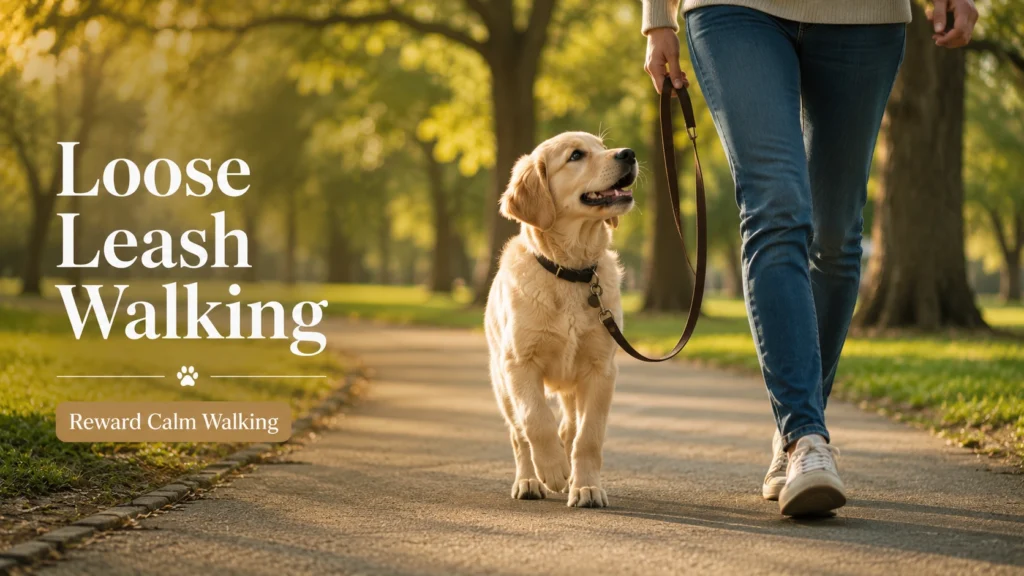
1. Master Loose-Leash Walking
Walking politely on a leash is one of the most valuable life skills your puppy can learn.
Don’t worry about covering long distances.
Instead, focus on teaching your puppy that staying close to you is rewarding.
How to practice
- Start in your garden, driveway, or another quiet area.
- Hold a few small treats in your hand.
- Reward your puppy every few steps when they walk beside you.
- If they pull ahead, stop walking.
- Continue only after the leash becomes loose again.
Avoid jerking the leash or dragging your puppy toward you.
Your puppy should learn that a loose leash makes the walk continue.
2. Introduce “Down”
Once your puppy understands “Sit,” teaching “Down” becomes much easier.
How to teach it
- Ask your puppy to sit.
- Lower a treat slowly toward the floor.
- Move the treat slightly away from them.
- As their elbows touch the ground, mark the behaviour with “Yes!” and reward.
Keep sessions short and fun.
Some puppies learn this quickly, while others need several days.
3. Begin Short “Stay” Exercises
Many owners rush this command.
Instead of asking for a long stay immediately, build success one second at a time.
Start with:
- Sit.
- Say “Stay.”
- Take one small step backwards.
- Count to three.
- Return and reward.
Increase only one thing at a time:
- Duration.
- Distance.
- Distractions.
Trying to increase all three together often leads to frustration.
4. Improve Recall Around Mild Distractions
Your puppy may come perfectly inside the house but completely ignore you outside.
That’s normal.
Dogs don’t automatically understand that a cue applies everywhere.
Try this progression
- Living room.
- Garden.
- Quiet street.
- Empty park.
- Busier environments.
Reward every successful recall generously.
A handful of treats and enthusiastic praise are far more memorable than a single biscuit.
Community advice from experienced owners also highlights building recall gradually before adolescence increases distractions.
5. Teach “Wait”
“Wait” helps prevent dangerous situations like running through doors or jumping out of the car.
Practice at doorways
- Ask your puppy to sit.
- Reach for the handle.
- If they move, close the door.
- If they remain still, reward them.
- Release them with a cue such as “Okay.”
Practise only for a few repetitions at a time.
6. Continue Bite Inhibition During Teething
Between 3 and 4 months, teething usually becomes more noticeable.
Chewing helps relieve discomfort, so provide plenty of safe chew toys.
If your puppy starts chewing furniture or hands:
- Redirect them to a chew toy.
- Praise them when they choose the toy.
- Rotate toys regularly to keep them interesting.
Avoid punishing chewing.
Instead, manage the environment so your puppy has appropriate outlets.
Continue Safe Socialization
Although the most sensitive socialisation period is nearing its end, positive experiences remain extremely important.
Try exposing your puppy to:
- Parks (when your veterinarian says it’s safe).
- Friendly, vaccinated dogs.
- Different ages of people.
- Bicycles.
- Joggers.
- Children playing.
- People carrying umbrellas.
- Outdoor cafés.
- Pet-friendly shops.
- Different weather conditions.
Watch your puppy’s body language.
If they seem worried, increase the distance from whatever is making them uncomfortable and reward calm behaviour.
Never force interactions.
Positive experiences build confidence.
Overwhelming experiences can create fear.
Sample Daily Training Schedule (3 to 4 Months)
| Time | Activity |
|---|---|
| 7:00 AM | Potty break |
| 7:15 AM | Breakfast |
| 7:30 AM | Loose-leash walking practice (5 minutes) |
| 9:30 AM | Nap |
| 11:00 AM | Down and Stay practice |
| 12:30 PM | Lunch |
| 3:00 PM | Recall game in the garden |
| 5:30 PM | Socialisation outing |
| 7:00 PM | Gentle play and chew toy time |
| Before bed | Potty break and quiet crate time |
Remember that learning also happens during everyday routines.
Ask for a sit before meals.
Practise “Wait” before opening doors.
Reward calm behaviour when guests arrive.
These small moments often have a bigger impact than formal training sessions.
Weekly Goal Checklist (3 to 4 Months)
By the end of this stage, many puppies should be progressing toward these milestones:
- Walks several steps on a loose leash.
- Responds to “Sit” without needing a food lure every time.
- Begins understanding “Down.”
- Comes when called in low-distraction environments.
- Waits briefly before walking through a doorway.
- Is comfortable meeting new people.
- Redirects chewing to appropriate toys.
- Can settle calmly for a few minutes after play.
Don’t worry if your puppy isn’t perfect.
Some breeds mature faster than others, and individual personalities play a big role. The goal is steady improvement, not flawless obedience.
Common Mistakes at This Stage
Taking walks that are too long
Young puppies tire quickly. Keep walks short and enjoyable instead of focusing on distance.
Training only during dedicated sessions
Real-life moments are powerful teaching opportunities. Ask for simple behaviours before meals, walks, play, or greetings.
Moving too quickly
If your puppy struggles outdoors, go back to practising indoors or in your garden before increasing distractions.
Expecting instant reliability
A cue learned in the kitchen may not work at the park yet. Dogs need practice in many different environments before a behaviour becomes dependable.
Expert Tips for Faster Puppy Training Success
No matter your puppy’s age or breed, a few simple habits can make training more effective and less frustrating.
Keep Training Sessions Short
Young puppies learn best in short bursts. Stop while your puppy is still interested instead of waiting until they lose focus.
As a general guide:
- 8 to 12 weeks: 3 to 5 minutes
- 3 to 6 months: 5 to 10 minutes
- 6 to 12 months: 10 to 15 minutes
Several short sessions throughout the day produce better results than one long lesson.
Reward Good Behavior Immediately
Your puppy connects actions with consequences within a second or two.
If you wait too long to give praise or a treat, they may not understand which behaviour earned the reward.
Mark the correct behaviour with “Yes!” or a clicker, then reward immediately.
Be Consistent
Dogs learn through repetition.
If one family member allows jumping while another discourages it, your puppy receives mixed signals and learning slows down.
Agree on:
- Training cues
- House rules
- Reward system
- Daily routine
Consistency builds confidence.
Train in Different Locations
A puppy that obeys perfectly in your kitchen may ignore you in the park.
Once your puppy understands a cue indoors, gradually practise in:
- Garden
- Driveway
- Quiet street
- Local park
- Pet-friendly stores
Increase distractions slowly.
End Every Session on a Success
Finish with an easy behaviour your puppy already knows.
Ending positively keeps training enjoyable and encourages enthusiasm for the next session.
Puppy Training Equipment Checklist
Having the right tools makes training easier.
Here’s a simple starter kit.
✅ Soft training treats
✅ Treat pouch
✅ Flat collar
✅ Adjustable harness
✅ 6-foot leash
✅ Long training line
✅ Safe chew toys
✅ Interactive puzzle toys
✅ Crate
✅ Enzymatic cleaner for accidents
You don’t need expensive equipment. Consistency matters far more than gadgets.
Printable Puppy Training Progress Checklist
Use this checklist to monitor your puppy’s progress.
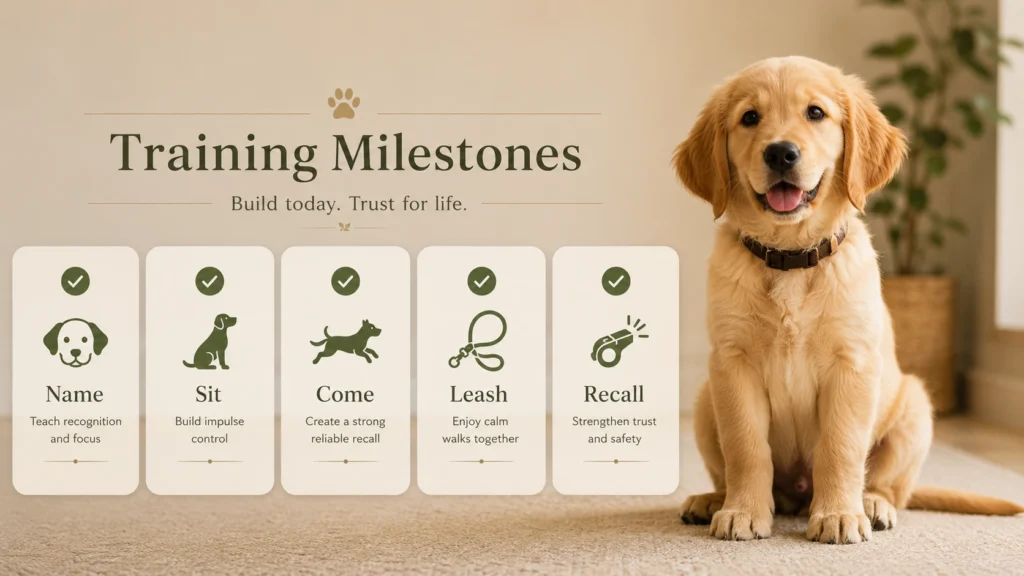
8 to 10 Weeks
☐ Responds to name
☐ Comfortable in crate
☐ Potty routine started
☐ Enjoys handling
☐ Sleeps well
10 to 12 Weeks
☐ Sit
☐ Come
☐ Leave It
☐ Accepts leash
☐ Reduced biting
3 to 4 Months
☐ Loose-leash walking
☐ Down
☐ Short Stay
☐ Wait
☐ Recall with mild distractions
4 to 6 Months
☐ Reliable recall outdoors
☐ Calm greetings
☐ Waits at doors
☐ Better impulse control
☐ Settles around visitors
6 to 12 Months
☐ Reliable obedience
☐ Walks politely in busy areas
☐ Responds around distractions
☐ Calm at cafés and parks
☐ Ready for advanced training
Frequently Asked Questions
At what age should puppy training begin?
Training should begin the day you bring your puppy home, usually around 8 weeks of age. Early lessons should focus on building routines, confidence, and trust rather than expecting perfect obedience.
How many times a day should I train my puppy?
Aim for several short sessions instead of one long lesson. Most puppies benefit from 3 to 8 sessions per day, depending on age.
Which command should I teach first?
Most trainers recommend starting with:
- Name recognition
- Sit
- Come
- Leave It
These commands provide the foundation for later training.
Is it normal if my puppy suddenly stops listening?
Yes. Many puppies experience temporary setbacks during teething and adolescence. Continue practicing consistently instead of assuming they’ve forgotten everything.
Should I use treats forever?
No. Once your puppy responds reliably, gradually replace food rewards with praise, toys, and occasional treats while still rewarding excellent responses.
Can older puppies still learn?
Absolutely. While early training is helpful, puppies and adult dogs can learn new behaviors at any age with patience and consistent practice.
Why does my puppy listen at home but not outside?
Dogs don’t automatically understand that a command applies in every location. Practice gradually in different environments while slowly increasing distractions.
How long does it take to fully train a puppy?
Most puppies learn basic household manners within the first few months, but training continues throughout adolescence. Many dogs don’t reach full emotional maturity until 12 to 24 months, depending on the breed, so consistency remains important well beyond puppyhood.
Conclusion
Training a puppy isn’t about teaching dozens of commands as quickly as possible. It’s about building good habits at the right time.
By matching your training to your puppy’s age and development, you’ll avoid frustration and help your dog learn with confidence.
Start with trust, routines, and socialisation during the early weeks. Add basic obedience as your puppy grows. Then gradually introduce distractions, longer training sessions, and real-world practice as they mature.
Remember that every puppy develops at a different pace. Some may master a new cue in a few days, while others need several weeks of consistent practice. That’s completely normal.
The most successful owners aren’t the ones who train the longest. They’re the ones who show up every day, stay patient, and celebrate small improvements.
If you focus on just one new skill at a time and practice for a few minutes each day, you’ll build a well-mannered, confident companion that you can enjoy for years to come.

Muzammil Khan is a certified canine behaviorist and the founder of Puppywhisper. With 8+ years of experience in positive reinforcement training, Muzammil has helped over 1,000 puppies transition smoothly into their new homes. All health advice is reviewed in collaboration with licensed veterinarians.