Introduction
Your puppy jumps on guests, bolts through doorways, and won’t hold still long enough for you to clip on a leash. You’ve probably heard that “sit” is the first command every puppy should learn especially if you’re also in the middle of potty training and trying to build good habits all at once. but nobody tells you how to actually get there without ending up frustrated on the kitchen floor with a fistful of treats and a puppy who’s more interested in your shoelaces.
The good news: teaching a puppy to sit is one of the fastest, most beginner-friendly skills in dog training. Most puppies pick it up within a few short sessions when the method is right. This guide walks you through exactly how to do it, what mistakes to avoid, and how to turn “sit” into a command your puppy will actually listen to even with distractions around.
How to Train a Puppy to Sit: Quick Answer
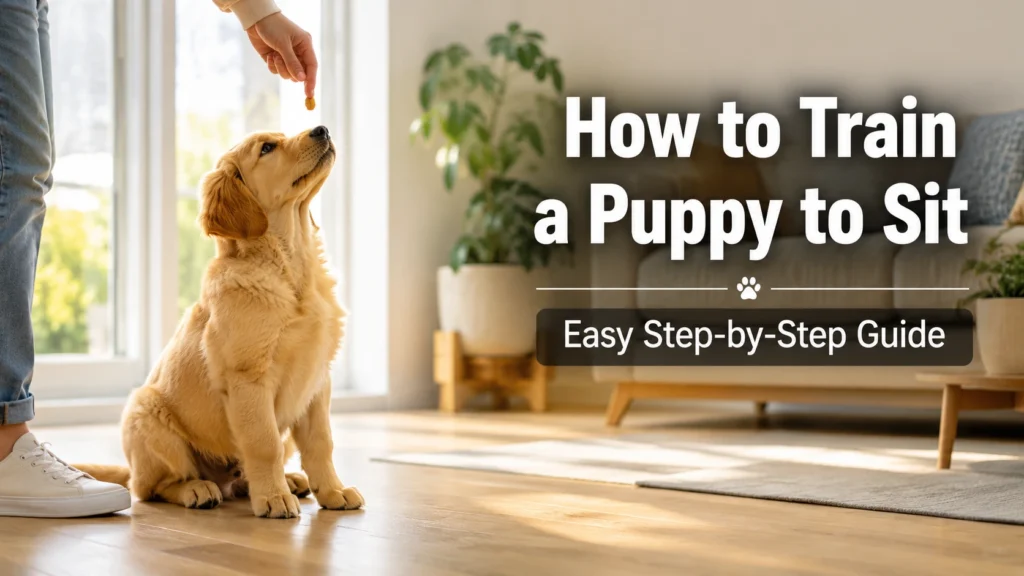
To train a puppy to sit, hold a treat close to their nose, then slowly raise it above their head. As their head tilts back to follow the treat, their bottom will naturally lower into a sit. The moment their bottom touches the ground, say “sit” and give the treat immediately. Repeat this 5–10 times per session, several times a day, and most puppies learn the behavior within a few days to two weeks. This same calm, reward-based approach works well alongside other early routines, like crate training at night.
What “Sit” Actually Teaches Your Puppy
Sit isn’t just a party trick. It’s the foundation command that teaches your puppy two important things: how to control their impulses, and how to look to you for direction. Once a puppy reliably sits on cue, it becomes much easier to manage everyday problems too including excessive barking and nipping during play. Once a puppy reliably sits on cue, it becomes much easier to teach:
- Polite greetings (sit instead of jumping)
- Waiting at doors instead of bolting
- Calm behavior before meals or leash walks
- Basic impulse control around distractions
The American Kennel Club (AKC) recommends teaching basic cues like sit early because they help puppies develop focus, self-control, and good manners before moving on to more advanced training.
When to Start Training a Puppy to sit
Every puppy learns at a different pace. Some understand the sit cue within a few days, while others may need several weeks of consistent practice. Staying patient and keeping training sessions positive will help your puppy build confidence over time.
Before You Start Training
Before your first training session, gather a few essentials to set your puppy up for success:
- Small, soft, high-value treats
- A quiet area with minimal distractions
- A comfortable collar or harness (if practicing outdoors later)
- Five minutes of uninterrupted time
- A calm, alert puppy who isn’t overly tired or hungry
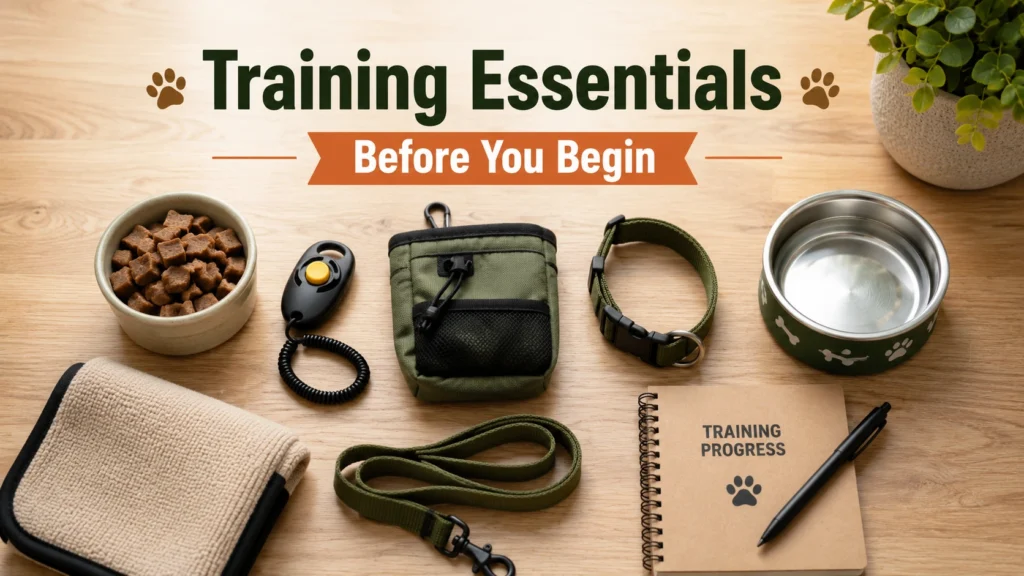
A good training setup helps your puppy stay focused and makes learning easier.
Puppies can start learning sit as early as 8 weeks old. Their attention span is short at this age, so the goal isn’t perfection it’s building a positive association with the word “sit” and the action of sitting.
A few things to keep in mind based on age:
| Puppy Age | What to Expect |
|---|---|
| 8–10 weeks | Very short attention span; use 2–3 minute sessions |
| 10–16 weeks | Can start holding sit for a few seconds before the reward |
| 4–6 months | Can generalize sit to new locations and distractions |
| 6+ months | Should reliably sit on cue with minimal repetition needed |
If your puppy seems distracted, unwell, or uninterested during training, it’s worth ruling out a health issue. A puppy who won’t engage at all especially alongside low energy or appetite changes should be checked by a veterinarian rather than assumed to simply be “stubborn.”
How to Train a Puppy to Sit (Step-by-Step)
Step 1: Choose the Right Environment
Start indoors, in a quiet room with no other pets, people, or noise. Puppies can’t focus on learning a new skill while also processing a distracting environment. A hallway or a corner of your living room works well.
Step 2: Use High-Value Treats
Skip the regular kibble for training sessions. Use something small, soft, and exciting shredded chicken, small training treats, or a soft dog treat cut into pea-sized pieces. The treat needs to be worth your puppy’s attention.
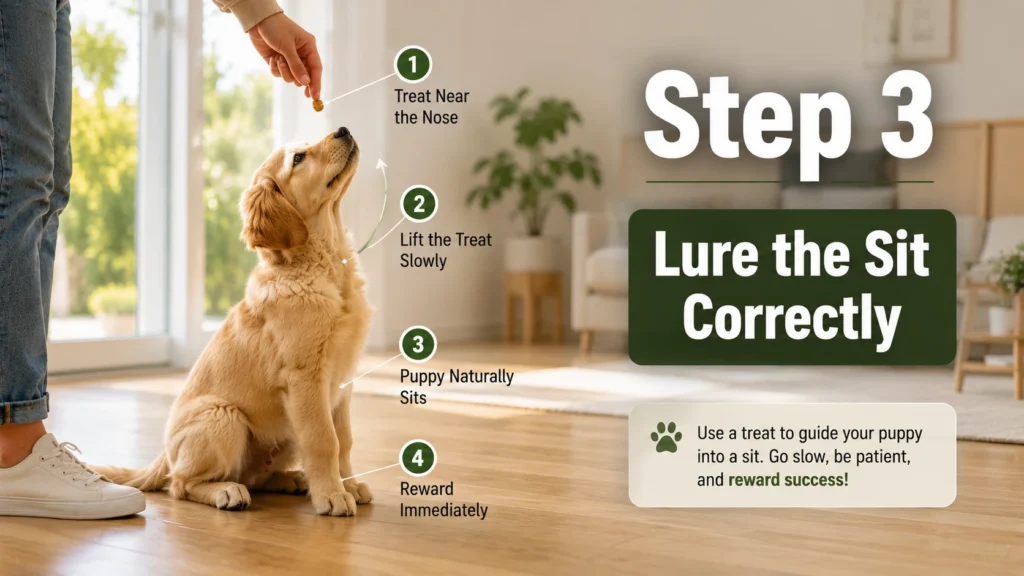
Step 3: Lure the Sit
- Hold the treat right at your puppy’s nose level.
- Slowly move the treat up and slightly back over their head.
- As their nose follows the treat upward, their bottom will lower to the ground.
- The instant their bottom touches the floor, mark the moment with the word “yes” or a clicker, then reward immediately.
Step 4: Add the Verbal Cue
Once your puppy is reliably following the lure into a sit (usually after 5–10 successful reps), start saying “sit” right before you begin the hand motion. This pairs the word with the action so your puppy starts associating the verbal cue with the behavior itself.
Step 5: Fade the Lure
After a few sessions, stop using a treat in your hand to lure the motion. Instead, use the same hand movement without a treat present, and reward from your other hand or a treat pouch after they sit. This teaches your puppy to respond to the cue, not just the food in your fingers.
Step 6: Practice in New Locations
Once your puppy sits reliably indoors, practice in the backyard, on walks, and around mild distractions like other people. Dogs don’t automatically generalize commands a puppy who sits perfectly in the kitchen may act like they’ve never heard the word outside. This is normal, not a training failure.
Step 7: Build Duration and Reliability
Start asking your puppy to hold the sit for 2–3 seconds before rewarding, then gradually build to 5, then 10 seconds. This builds impulse control, which pays off later when you want your puppy to sit calmly at the door or before meals.
Troubleshooting Common Training Problems
If your puppy isn’t learning to sit as quickly as expected, don’t worry. Every puppy learns at their own pace. Here are some common problems and how to solve them.
My puppy jumps instead of sitting
You may be raising the treat too high or moving it too quickly. Hold the treat close to your puppy’s nose and slowly move it upward and slightly back.
My puppy keeps walking backward
Practice near a wall or in a corner to reduce backward movement. This encourages your puppy to lower their bottom into a sit instead.
My puppy loses interest after a few minutes
Keep sessions short, about 2 to 5 minutes, and use treats your puppy finds exciting. Training before mealtime can also improve motivation.
My puppy listens indoors but ignores me outside
Dogs don’t automatically understand that a command means the same thing in different places. Practice in quiet outdoor areas first, then gradually increase distractions as your puppy becomes more confident.
Benefits of Teaching Sit Early
- Prevents jumping. A puppy that knows sit can be redirected the moment they start jumping on guests.
- Builds a training foundation. Every other command builds on the focus and impulse control sit teaches.
- Strengthens your bond. Positive reinforcement training increases trust between you and your puppy.
- Improves safety. A reliable sit-stay can prevent your puppy from darting into a street or through an open door.
Best Ways to Teach a Puppy to Sit
| Method | Recommended | Why |
|---|---|---|
| Treat lure | ✅ Yes | Simple and effective for beginners |
| Clicker training | ✅ Yes | Clearly marks the correct behavior |
| Hand signal | ✅ Yes | Helps puppies respond to visual cues |
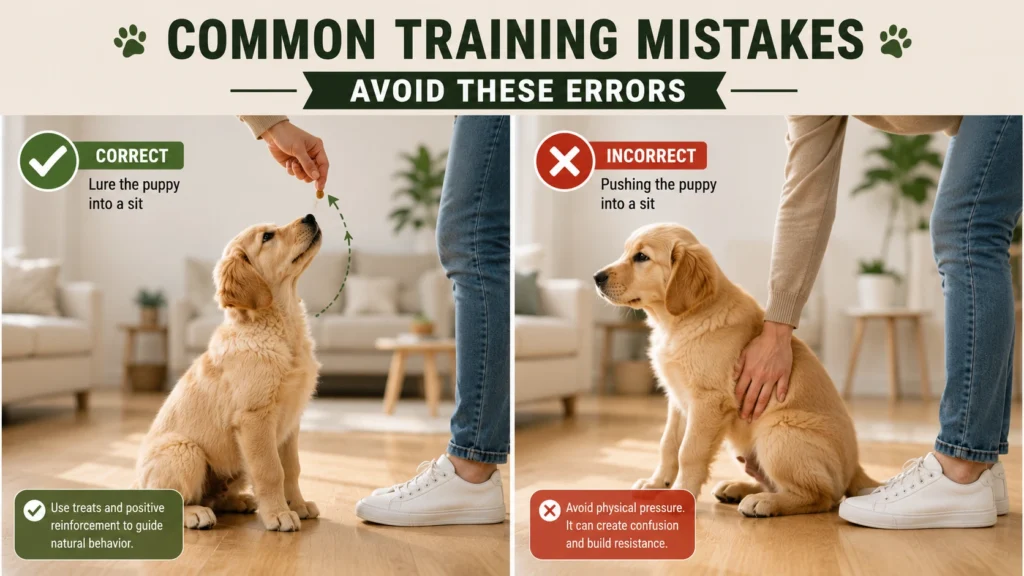
| Pushing the puppy into position | ❌ No | May cause discomfort or confusion |
| Yelling or punishment | ❌ No | Can create fear and slow learning |
Risks and Considerations
Training itself carries no health risk, but a few things are worth watching for:
- Overtraining. Puppies tire quickly. Sessions longer than 5 minutes often backfire, leading to frustration instead of learning.
- Physical discomfort. Puppies with hip or joint issues may resist sitting. If your puppy consistently avoids sitting or seems to yelp or hesitate, consult your veterinarian before continuing training.
- Food-based training with sensitive stomachs. If your puppy has a sensitive digestive system, choose low-fat, vet-approved training treats and adjust their regular meal portions to account for the extra calories.
Signs Your Puppy Is Ready for the Next Command
Once your puppy can reliably sit, they may be ready to learn another basic cue. Look for these signs:
- Sits after hearing the command once.
- Holds the sit for at least 10 seconds.
- Responds in different rooms or outdoor areas.
- Can stay focused despite mild distractions.
- Waits calmly before meals or walks.
At this stage, you can begin teaching commands like stay, come, or down.
Expert Tips
- Train before meals, not after. A slightly hungry puppy is far more food-motivated than one who just ate.
- Keep sessions short and frequent. Five short 2–3 minute sessions throughout the day beat one long 20-minute session.
- End on a win. Always finish a training session after a successful sit, not after a failed attempt, so your puppy ends on a positive note.
- Use a consistent word and tone. Say “sit” the same way every time — puppies respond to consistency, not enthusiasm or volume.
- Reward generously at first. You can reduce treat frequency once the behavior is reliable, but early repetition needs consistent reinforcement.
Sample Daily Training Schedule
| Time | Activity |
|---|---|
| Morning | Practice 3 to 5 repetitions before breakfast |
| Afternoon | Short training session during playtime |
| Evening | Practice before dinner or a walk |
| Before Bed | Quick review of the sit command |
Keeping sessions short and consistent is more effective than one long training session.
Common Mistakes (And What to Do Instead)
| Mistake | Why It Backfires | What to Do Instead |
|---|---|---|
| Repeating “sit, sit, sit” | Teaches the puppy the word doesn’t need immediate action | Say it once, wait, then help them into position if needed |
| Pushing down on the puppy’s rear | Can cause fear or resistance, and risks joint strain | Use the treat lure method instead |
| Training when the puppy is overtired or overstimulated | Puppies can’t focus when exhausted or overexcited | Train during calm, alert periods |
| Only practicing in one room | Puppy won’t generalize the command elsewhere | Practice in multiple locations gradually |
| Waiting too long to reward | Puppy won’t connect the treat to the action | Reward within 1–2 seconds of the sit |
Key Takeaways
- Start training as early as 8 weeks of age.
- Keep each training session between 2 and 5 minutes.
- Reward your puppy immediately after a successful sit.
- Practice in different locations to build reliability.
- Stay patient and consistent because every puppy learns at a different pace.
Frequently Asked Questions
How long does it take to train a puppy to sit?
Most puppies learn the basic motion within a few days of short daily sessions, though full reliability with distractions can take several weeks.
Why won’t my puppy sit even with treats?
This is often due to a low-value treat, an overstimulating environment, or physical discomfort. Try a higher-value treat in a quieter space, and rule out joint pain if the behavior persists.
Should I push my puppy’s bottom down to teach sit?
No. Physically pushing a puppy into position can cause discomfort or fear and may strain developing joints. The treat-luring method is safer and more effective.
What age is too young to start training?
Puppies can begin learning basic cues like sit as early as 8 weeks old, as long as sessions stay short and positive.
Can I use a clicker instead of saying “yes”?
Yes. Clicker training works well for marking the exact moment of a correct behavior and can be more precise than a verbal marker for some owners.
My puppy sits at home but not outside why?
Dogs don’t automatically transfer a learned behavior to new environments. Practice sit in different locations, starting with low-distraction outdoor areas before progressing to busier ones.
How many times a day should I practice?
Aim for 3–5 short sessions daily, each lasting 2–5 minutes, rather than one long session.
Is it normal for my puppy to lose interest quickly?
Yes, especially in puppies under 12 weeks old. Short attention spans are developmentally normal keep sessions brief and end before your puppy loses focus.
Conclusion
Teaching your puppy to sit is one of the first steps toward raising a confident, well-behaved dog. Keep each session short, stay consistent, and celebrate small successes along the way. Once your puppy responds reliably to the sit command, you can begin introducing other essential skills like stay, come, and loose leash walking to continue building good manners and obedience.
Next step: Once your puppy has a reliable sit, move on to teaching “stay” to build on the impulse control you’ve already started.

Muzammil Khan is a certified canine behaviorist and the founder of Puppywhisper. With 8+ years of experience in positive reinforcement training, Muzammil has helped over 1,000 puppies transition smoothly into their new homes. All health advice is reviewed in collaboration with licensed veterinarians.