Introduction
Your puppy just chewed through another shoe, and now you’re wondering if this is ever going to stop. Maybe you’ve also spotted a tiny white tooth on the floor and panicked for a second, thinking something is wrong.
It isn’t. Your puppy is teething.
Teething is one of the most confusing stages of early puppy ownership because nobody hands you a schedule when you bring your puppy home. You’re left guessing whether the chewing, drooling, and grumpy moods are normal, or whether it’s time to call the vet.
This guide breaks down the puppy teething timeline by age, stage by stage, so you know exactly what’s happening in your puppy’s mouth at any given week, what’s normal, what’s not, and how to make the whole process easier on both of you. If you’re still finding your feet, our first week with a new puppy guide covers the basics that pair well with this one.
Quick Answer
Puppies begin teething around 2 to 3 weeks old, when their first baby teeth break through the gums. By 6 to 8 weeks, all 28 baby teeth are usually in. Baby teeth start falling out around 3 to 4 months of age as the 42 permanent adult teeth push through, and most puppies finish teething by about 6 months, though some continue into their seventh or eighth month.
Puppy Teething Timeline by Age
Every puppy develops at a slightly different pace, and small breeds often finish teething a little earlier than large breeds. Still, most puppies follow the same general pattern. Here’s what that pattern looks like.
Birth to 2 Weeks: No Teeth Yet
Newborn puppies are born completely toothless. At this stage, they rely entirely on nursing, and their jaw muscles are still too weak to do much of anything besides suckle.
There’s nothing to do here except let nature take its course. If you’re fostering or bottle-feeding a very young puppy, this is also the stage where you don’t need to worry about teething symptoms at all.
2 to 3 Weeks: First Baby Teeth Appear
This is when teething officially begins. The tiny, needle-sharp incisors (the small front teeth) start pushing through the gums first, followed shortly by the equally sharp canine teeth, a process the American Kennel Club also confirms follows this same early sequence.
Most owners never actually witness this stage, since puppies this young are still with their mother and breeder.
3 to 6 Weeks: The Full Baby Teeth Set Comes In
Over the next few weeks, the rest of the baby teeth, technically called deciduous teeth, continue to erupt. By around 5 to 6 weeks of age, most puppies have a complete set of 28 baby teeth.
This is also roughly when breeders begin the weaning process, since those sharp little teeth make nursing uncomfortable for the mother.
8 Weeks: Coming Home With a Full Set of Baby Teeth
If you brought your puppy home around the standard 8-week mark, this is likely the mouth you first met: 28 small, sharp baby teeth already in place. This lines up closely with our 8-week-old puppy schedule, so it’s worth having both timelines side by side.
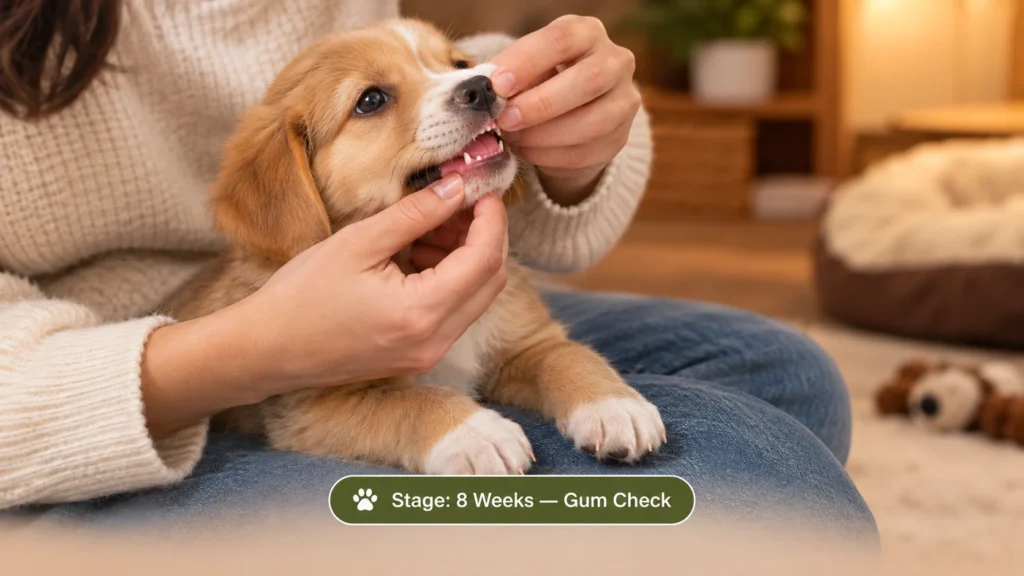
If you haven’t already worked through our new puppy checklist, this stage is a good checkpoint to catch anything you missed. This is also a great time to start gently getting your puppy comfortable with having their mouth and gums touched. Rub a finger along the gum line for a few seconds during calm moments. It won’t stop teething, but it makes future tooth brushing and vet dental checks much easier.
12 to 16 Weeks (3 to 4 Months): Baby Teeth Start Falling Out
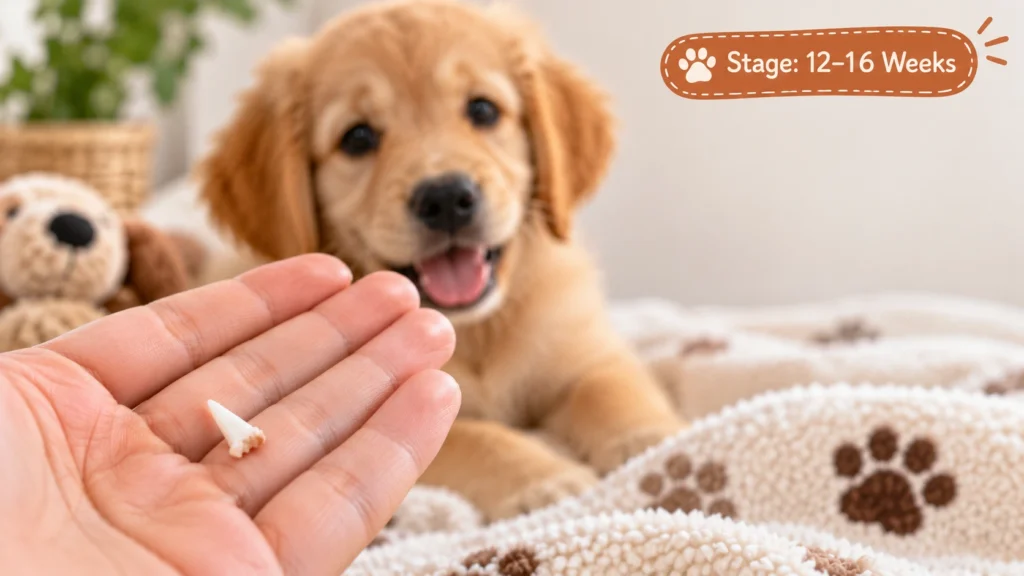
This is where things ramp up. Around 3 to 4 months of age, those baby teeth begin loosening and falling out to make room for permanent adult teeth. The incisors are usually the first to go.
You may notice:
- Tiny teeth on the floor, in bedding, or in toys
- Small spots of blood on chew toys (a few drops is normal; anything more should be checked by a vet)
- Increased chewing, gnawing, and mouthing
- More drooling than usual
- A short, temporary dip in appetite
- More fussing or crying at night than usual (see our guide on how to stop a puppy crying at night if this is new)
This is also the stage where destructive chewing tends to peak, simply because your puppy’s gums are sore and chewing relieves the pressure a good reason to double-check your puppy-proofing before it hits.
4 to 6 Months: Adult Teeth Push Through
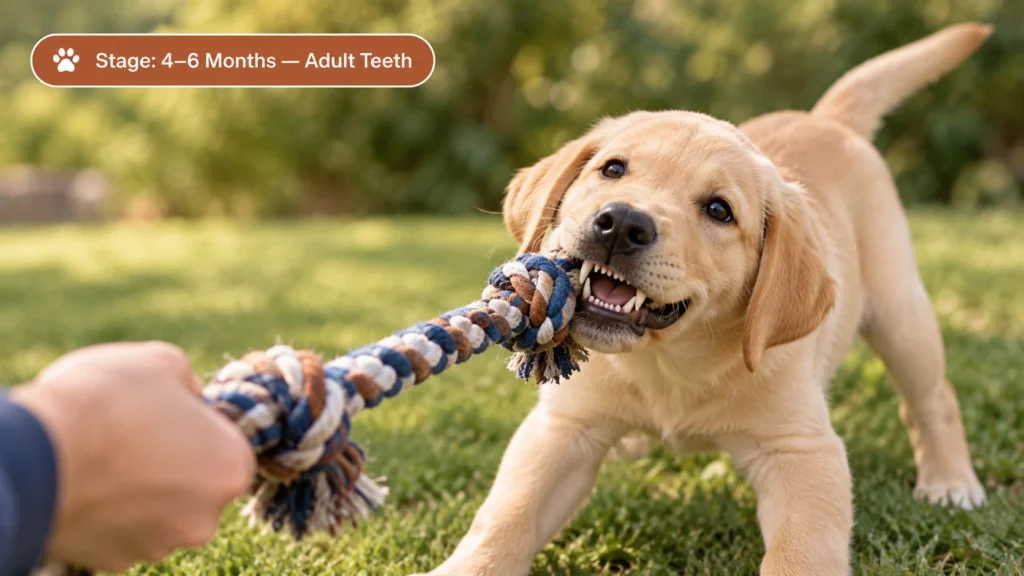
Between 4 and 6 months, the permanent canines, premolars, and eventually molars come in behind the baby teeth. By the end of this window, most puppies have their full set of 42 adult teeth.
Occasionally a baby tooth doesn’t fall out on its own before the adult tooth comes in beside it. This is called a “retained baby tooth,” and it’s worth pointing out to your vet at your next visit, since it can sometimes lead to crowding or bite problems if left alone.
6 to 8 Months: Teething Winds Down
By 6 months, most puppies are done teething. Some, especially larger breeds, may still be finishing up through 7 or 8 months. Once teething ends, the intense urge to chew everything in sight usually settles down too, though most dogs still enjoy chewing for mental stimulation well into adulthood.
Puppy Teething Timeline at a Glance
| Age | What’s Happening |
|---|---|
| Birth – 2 weeks | No teeth; puppy nurses only |
| 2 – 3 weeks | First baby teeth (incisors) erupt |
| 3 – 6 weeks | Full set of 28 baby teeth comes in |
| 8 weeks | Puppy typically goes home with full baby teeth |
| 12 – 16 weeks | Baby teeth fall out; adult teeth begin erupting |
| 4 – 6 months | Adult canines, premolars, and molars come in |
| 6 – 8 months | Teething finishes; 42 adult teeth in place |
Expert Tips to Help Your Puppy Through Teething
Offer the right chew toys, and rotate them. Puppies lose interest in a toy that’s always available. Keep three or four safe chew toys in rotation so there’s always something “new” to redirect their attention to.
Try the cold trick. A clean, damp washcloth twisted into a knot and frozen for a couple of hours can numb sore gums the same way an ice pack helps a sore joint. Always supervise while your puppy chews it.
Puppy-proof before the peak stage hits. By the time your puppy reaches 3 to 4 months, cords, shoes, and furniture legs are all fair game. It’s easier to puppy-proof early than to fix chewed baseboards later.
Redirect, don’t punish. If your puppy grabs something they shouldn’t, calmly swap it for an appropriate chew toy instead of scolding. Teething pain is not a training issue, and punishment at this stage can create fear or confusion instead of solving anything.
Keep up with gentle mouth handling. A few seconds of lifting the lip and touching the gums a couple of times a week, paired with a treat, builds the foundation for stress-free tooth brushing and vet exams later on.
Watch for retained baby teeth after 6 months. If a baby tooth is still in place next to a fully grown adult tooth once your puppy is past 6 months old, mention it at their next veterinary visit.
Common Mistakes Puppy Owners Make During Teething
Assuming every drop of blood is an emergency. A little blood on a chew toy during the 3 to 4 month window is usually just a loose tooth working its way out. Ongoing bleeding, swelling, or a puppy who won’t eat is different and warrants a vet call.
Giving overly hard chew items. Antlers, real bones, and hard nylon chews can be tough enough to fracture a puppy’s soft, developing teeth. A good general rule: if you can’t dent the item with your fingernail, it’s likely too hard.
Punishing chewing instead of redirecting it. Teething chewing isn’t defiance. Scolding a puppy for something driven by physical discomfort tends to backfire and can make training harder down the road.
Ignoring the mouth after teething “ends.” Many owners assume once the adult teeth are in, dental care can wait. In reality, this is the perfect time to start a regular brushing routine before tartar has a chance to build up.
Forgetting that teething affects mood, not just teeth. A normally easygoing puppy can become clingy, grumpy, or more nippy during peak teething weeks. This is temporary and tends to improve once the adult teeth settle in.
Frequently Asked Questions
At what age do puppies start teething?
Puppies begin teething around 2 to 3 weeks old, when the first baby teeth erupt. Most owners don’t notice symptoms until the baby-teeth-falling-out stage, around 3 to 4 months.
How long does puppy teething last?
Teething typically runs from about 3 weeks of age to around 6 months, though some puppies, especially larger breeds, continue into 7 or 8 months.
Is it normal to find blood on my puppy’s toys?
A small amount of blood during the 3 to 4 month window, when baby teeth are falling out, is usually normal. Persistent bleeding, swelling, or a puppy that stops eating should be evaluated by a veterinarian.
How many teeth do puppies have, and how many do adult dogs have?
Puppies have 28 baby teeth. Adult dogs have 42 permanent teeth.
What can I give my teething puppy to chew?
Soft rubber chew toys, frozen washcloths, and puppy-specific teething toys designed for sore gums are good options. Avoid anything hard enough that you can’t dent it with a fingernail.
Should I be worried if my puppy stops eating during teething?
A brief, mild dip in appetite can happen when gums are sore. If your puppy refuses food for more than a day, seems lethargic, or shows other symptoms, contact your veterinarian, since this could point to something unrelated to teething.
Do all puppies finish teething at 6 months?
Most do, but it varies. Large and giant breeds sometimes take slightly longer, occasionally finishing closer to 7 or 8 months.
What is a retained baby tooth, and is it serious?
It’s a baby tooth that hasn’t fallen out even though the adult tooth beside it has already erupted. It’s not an emergency, but it should be pointed out to your veterinarian, since it can occasionally cause crowding or bite issues if left untreated.
Conclusion
Puppy teething isn’t fun for anyone involved, but it is temporary, and it follows a fairly predictable path from those first tiny incisors at 2 to 3 weeks old to a full set of 42 adult teeth by around 6 months. Knowing what stage your puppy is in makes it much easier to tell normal teething behavior apart from something that actually needs a vet’s attention.
The best thing you can do right now is set your puppy up with a rotation of safe chew toys and start those gentle mouth-handling habits early. Your shoes, and your puppy’s future dental checkups, will both thank you.

Muzammil Khan is a certified canine behaviorist and the founder of Puppywhisper. With 8+ years of experience in positive reinforcement training, Muzammil has helped over 1,000 puppies transition smoothly into their new homes. All health advice is reviewed in collaboration with licensed veterinarians.