Introduction
Your puppy just came home, and by hour three you’ve already mopped the kitchen floor twice, missed a nap window, and started wondering if anyone actually enjoys this stage. Here’s the good news: it gets easier fast once your puppy has a schedule to follow especially if you’d already puppy-proofed the house and know how to properly introduce your new puppy to the rest of the family before things got chaotic.
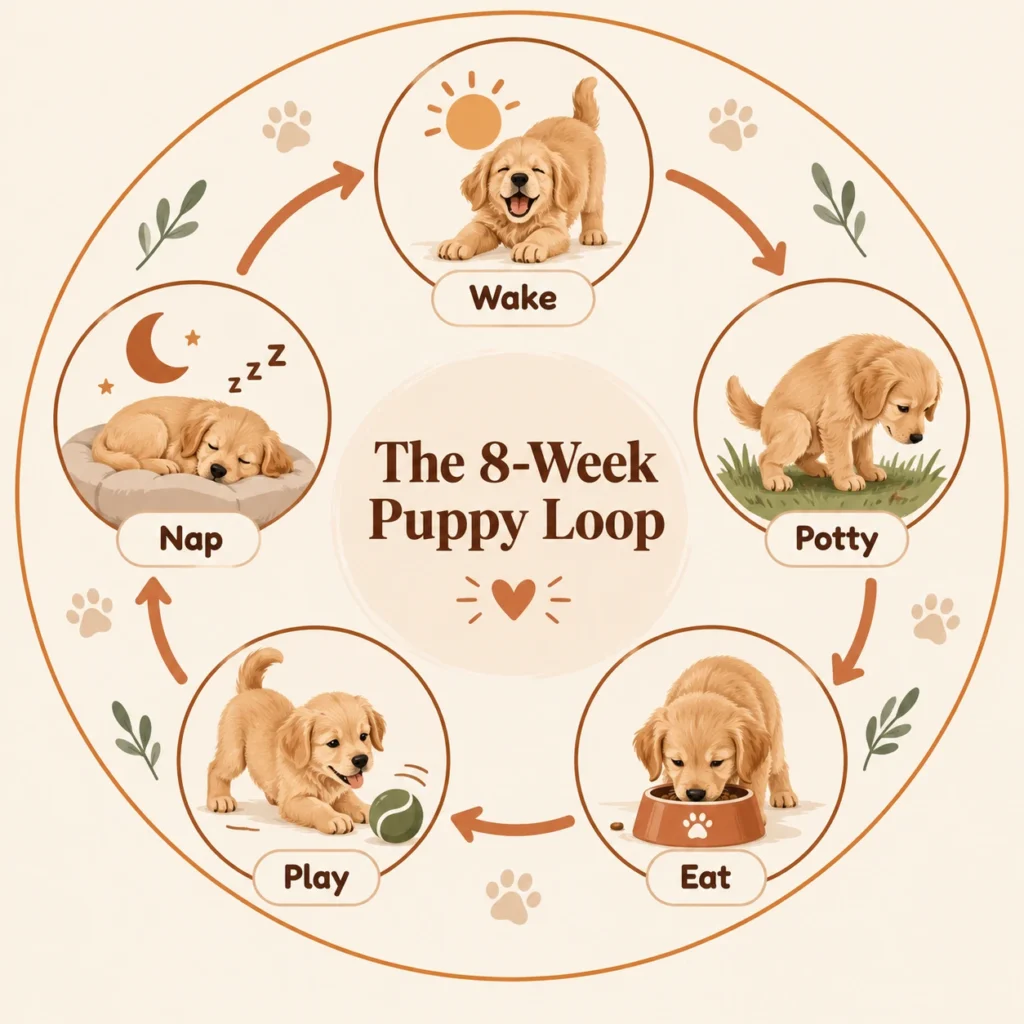
An 8 week old puppy doesn’t need a strict military routine. What it needs is a predictable loop wake up, go potty, eat, play a little, go potty again, sleep repeated all day, every day. Puppies feel calmer when they can predict what happens next, and you’ll have far fewer accidents to clean up once that rhythm is in place.
This guide gives you an hour-by-hour 8 week old puppy schedule you can copy today, plus the feeding, sleep, and potty training numbers behind it, so you’re not guessing. Pair it with our first week with a new puppy guide for the bigger picture beyond just the clock.
8 Week Old Puppy Schedule: Quick Answer
An 8 week old puppy schedule should include 3 to 4 small meals, 18 to 20 hours of sleep, and a potty break every 1 to 2 hours while awake, plus immediately after waking, eating, and playing. Build the day around a simple loop: wake, potty, eat or play, potty again, nap, repeat. Keep training sessions under 5 minutes, and avoid letting your puppy stay awake for more than 60 to 90 minutes at a stretch.
This article is for general educational purposes and is not a substitute for personalized veterinary advice. Always check your puppy’s feeding amounts, deworming schedule, and vaccination timeline with your veterinarian.
Sample 8 Week Old Puppy Daily Schedule
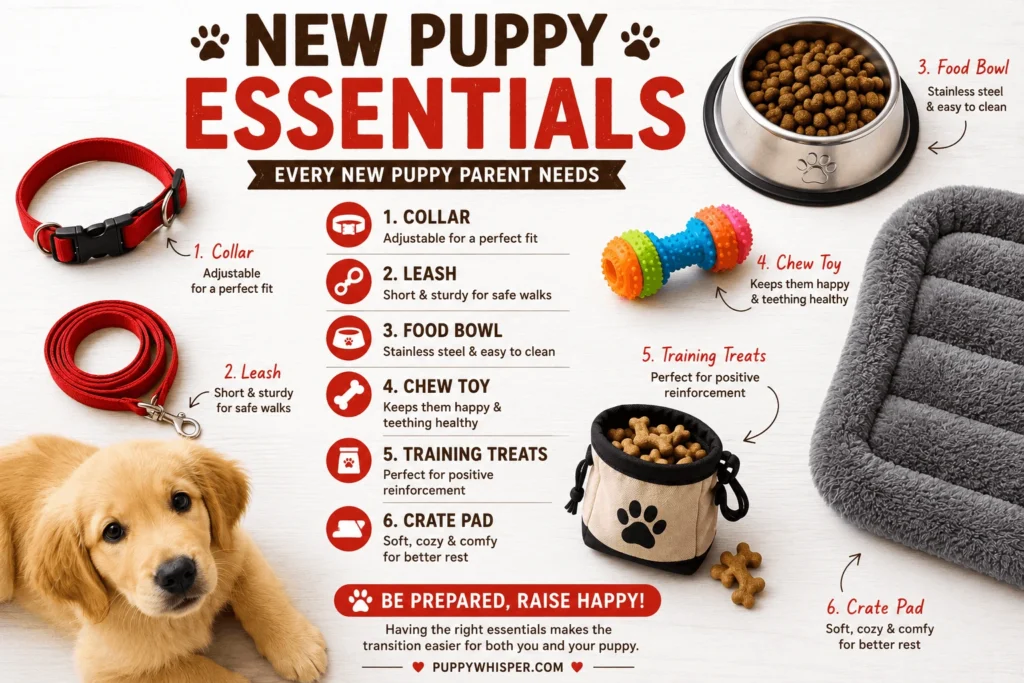
Use this as a starting template and shift the clock times to match your own wake-up time if you’re still gathering gear, run through our new puppy checklist first so nothing’s missing before day one. The pattern not the exact hour is what matters.
| Time | Activity |
| 6:30 AM | Wake up, go straight outside for potty |
| 6:45 AM | Breakfast (Meal 1) |
| 7:00 AM | Short play or sniff time (10–15 min) |
| 7:15 AM | Potty break |
| 7:30 AM | Nap in crate |
| 9:00 AM | Wake, potty break |
| 9:15 AM | Snack or Meal 2, gentle training (2–5 min) |
| 9:45 AM | Potty break, nap |
| 11:30 AM | Wake, potty break |
| 11:45 AM | Meal 3, playtime |
| 12:15 PM | Potty break, nap |
| 2:00 PM | Wake, potty, short training session |
| 2:30 PM | Nap |
| 4:00 PM | Wake, potty, playtime outside (weather permitting) |
| 4:30 PM | Meal 4 (if feeding 4x/day) |
| 5:00 PM | Potty, quiet time or family time |
| 6:30 PM | Short walk in the yard, gentle socialization |
| 7:00 PM | Potty, wind-down play |
| 8:30 PM | Last meal or snack, water access reduced |
| 9:00 PM | Final potty break of the night |
| 9:15 PM | Bedtime in crate |
| 1:00–2:00 AM | Overnight potty break (expect at least one) |
Most puppies need one, sometimes two, overnight bathroom trips at 8 weeks. This isn’t a training failure their bladder simply can’t hold through a full night yet.
Feeding Schedule for an 8 Week Old Puppy
At 8 weeks old, puppies typically eat 3 to 4 small meals a day, spaced roughly 4 to 6 hours apart. Free-feeding (leaving food out all day) makes potty timing unpredictable, so a set meal schedule works far better for house-training.
A few practical rules:
- Feed at the same times every day. Consistent meals create consistent potty breaks, because most puppies need to eliminate within 10 to 20 minutes of eating.
- Ask your vet or breeder about the right food and portion size for your puppy’s breed, expected adult size, and activity level. A large-breed puppy and a toy-breed puppy have very different calorie needs.
- Stick with the food your breeder or shelter used for the first week, then transition slowly to a new food over 5 to 7 days if you want to switch, mixing in a little more of the new food each day.
- Pick up water bowls about 2 to 3 hours before bedtime to help reduce overnight accidents, but never restrict water during the day puppies need regular access to stay hydrated.
Sleep Schedule: How Much Sleep Does an 8 Week Old Puppy Need?
An 8 week old puppy sleeps 18 to 20 hours a day, usually in short bursts of 30 minutes to 2 hours between bursts of activity see our full new puppy sleep schedule if you want the week-by-week breakdown as your puppy grows. This is completely normal, even if it looks like your puppy goes from “wide awake and biting your shoelaces” to “passed out” in under a minute.
The single biggest mistake new owners make here is letting a tired puppy stay awake too long. An overtired puppy doesn’t calm down on its own it gets more hyper, mouthier, and harder to manage. If your puppy has been awake for more than 60 to 90 minutes and starts biting at your hands, sleeves, or the leash more than usual, that’s usually a sign it’s overtired, not that it needs more exercise.
What helps:
- Use a crate or a small, safe pen as the default nap spot so your puppy learns to settle there.
- Keep the nap space calm and away from heavy foot traffic.
- Don’t wake a sleeping puppy just to keep the schedule “on time” let naps run their course when possible.
- If the crying continues well past a normal potty need, especially overnight in the crate, that’s usually a separate, very fixable issue see how to stop a puppy crying at night.
Potty Training Schedule for an 8 Week Old Puppy
House-training success at this age comes down to timing, not punishment. An 8 week old puppy has very little bladder control, so the goal is to prevent accidents by taking your puppy out before they happen, rather than reacting after the fact.
Take your puppy outside:
- Immediately after waking up (even from a short nap)
- Within 10 to 15 minutes of eating or drinking
- After every play session
- Every 1 to 2 hours while awake, as a general rule
- Right before bedtime and again during the night if needed
Watch for the warning signs: sniffing the floor in circles, sudden restlessness, whining near the door, or squatting. If you catch your puppy mid-signal, calmly interrupt and head outside don’t scold, just redirect.
Take your puppy to the same spot in the yard each time and use one consistent word, like “go potty,” right as they start to go. Reward with quiet praise or a small treat within a few seconds of finishing. Timing the reward matters more than the size of it.
These short outdoor trips double as early socialization opportunities our puppy socialization checklist covers what’s safe to expose your puppy to at this age.
Training and Socialization at 8 Weeks
Formal obedience training isn’t the priority yet building trust and positive associations is. Keep training sessions short, 2 to 5 minutes, several times a day, using food rewards and a calm voice.
Good first skills to introduce:
- Name recognition – say your puppy’s name and reward when they look at you.
- Sit – lure with a treat over the nose and up, rewarding the moment the hips touch the ground.
- Crate = good place – toss treats into the crate throughout the day so it builds a positive association, not just a bedtime box.
- Handling – gently touch paws, ears, and mouth for a few seconds daily so grooming and vet visits are less stressful later.
Socialization matters just as much as training. If your puppy hasn’t completed their full vaccination series yet, avoid dog parks and areas with unknown dogs, but you can still safely expose them to new sounds, surfaces, and calm, vaccinated adult dogs, following your veterinarian’s guidance on timing. The American Veterinary Medical Association has more on how core vaccines protect puppies during this window.
Adjusting the Schedule If You Work Outside the Home
If you’re gone for 8 or more hours a day, an 8 week old puppy genuinely cannot hold their bladder that long unsupervised. Options that work well:
- Arrange for a midday potty break from a family member, neighbor, or pet sitter.
- Use a puppy-proofed pen with a designated potty pad area for longer stretches, rather than a full-size crate.
- Consider doggy daycare only once your puppy is fully vaccinated, per your vet’s schedule.
Trying to force a full workday into a crate at this age usually backfires it either leads to accidents in the crate or a puppy that becomes anxious about confinement.
Expert Tips
- Log the schedule for the first two weeks. A simple notes app entry (“7:15 AM – potty, success”) helps you spot patterns fast, like a puppy who always needs to go 12 minutes after eating instead of the “standard” 10 to 20.
- Keep a leash by the door, even in a fenced yard, for the first few weeks. It’s easier to guide a distracted puppy back to the potty spot than to chase one.
- Shorten activities, don’t add more, when the day falls apart. If your puppy is overtired and melting down, the fix is an earlier nap, not more playtime.
- Involve the whole household in the same routine. Mixed signals one person allowing something another corrects slow down training significantly.
Common Mistakes
Mistake: Letting the puppy “cry it out” in the crate at night.
Why it’s a problem: at 8 weeks, crying is often a real signal of needing the bathroom, not just protest. Ignoring it consistently can lead to more crate accidents and anxiety.
What to do instead: respond to nighttime crying with a calm, low-key potty trip, then straight back to bed with no play.
Mistake: Free-feeding throughout the day.
Why it’s a problem: it makes potty timing impossible to predict and can contribute to picky eating.
What to do instead: offer food for 15 to 20 minutes at scheduled meal times, then pick up the bowl.
Mistake: Overdoing exercise to “tire the puppy out.”
Why it’s a problem: young puppies’ joints and growth plates are still developing, and overtiredness actually increases hyper, bitey behavior rather than reducing it.
What to do instead: prioritize naps and short, low-impact play sessions instead of long walks or hard play.
Mistake: Punishing accidents after the fact.
Why it’s a problem: puppies don’t connect punishment to something that happened minutes earlier it just teaches them to be afraid of you or to hide when they need to go.
What to do instead: clean it up without drama and tighten up the potty schedule going forward.
Frequently Asked Questions
How many hours can an 8 week old puppy hold its bladder?
As a rough guide, puppies can hold their bladder for about one hour per month of age, so an 8 week old puppy can typically hold it for around 1 to 2 hours during the day, less overnight when they’re less active.
Should I wake my puppy up at night for potty breaks?
In the first week or two, yes — a planned overnight potty trip around the middle of the night is usually easier to manage than an accident in the crate. Many puppies can start sleeping longer stretches within a few weeks.
How many times a day should an 8 week old puppy eat?
Most 8 week old puppies do well on 3 to 4 small meals a day. Confirm the right amount and frequency with your veterinarian based on your puppy’s breed and size.
Is it normal for an 8 week old puppy to sleep most of the day?
Yes. Sleeping 18 to 20 hours a day is normal and important for healthy development. Interrupting sleep too often can lead to overtired, harder-to-manage behavior.
When should I start training my 8 week old puppy?
You can start on day one with very short, low-pressure sessions name recognition, sit, and positive crate association. Formal obedience classes usually begin closer to 10 to 12 weeks, once your vet confirms it’s safe for your puppy to be around other dogs.
How do I stop my 8 week old puppy from biting during play?
Redirect biting onto an appropriate chew toy the moment it starts, and pause play with a calm “ouch” and brief break if biting continues. Puppy biting is usually a normal developmental stage, but check with your vet if it seems unusually intense or paired with other behavior concerns.
What’s the biggest mistake new puppy owners make with scheduling?
Letting the puppy stay awake too long between naps. Overtiredness is behind most of the “witching hour” biting and zoomies that new owners mistake for a behavior problem.
Do I need to follow the schedule exactly to the minute?
No. The clock times are a template the sequence (wake, potty, eat, play, potty, sleep) is what actually matters. Adjust the hours to fit your household.
Conclusion
An 8 week old puppy schedule doesn’t need to be complicated to work. What makes the biggest difference is repeating the same loop potty, food, play, potty, sleep at roughly the same times every day, so your puppy learns what to expect and your house-training sticks faster.
Start today: pick your puppy’s wake-up time, write out the loop from the sample schedule above, and stick to it for the next seven days before you fine-tune anything. Consistency in week one is what makes weeks two through twelve so much easier.

Muzammil Khan is a certified canine behaviorist and the founder of Puppywhisper. With 8+ years of experience in positive reinforcement training, Muzammil has helped over 1,000 puppies transition smoothly into their new homes. All health advice is reviewed in collaboration with licensed veterinarians.