Introduction
You just brought your puppy home, poured a bowl of kibble, and now you’re standing in the kitchen wondering if you gave too much or not nearly enough. It’s one of the most common questions new puppy owners search for, and honestly, most feeding charts on the bag don’t tell you the whole story.
Feed a puppy too little and you risk stunted growth, low energy, and poor bone development. Feed too much and you’re setting your puppy up for joint problems, obesity, and a lifetime of weight struggles. Neither outcome is what you want for your new best friend. It also helps to know upfront which foods puppies should avoid, so one simple mistake at mealtime doesn’t turn into a bigger problem.
The good news is that once you understand the basic formula, feeding your puppy the right amount becomes second nature. This guide breaks it down by age, weight, and breed size so you can stop guessing and start feeding with confidence.
Medical Disclaimer: This article is for general educational purposes and is not a substitute for professional veterinary advice. Every puppy’s calorie and nutrient needs are different based on breed, activity level, and health history. Always confirm your puppy’s feeding plan with a licensed veterinarian.
How Much to Feed a Puppy: Quick Answer
Most puppies need about 2 to 3 times more calories per pound of body weight than adult dogs, split across 3 to 4 meals a day under 6 months old. A simple starting point is roughly 5 to 6% of your puppy’s estimated adult body weight in food per day, adjusted as they grow. Always check the feeding guide on your specific puppy food bag and confirm portions with your vet, since calorie density varies by brand. For the full breakdown of meal timing at every age, see our puppy feeding schedule by age.
Why Puppy Feeding Amounts Are Different From Adult Dogs
Puppies are growing at a rate no adult dog will ever match again. Bones are lengthening, muscles are forming, and the brain is still developing rapidly through the first year of life. That growth demands more energy and more protein per pound of body weight than a fully grown dog needs just to maintain itself.
This is exactly why choosing the right puppy food matters so much, since puppy food and adult dog food are not interchangeable. Puppy formulas are built with higher protein for muscle development, more calories for sustained energy, DHA to support brain and vision development, and a calcium-to-phosphorus ratio designed for safe bone growth, standards set out in the AAFCO nutrient profiles for growth. Feeding an adult formula too early can leave a growing puppy short on the nutrients it needs during this critical window.
Puppy Feeding Chart by Age and Weight
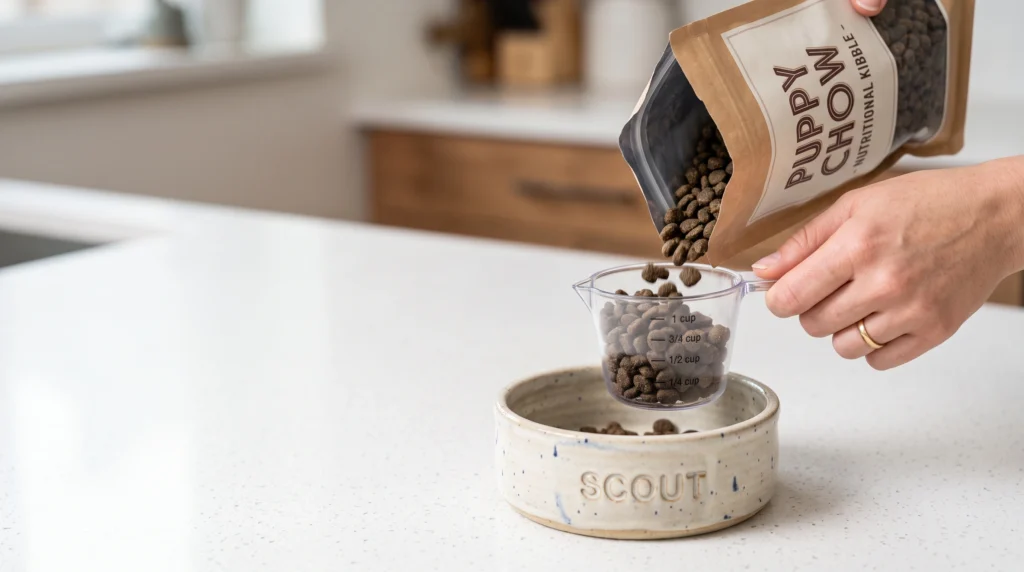
Use this chart as a starting baseline. It’s built around general veterinary feeding guidance, not a specific brand, so always cross-check against the calorie content and feeding table printed on your puppy’s actual food bag. If you’re still deciding between kibble, canned food, or a mix, our wet vs. dry puppy food comparison breaks down how portions differ between the two.
| Puppy Age | Meals Per Day | Rough Daily Portion (Small Breed, 5-15 lbs adult) | Rough Daily Portion (Medium Breed, 16-50 lbs adult) | Rough Daily Portion (Large Breed, 51+ lbs adult) |
|---|---|---|---|---|
| 6-12 weeks | 4 meals | 3/4 – 1 1/4 cups | 1 1/2 – 2 1/2 cups | 2 – 3 1/2 cups |
| 3-6 months | 3 meals | 3/4 – 1 1/2 cups | 2 – 3 cups | 3 – 5 cups |
| 6-9 months | 2-3 meals | 1/2 – 1 1/4 cups | 2 – 3 1/2 cups | 4 – 6 cups |
| 9-12 months | 2 meals | 1/2 – 1 cup | 2 – 3 cups | 4 – 7 cups |
Large and giant breed puppies often need to stay on a puppy formula until 18 to 24 months, since their growth plates close much later than small breeds. Talk to your vet before switching a large breed puppy to adult food.
The Simple Formula: 5-6% of Estimated Adult Weight
If your puppy’s food bag doesn’t line up neatly with the chart above, use this shortcut that veterinarians commonly recommend.
- Estimate your puppy’s adult weight. Your vet or breeder can usually give you a solid range based on the parents and breed.
- Multiply that estimated adult weight by 5 to 6%. That’s roughly how much food, by weight, your puppy needs per day during the fastest growth phase.
- As your puppy approaches its adult size, gradually reduce that percentage down to 2 to 3%, which is closer to adult maintenance needs.
- Split the daily total evenly across the number of meals appropriate for their age.
Example: If you expect your puppy to weigh 40 pounds as an adult, 5 to 6% of that is roughly 2 to 2.4 pounds of food per day during peak puppy growth, split into 3 or 4 meals. This is a starting estimate, not a fixed rule, since kibble weight and calorie density vary widely between brands.
How Often Should Puppies Eat?
Meal frequency matters just as much as portion size, especially for small breeds that are prone to blood sugar drops.
- 6 to 12 weeks old: 4 meals a day, spaced evenly
- 3 to 6 months old: 3 meals a day
- 6 to 12 months old: 2 meals a day
- After 12 months (or later for large breeds): Transition to 1-2 meals a day as an adult
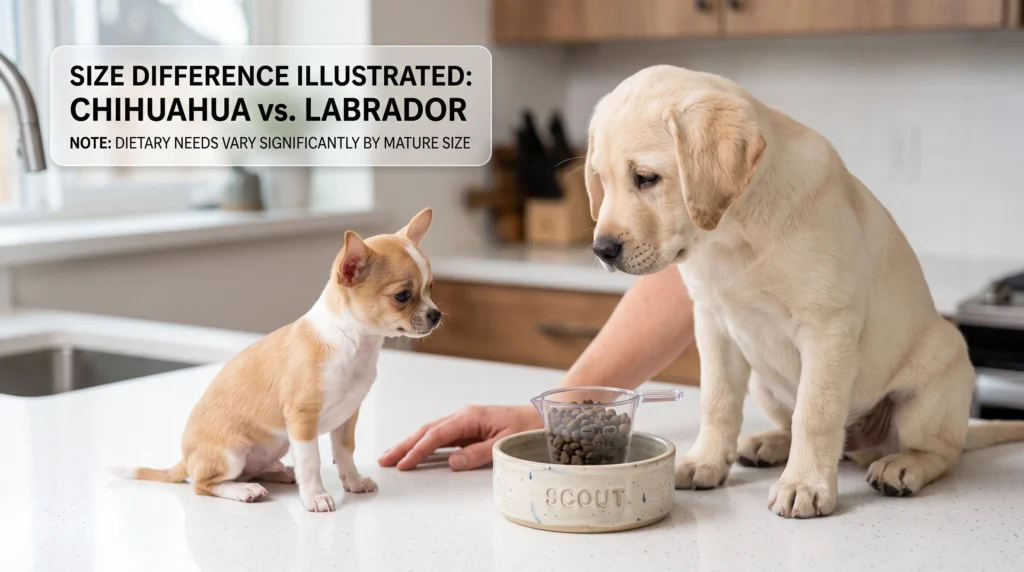
Toy breeds like Chihuahuas and Yorkies are especially sensitive to skipped meals and can develop hypoglycemia if left too long without food, so don’t stretch their feeding windows even if they seem uninterested at one meal.
Wet Food, Dry Food, or a Mix
All three approaches can support healthy growth as long as the total calorie and nutrient intake is correct.
- Dry kibble is calorie-dense, budget-friendly, and good for dental health through chewing
- Wet food is higher in moisture, often more palatable for picky eaters, but calorie-light per cup, so portions need to be larger
- Mixed feeding combines a base of kibble with a topper of wet food for flavor and hydration
If you mix wet and dry, adjust the dry portion down to avoid doubling up on calories. This is one of the most common feeding mistakes new owners make.
How to Tell If You’re Feeding the Right Amount
Numbers on a chart are a starting point, but your puppy’s body is the real feedback loop.
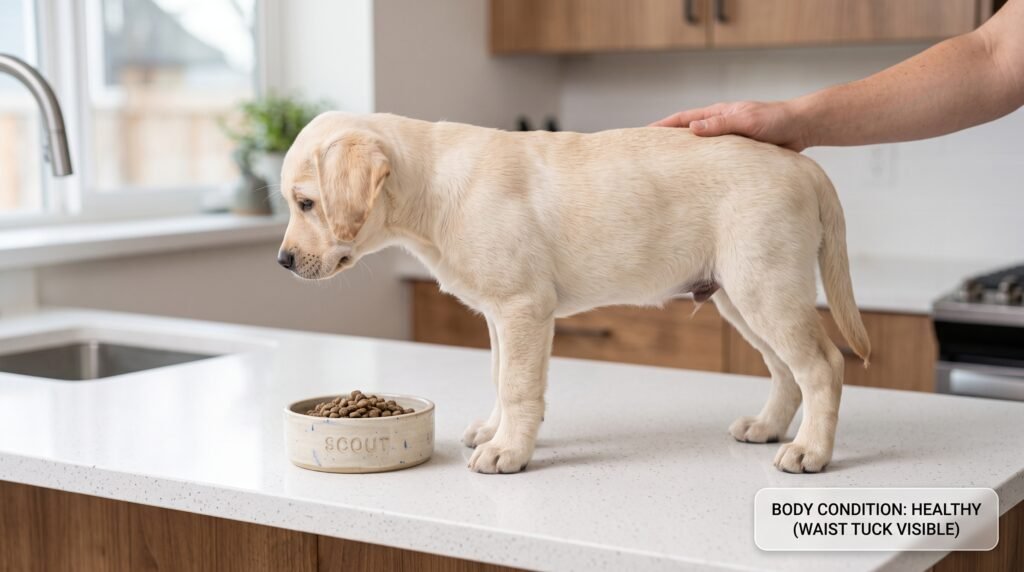
- Ribs: You should be able to feel the ribs easily under a thin layer of fat, without them being visibly sharp
- Waist: Looking down from above, there should be a visible narrowing behind the ribs
- Tummy tuck: From the side, the belly should tuck up slightly behind the ribcage, not hang level or sag
- Energy: A well-fed puppy has steady energy for play and training, without constant begging or sudden crashes
If your puppy is consistently too thin or gaining weight faster than expected, adjust the daily portion by small increments and recheck body condition every two weeks.
Expert Tips for Feeding Success
- Weigh your puppy weekly during the first few months so your portions keep pace with rapid growth instead of falling behind
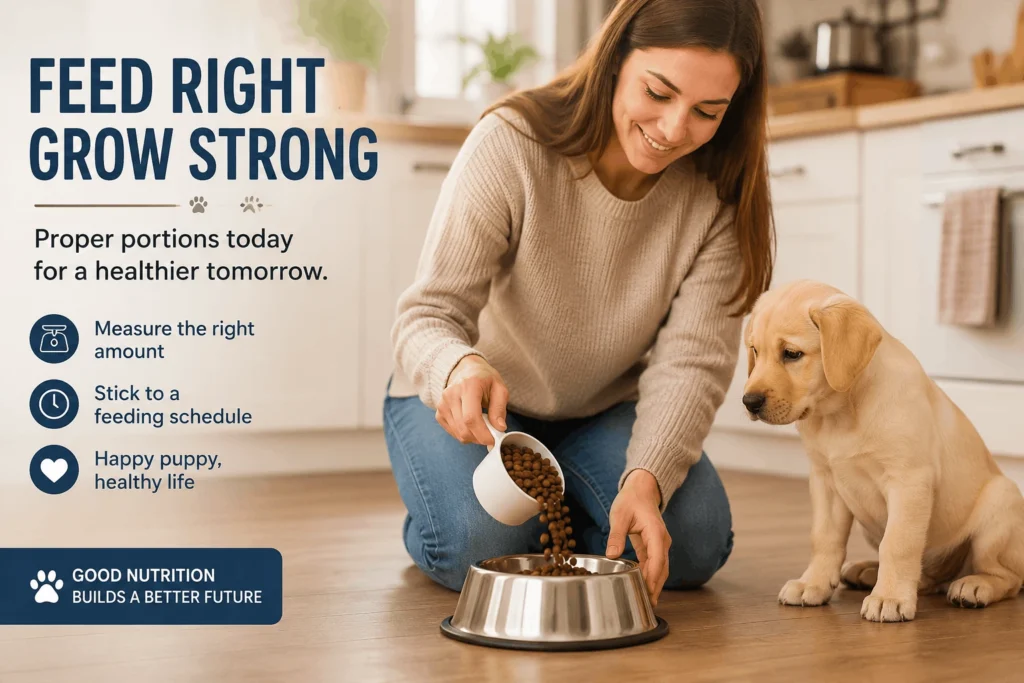
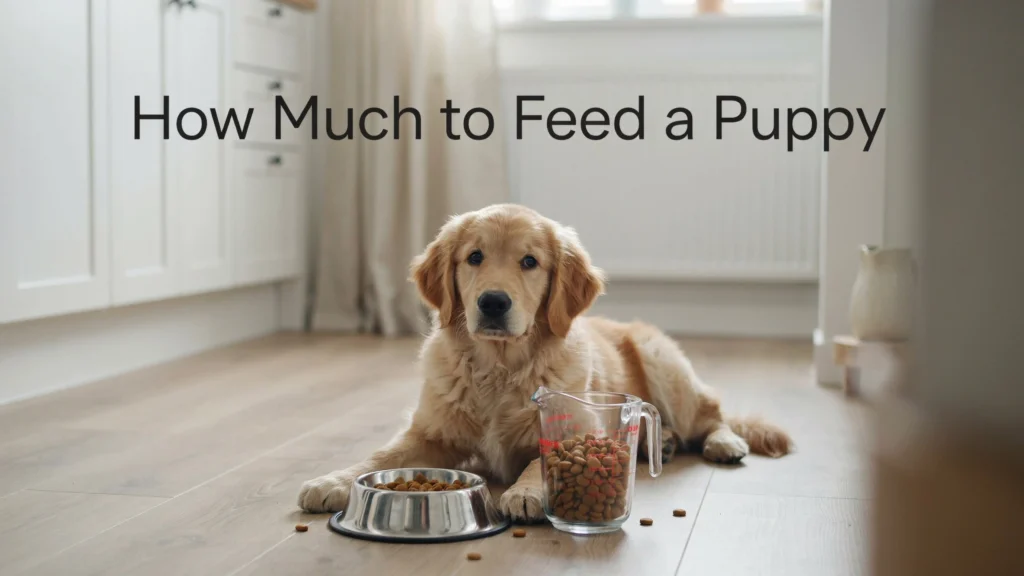
- Measure food with an actual measuring cup, not by eye. This single habit prevents most overfeeding
- Introduce any new food gradually over 5 to 7 days, mixing increasing amounts with the old food to avoid stomach upset
- Reserve 10% or less of daily calories for treats, especially during training-heavy phases, so treats don’t crowd out balanced nutrition
- Feed on a consistent schedule at the same times each day. Predictable meals support house training and reduce begging behavior
Common Feeding Mistakes and How to Fix Them
Mistake: Free-feeding puppies all day
Leaving food out constantly makes it nearly impossible to track intake or house-train effectively. Instead, offer measured meals at set times and pick the bowl up after 15 to 20 minutes.
Mistake: Guessing portions instead of measuring
Eyeballing a scoop leads to inconsistent intake and makes it hard to troubleshoot weight issues. Instead, use a standard measuring cup every single time.
Mistake: Switching foods too quickly
An abrupt food change is one of the top causes of puppy diarrhea and vomiting. Instead, transition over a full week using a gradual mixing ratio.
Mistake: Overfeeding because the puppy “seems hungry”
Puppies are opportunistic eaters and will often act hungry even when their needs are met. Instead, trust the feeding chart and body condition checks over begging behavior.
Mistake: Switching to adult food too early
This can shortchange a still-growing puppy on protein and calcium. Instead, wait until your vet confirms your puppy has reached the appropriate age and size for adult food.
Frequently Asked Questions
How much should an 8-week-old puppy eat per day?
Most 8-week-old puppies need roughly 3/4 to 1 1/2 cups of puppy food total per day, split into 4 small meals, though this varies by expected adult size and the specific food’s calorie density.
Can I overfeed my puppy?
Yes. Overfeeding during the rapid growth phase is linked to excess weight gain and increased stress on developing joints, particularly in large breed puppies. Stick to measured portions and monitor body condition.
When should I switch my puppy to two meals a day?
Most puppies can move to two meals a day around 6 months old, though small and toy breeds sometimes benefit from staying on three meals slightly longer.
Do large breed puppies need special food?
Yes. Large breed puppy formulas are formulated with controlled calcium and phosphorus levels to support slower, steadier bone growth and reduce the risk of developmental joint issues.
How do I know if my puppy food bag’s feeding chart is accurate?
Bag charts are a starting estimate based on average puppies. Use your puppy’s actual body condition and weekly weight checks to fine-tune the amount rather than following the chart rigidly.
Is it okay to give my puppy table scraps?
Occasional plain, puppy-safe foods in small amounts are generally fine, but scraps should never replace balanced meals or exceed about 10% of daily calories. Some human foods are toxic to dogs, so always check before sharing.
Why does my puppy act hungry all the time?
Puppies are naturally food-motivated and often act hungry even when properly fed. Use rib and waist checks rather than begging behavior to judge whether more food is actually needed.
When should I switch from puppy food to adult food?
Small and medium breeds typically switch around 9 to 12 months old, while large and giant breeds often stay on puppy food until 18 to 24 months. Your vet can confirm the right timing based on growth plates and breed.
Conclusion
Feeding your puppy the right amount comes down to three things: starting with a reliable baseline, measuring consistently, and adjusting based on what you actually see and feel on your puppy’s body. Charts and formulas get you close, but your puppy’s ribs, waist, and energy level are the real proof that you’ve got it right.
As a next step, weigh your puppy this week, compare that number against the chart above, and set a reminder to recheck body condition in two weeks. Small, consistent adjustments now build the foundation for a healthy adult dog later.

Muzammil Khan is a certified canine behaviorist and the founder of Puppywhisper. With 8+ years of experience in positive reinforcement training, Muzammil has helped over 1,000 puppies transition smoothly into their new homes. All health advice is reviewed in collaboration with licensed veterinarians.