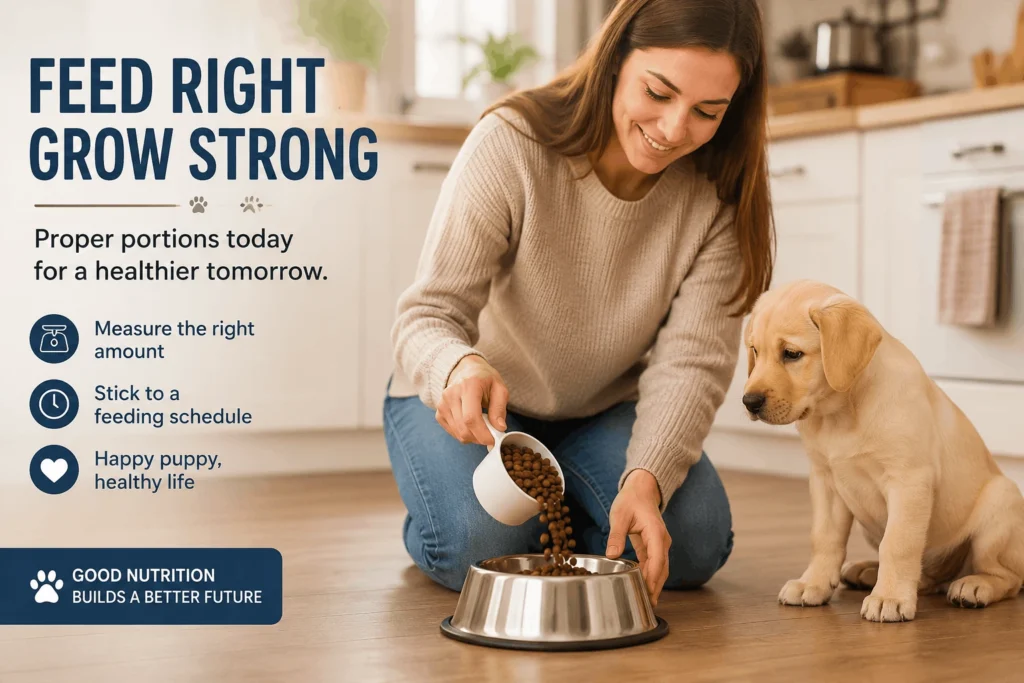
You just brought your puppy home and now you are standing in the pet food aisle staring at 40 different bags, each one claiming to be the best. Once you’ve chosen a food, two more questions matter just as much: how much your puppy should actually eat and the right feeding schedule for their age.
Grain-free. High protein. Natural. Breed-specific. Vet-formulated. The labels are endless and confusing.
Here is the hard truth: choosing the wrong food in the first months of your puppy’s life can cause nutritional deficiencies, weak bones, stunted growth, and digestive problems that follow them for years.
Puppy nutrition is not something to guess at. The good news is that once you know what to look for and what to avoid, picking the right food becomes simple and straightforward.
This guide breaks everything down clearly so you can feed your puppy with total confidence starting today.
Quick Answer: Best Food for Puppies
The best food for puppies is one labeled “complete and balanced for growth” by AAFCO, made with a named animal protein as the first ingredient, and formulated specifically for puppies rather than adult dogs. High-quality dry kibble is the most practical and vet-recommended starting point. Choose a formula matched to your puppy’s expected adult size small breed, medium breed, or large breed for the right calcium and protein ratios.
Why Puppy Nutrition Matters More Than Most Owners Realize
Puppies are not small adult dogs. Their bodies are growing at a rate that most owners significantly underestimate.
In the first 12 months of life, a puppy builds its entire skeletal structure, develops its brain and nervous system, establishes its immune system, and forms lifelong metabolic patterns. Every single one of these processes depends directly on what goes into the food bowl.
A puppy eating a nutritionally inadequate diet does not just grow slowly. It grows incorrectly. Bone deformities, immune weakness, poor coat quality, and digestive instability are all direct results of poor early nutrition.
Feeding your puppy well from day one is one of the most powerful investments you can make in their long-term health.

What Makes a Puppy Food Truly High Quality
The AAFCO Label Your Single Most Important Buying Signal
Before you read a single ingredient on any puppy food bag, look for this statement: “formulated to meet the nutritional levels established by AAFCO for growth.”
AAFCO stands for the Association of American Feed Control Officials. This statement means the food has been tested or formulated to meet minimum nutritional requirements specifically for puppies.
If a bag does not carry this statement, do not buy it regardless of how appealing the marketing looks.
5 Key Nutrients Every Puppy Needs
1. Animal Protein — Should be the first ingredient. Look for chicken, beef, salmon, turkey, or lamb. Avoid foods where corn, wheat, or soy appears before any meat source.
2. DHA (Docosahexaenoic Acid) — An omega-3 fatty acid essential for brain development and vision. Look for it listed in ingredients, often sourced from fish oil or egg product.
3. Calcium and Phosphorus — Critical for bone and teeth development. The ratio between these two minerals matters enormously, especially for large breed puppies. Too much calcium causes the same damage as too little.
4. Healthy Fats — Fat provides energy and supports skin and coat health. Chicken fat, salmon oil, and flaxseed are quality sources.
5. Digestive Support — Probiotics, prebiotics, and fermentable fibers help puppies maintain gut health during the stressful transition to a new home and new food.

The 7 Best Food Types for Puppies Explained
1. High-Quality Dry Kibble The Most Practical Starting Point
Dry kibble is the most widely recommended puppy food format because it is nutritionally complete, shelf-stable, easy to measure, and generally affordable.
Look for brands that list a specific animal protein as the first ingredient and carry clear AAFCO certification for growth.
Kibble also provides mild mechanical abrasion on teeth, which supports early dental hygiene.
Best for: Most puppies as a primary diet.
2. Wet Canned Puppy Food Excellent for Hydration and Palatability
Wet food contains significantly more moisture than kibble, which supports kidney function and helps puppies who are reluctant eaters. Many owners mix a small amount of wet food with dry kibble to increase palatability without increasing cost dramatically.
Wet food alone can work as a complete diet if the label carries AAFCO certification, but it is more expensive and has a shorter shelf life once opened.
Best for: Picky eaters, puppies recovering from illness, or as a kibble topper.
3. Raw Diet Possible but Requires Serious Research
Raw feeding involves uncooked meat, bones, and organs. Some owners report impressive results including improved coat quality and digestion. However, raw diets carry real risks: bacterial contamination (salmonella, E. coli), nutritional imbalances, and choking hazards from bone fragments.
The American Veterinary Medical Association (AVMA) advises caution with raw diets, particularly for puppies, elderly dogs, and homes with young children or immunocompromised individuals.
If you choose raw feeding, work directly with a veterinary nutritionist to ensure the diet is properly balanced.
Best for: Experienced owners who research thoroughly and consult a vet nutritionist.
4. Fresh Cooked Puppy Food A Growing and Promising Option
Fresh cooked food brands like The Farmer’s Dog and Nom Nom have grown significantly in popularity. These services deliver pre-portioned, gently cooked meals made with whole ingredients.
They tend to be more digestible and more palatable than dry kibble. The main drawback is cost — fresh food is significantly more expensive than kibble.
If budget allows, fresh food is an excellent option provided the brand carries AAFCO certification.
Best for: Owners willing to invest more for maximum ingredient quality.
5. Large Breed Puppy Formula Non-Negotiable for Big Dogs
This is one of the most critical points in this entire guide. If your puppy will grow into a dog over 50 pounds as an adult, they must eat a large breed puppy formula — not a standard puppy formula and not adult food.
Large breed puppies that eat regular puppy food receive too much calcium and grow too rapidly. This causes developmental orthopedic conditions including hip dysplasia and osteochondrosis.
Large breed formulas are specifically calibrated to slow growth to a healthy pace while still providing complete nutrition.
Best for: Golden Retrievers, German Shepherds, Labrador Retrievers, Huskies, and any breed with an adult weight above 50 pounds.
6. Small Breed Puppy Formula Built for Tiny but Fast Metabolisms
Small breed puppies have higher metabolic rates and smaller stomachs than medium and large breeds. They need calorie-dense food in smaller, more frequent meals.
Small breed formulas feature smaller kibble size for easier chewing and higher caloric density to meet energy demands.
Best for: Chihuahuas, Yorkshire Terriers, Shih Tzus, Pomeranians, and any breed with an adult weight under 20 pounds.
7. Combination Feeding Mixing Formats Effectively
Many experienced owners combine dry kibble as the base with a small amount of wet food or fresh food as a topper. This approach balances cost, nutrition, palatability, and variety.
When combining foods, reduce kibble quantity proportionally to account for the added calories from wet or fresh food. Overfeeding is a real risk when combining.
Best for: Owners who want variety and better palatability without switching entirely to expensive formats.

5 Dangerous Ingredients to Avoid in Puppy Food
1. Artificial Preservatives — BHA, BHT, and ethoxyquin are synthetic preservatives linked in ongoing research to potential health concerns. Look for foods preserved naturally with vitamin E (mixed tocopherols) or vitamin C.
2. Artificial Colors and Dyes — Red 40, Yellow 5, and Blue 2 serve no nutritional purpose. They exist purely to appeal to the human buying the food, not the puppy eating it.
3. Generic Meat Meals — “Meat meal” or “poultry meal” without specifying the animal source is a red flag. “Chicken meal” is acceptable because the source is identified. Unspecified meat meals can contain any animal byproduct.
4. Excessive Fillers — Corn syrup, white rice in large quantities, and excessive starchy fillers lower the nutritional quality and can cause blood sugar spikes in small breeds.
5. Xylitol — This artificial sweetener is extremely toxic to dogs and causes rapid, life-threatening drops in blood sugar. It occasionally appears in flavored treats and certain commercial foods. Always check the ingredient list.
How Much to Feed Your Puppy by Age
Feeding amounts vary by breed, size, and individual metabolism. Always start with the packaging guidelines as a baseline and adjust based on your puppy’s body condition score.
General age-based feeding frequency:
8 to 12 weeks: 4 meals per day 3 to 6 months: 3 meals per day 6 to 12 months: 2 meals per day 12 months and above: Transition to adult food and 2 meals daily
A healthy puppy at a proper weight should have a visible waist when viewed from above, and ribs that are easily felt but not prominently visible. If you are unsure, your vet can assess body condition score at each checkup.
6 Critical Mistakes New Owners Make With Puppy Food
Mistake 1: Feeding adult dog food to puppies. Adult formulas do not contain the nutrient ratios required for growth. Puppies fed adult food consistently often show slower development and nutritional deficiencies.
Mistake 2: Switching foods too quickly. A sudden food change causes diarrhea and digestive upset in most puppies. Always transition over 7 to 10 days — 25% new food mixed with 75% old food, gradually shifting the ratio daily.
Mistake 3: Free-feeding all day. Leaving food out constantly makes it nearly impossible to potty train because you cannot predict when your puppy needs to go. Scheduled meals create predictable bathroom windows.
Mistake 4: Giving too many treats. Treats should make up no more than 10% of your puppy’s daily caloric intake. Excessive treats unbalance the diet and contribute to obesity and picky eating habits.
Mistake 5: Ignoring breed size requirements. Feeding a Great Dane puppy a standard puppy formula because it looks healthy is one of the most damaging nutritional mistakes large breed owners make. Size-specific formulas exist for a scientifically important reason.
Mistake 6: Choosing food based on marketing alone. Words like “natural,” “holistic,” “premium,” and “ancestral” are marketing terms with no legal or nutritional definition. They tell you nothing about quality. Always read the ingredient list and AAFCO statement, not the front of the bag.
Expert Tips for Feeding Your Puppy Right
Tip 1 — Schedule a nutritional conversation at your first vet visit. Ask your vet to confirm whether your chosen food is appropriate for your specific breed and size. This single conversation prevents many common feeding mistakes.
Tip 2 — Track your puppy’s weight weekly. A kitchen scale works perfectly for small breeds. Consistent weight gain on a healthy growth curve means your feeding plan is working.
Tip 3 — Do not supplement unless your vet advises it. A puppy eating a complete and balanced diet does not need additional calcium, vitamins, or mineral supplements. Supplementing a balanced diet can actually create harmful nutrient imbalances.
Tip 4 — Store dry kibble properly. Exposure to air, heat, and humidity degrades nutritional quality and promotes mold growth. Keep kibble in an airtight container in a cool, dry location.
Tip 5 — Watch stool quality as your nutrition guide. Firm, well-formed stools indicate good digestion and appropriate food tolerance. Loose, mucous-covered, or very pale stools signal a dietary issue worth discussing with your vet.
FAQ Section
Q1: When should I switch my puppy from puppy food to adult food?
Most medium breed puppies transition to adult food around 12 months. Small breeds can transition between 10 and 12 months. Large and giant breeds should stay on large breed puppy formula until 18 to 24 months because their growth period is longer. Always confirm timing with your vet.
Q2: Is grain-free puppy food safe?
This is an ongoing area of research. The FDA has investigated a potential link between grain-free diets high in legumes and dilated cardiomyopathy (DCM) in dogs. While the link is not yet definitively proven, many vets currently recommend caution with grain-free diets, particularly for breeds already predisposed to heart conditions. Discuss with your vet before choosing grain-free.
Q3: Can I feed my puppy human food?
Some human foods are safe in small quantities plain cooked chicken, carrot sticks, and blueberries are common examples. However, many human foods are toxic to dogs including onions, garlic, grapes, raisins, macadamia nuts, chocolate, and xylitol.
Q4: What is the best food for a puppy with a sensitive stomach?
Look for limited ingredient diets with a single protein source and easily digestible carbohydrates like sweet potato or white rice. Avoid foods with multiple protein sources, artificial additives, and high fat content. Probiotic supplementation, approved by your vet, can also help.
Q5: How do I know if my puppy’s food is working well?
Signs of a successful diet include consistent healthy weight gain, firm stools, bright eyes, a shiny coat, good energy levels during play, and enthusiasm at mealtimes. If any of these are absent or declining, review the diet with your vet.
Q6: Is wet food better than dry food for puppies?
Neither is universally better. Both can be nutritionally complete if they carry AAFCO certification. Dry food is more convenient and cost-effective. Wet food provides more hydration and is generally more palatable. Many owners use both in combination to get the benefits of each format.
Q7: My puppy refuses to eat. What should I do?
A puppy skipping one meal during the first few days home is common due to stress. Offer the same food used by the breeder or shelter. If your puppy refuses food for more than 24 hours, or shows other symptoms like lethargy or vomiting, contact your vet promptly.
Conclusion
Feeding your puppy well does not require a veterinary degree. It requires understanding 3 core principles: buy food with AAFCO certification for growth, match the formula to your puppy’s expected adult size, and feed on a consistent schedule.
The 7 food types covered here give you a complete picture of your options from affordable dry kibble to premium fresh food so you can choose what fits your puppy’s needs and your budget.
Start strong with nutrition in these early months and you are giving your puppy one of the most powerful gifts of their life: a body built on the right foundation.
When in doubt, your vet is always your most reliable resource for personalized feeding guidance.

Muzammil Khan is a certified canine behaviorist and the founder of Puppywhisper. With 8+ years of experience in positive reinforcement training, Muzammil has helped over 1,000 puppies transition smoothly into their new homes. All health advice is reviewed in collaboration with licensed veterinarians.