
Your puppy freezes the moment you clip on the leash. Or maybe they pull so hard that they start coughing after only a few steps. If you’ve experienced either of these situations, you’re asking the same question countless new dog owners do: what are the best puppy harnesses, and how do you choose the right one?
A well-fitted harness does much more than make walks easier. It protects your puppy’s delicate neck, gives you better control during training, and makes it much harder for an excited youngster to slip free if they become frightened.
The challenge is that puppy harnesses aren’t one-size-fits-all. A harness that’s perfect for a calm, eight-week-old puppy may be completely unsuitable for an energetic six-month-old who loves to pull. Add in rapid growth, different body shapes, and dozens of harness styles, and choosing the right one can quickly become overwhelming.
This guide walks you through everything you need to know from understanding the different harness styles to measuring your puppy correctly so you can choose a harness that keeps every walk safe, comfortable, and enjoyable.
Quick Answer About Best Puppy Harnesses
For most puppies, the best puppy harness is a lightweight, adjustable harness with soft padding and multiple adjustment points around the neck and chest. Calm walkers usually do well with a back-clip harness, while puppies that pull benefit from a front-clip or dual-clip design. Whatever style you choose, a proper fit is far more important than the brand name, as an ill-fitting harness can cause rubbing, discomfort, or even allow your puppy to escape.
Why Choosing the Right Puppy Harness Matters
Many first-time owners assume a collar is enough because that’s what most dogs wear. While collars are useful for holding identification tags, they’re not always the safest choice for everyday walks especially during puppyhood.
Young puppies are still developing physically. Their bones, muscles, and joints continue to grow throughout the first year, and their neck structures are far more delicate than those of adult dogs. When a puppy suddenly lunges after a bird or pulls toward another dog, the pressure from a collar is concentrated on the throat.
Over time, repeated strain can lead to coughing, discomfort, or irritation around the windpipe. Some breeds with naturally delicate airways are even more sensitive to this kind of pressure.
A properly fitted harness changes where that force is applied. Instead of pressing against the neck, it distributes pressure across the chest and shoulders the strongest parts of a puppy’s body. This makes walks more comfortable while giving owners greater control.
Many puppy owners also notice that their dogs seem more confident once they switch to a harness. Without pressure on the throat, puppies often move more naturally and become more willing to explore their surroundings during walks.
Safety Benefits Beyond Comfort
Comfort is only part of the story.
Puppies are naturally curious, and they can react to unexpected sights or sounds in an instant. A passing bicycle, loud truck, or unfamiliar dog may cause even a normally calm puppy to panic.
Unfortunately, frightened puppies are surprisingly good at backing out of loose collars.
A properly adjusted harness provides multiple points of contact around the body, making accidental escapes much less likely. That extra security gives owners valuable peace of mind during the early months when puppies are still learning how to behave on a leash.
Another important benefit is improved control.
Instead of relying on your puppy’s neck to guide them, a harness lets you gently steer their entire body. This is especially useful while teaching loose-leash walking because it allows you to redirect your puppy without causing unnecessary discomfort.
Harness vs. Collar: Which Is Better for Puppies?
One of the most common questions new owners ask is whether they should skip the collar altogether.
The answer is simple: most puppies benefit from wearing both but for different purposes.
A collar is ideal for carrying identification tags and can be worn around the house under supervision. A harness, however, is usually the better option whenever you’re heading outside for walks or training sessions.
Here’s a quick comparison:
| Feature | Puppy Harness | Puppy Collar |
|---|---|---|
| Walking Comfort | ★★★★★ | ★★☆☆☆ |
| Pressure on Neck | Very Low | High |
| Escape Resistance | Excellent | Moderate |
| Training Control | Excellent | Limited |
| Holds ID Tags | Sometimes | Yes |
| Best For | Daily walks and leash training | Identification and short outings |
Think of it this way: your puppy’s collar is like their identification bracelet, while the harness is their walking gear.
Using both together allows each to do the job it’s designed for.
When Should a Puppy Start Wearing a Harness?
Most puppies can begin wearing a lightweight harness as soon as they start learning about the leash, which is usually around 8 to 10 weeks of age. This is often the same stretch when puppies are also settling into a crate routine, so keep both introductions calm and positive.
The goal at this stage isn’t long walks young puppies often aren’t fully vaccinated yet. Until vaccinations are complete, training pads can cover bathroom breaks while you save the harness for short supervised yard time. Instead, you’re helping them become comfortable wearing the equipment before outdoor adventures begin.
Starting early has several advantages.
Young puppies are naturally curious and tend to accept new experiences more easily than older dogs. A harness introduced during this early learning period often becomes something they barely notice.
The key is to make every introduction positive.
Rather than fastening the harness and immediately heading outside, let your puppy investigate it first. Pairing this with a favorite interactive toy or treat keeps the introduction upbeat rather than stressful. Place it on the floor, reward curiosity with treats, and gradually work up to wearing it for short periods indoors.
Many experienced trainers recommend several five-minute indoor sessions before attaching a leash for the first time.
This simple approach helps prevent one of the most common beginner mistakes creating a negative association with the harness by rushing the process.
Signs Your Puppy Is Ready for a Harness
Every puppy develops at a slightly different pace, but most are ready when they:
- Show confidence exploring new environments.
- Wear a lightweight collar comfortably.
- Respond positively to treats and praise during training.
- Can move freely without becoming frightened by new objects.
- Are beginning short leash introduction sessions.
If your puppy freezes or refuses to move after putting on a harness, don’t worry. This behavior is extremely common and usually disappears after several short, reward-based practice sessions.
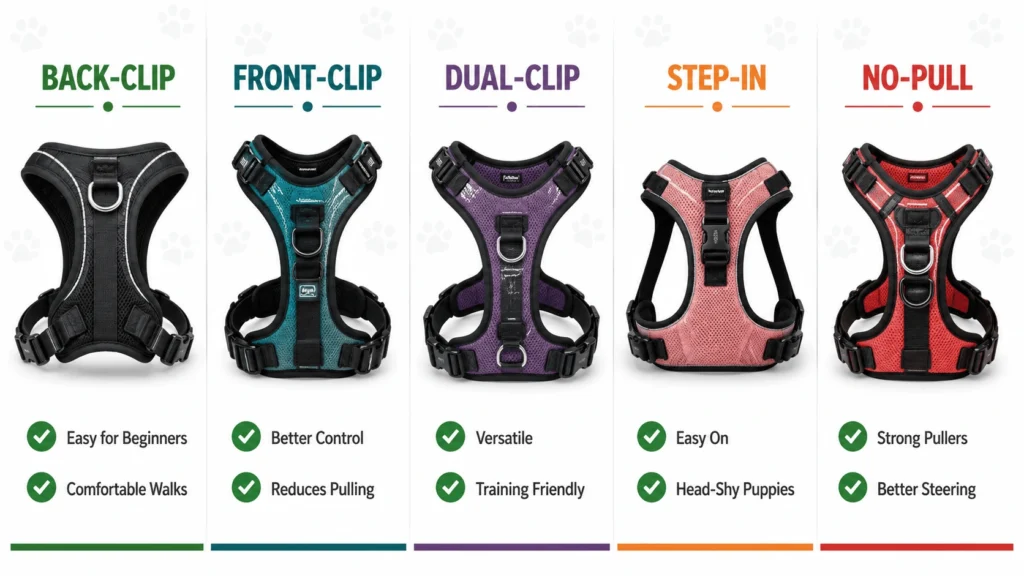
Understanding the Different Types of Puppy Harnesses
Walk into any pet store and you’ll find dozens of harness styles that all promise to be the “best.” In reality, each design solves a different problem.
The best puppy harness depends less on the manufacturer and more on your puppy’s size, personality, and walking habits.
Let’s look at the most common options.
1. Back-Clip Harness
A back-clip harness is the style most new puppy owners recognize.
The leash attaches to a metal D-ring positioned between the shoulder blades, making it simple to clip on before heading out for a walk.
Because the leash stays behind the puppy, this design feels natural and allows plenty of freedom of movement. That’s why it’s often recommended for puppies that are just beginning leash training.
Best for
- First-time puppy owners
- Small and toy breeds
- Calm walkers
- Daily neighborhood walks
- Puppies learning leash confidence
Advantages
- Easy to put on and remove
- Comfortable for everyday use
- Lightweight and beginner-friendly
- Doesn’t interfere with natural movement
- Widely available in many sizes
Potential Drawbacks
Because the leash pulls from behind, determined puppies can lean into the harness and pull with surprising strength. If your puppy already charges toward squirrels or drags you down the sidewalk, you’ll probably need more steering control than a standard back-clip harness provides.
2. Front-Clip Harness
Unlike traditional designs, a front-clip harness places the leash attachment on the puppy’s chest.
This simple change has a noticeable effect on walking behavior.
Instead of allowing your puppy to pull straight ahead, the leash gently redirects their body back toward you whenever they surge forward. Many trainers prefer this style because it naturally discourages pulling without causing pain or harsh corrections.
For energetic puppies, that extra control can make leash training much easier.
However, some puppies need a few walks to adjust because the leash passes closer to their front legs than they’re used to.
3. Dual-Clip Harness
If you’re looking for one harness that can adapt as your puppy grows and learns, a dual-clip harness is one of the most versatile choices.
As the name suggests, these harnesses include two leash attachment points one on the chest and another between the shoulder blades. This lets you switch between front-clip and back-clip walking depending on your puppy’s behavior.
For example, you might use the front clip during training sessions to discourage pulling, then switch to the back clip for relaxed neighborhood walks once your puppy is walking politely.
Many professional trainers recommend dual-clip harnesses because they can grow with your puppy’s training progress instead of becoming obsolete after a few months.
Best For
- Puppies actively learning leash manners
- Families wanting one versatile harness
- Medium and large breeds
- Owners who want extra control without buying multiple harnesses
Advantages
- Two leash attachment options
- Excellent for training
- Suitable for different walking situations
- Can reduce the need to buy another harness later
- Offers more flexibility than single-clip designs
Potential Drawbacks
Dual-clip harnesses usually cost slightly more than basic models. Some also have a few extra straps, so they may take a little longer to put on until you become familiar with the design.
4. Step-In Harness
Some puppies dislike anything going over their head.
If your puppy backs away every time you try to slip on a harness, a step-in harness may be a better option.
Instead of placing the harness over the head, your puppy simply steps into two openings before you fasten the clips on their back.
Many owners find this style much easier for nervous puppies, particularly during the first few weeks of harness training.
Best For
- Head-shy puppies
- Toy breeds
- Puppies with floppy ears
- Owners wanting quick dressing
Advantages
- Easy to put on
- Less stressful for sensitive puppies
- Comfortable for short walks
- Great introduction harness
Potential Drawbacks
Not every step-in harness provides excellent escape protection. If your puppy is especially energetic or prone to backing out of harnesses, choose one with multiple adjustment points and always check the fit carefully.
5. No-Pull Harness
A no-pull harness is designed specifically for puppies that already pull strongly on the leash.
Most no-pull models use a front attachment point or a tightening system that gently redirects your puppy instead of allowing them to charge ahead.
It’s important to understand that these harnesses are training tools not magic solutions.
A harness can help manage pulling, but your puppy still needs consistent, reward-based loose-leash training to develop good walking habits.
When used correctly, however, a no-pull harness can make training sessions calmer and more enjoyable for both puppy and owner.
Best For
- Strong pullers
- Large-breed puppies
- Adolescent dogs
- Busy walking environments
Advantages
- Improves steering control
- Helps reduce pulling
- Makes training easier
- Can improve walking confidence for owners
Potential Drawbacks
A poorly fitted no-pull harness may restrict natural movement or rub against the shoulders. Always choose the correct size and monitor your puppy for any signs of discomfort.
Puppy Harness Comparison Table
| Harness Style | Best For | Control | Ease of Use | Training Value |
|---|---|---|---|---|
| Back-Clip | First-time walkers | ⭐⭐☆☆☆ | ⭐⭐⭐⭐⭐ | ⭐⭐⭐☆☆ |
| Front-Clip | Puppies that pull | ⭐⭐⭐⭐⭐ | ⭐⭐⭐☆☆ | ⭐⭐⭐⭐⭐ |
| Dual-Clip | Growing puppies | ⭐⭐⭐⭐☆ | ⭐⭐⭐⭐☆ | ⭐⭐⭐⭐⭐ |
| Step-In | Head-sensitive puppies | ⭐⭐⭐☆☆ | ⭐⭐⭐⭐⭐ | ⭐⭐⭐☆☆ |
| No-Pull | Strong pullers | ⭐⭐⭐⭐⭐ | ⭐⭐⭐☆☆ | ⭐⭐⭐⭐⭐ |
How to Choose the Best Puppy Harness
With so many options available, it’s easy to focus on colors, patterns, or brand names.
Instead, start by thinking about your puppy’s needs.
The best harness is one that fits properly, allows natural movement, and matches your puppy’s current stage of training.
Here are the features that matter most.
1. Adjustability
Puppies seem to grow overnight.
A harness that fits perfectly today may become tight within a few weeks, especially during the first six months.
Look for models with adjustment points around both the neck and chest.
The more adjustable the harness, the longer you’ll be able to use it before replacing it.
2. Lightweight Construction
Heavy hardware can feel awkward on a small puppy.
A lightweight harness allows natural movement and reduces fatigue during walks.
This is especially important for toy and small breeds.
If the harness feels bulky in your hand, imagine how it feels on a puppy that weighs only a few pounds.
3. Comfortable Padding
Good padding helps prevent rubbing while spreading pressure evenly across the chest.
Soft padding is particularly valuable if your puppy enjoys long walks or has short, fine fur.
However, padding shouldn’t make the harness excessively bulky.
Comfort comes from thoughtful design rather than thick materials alone.
4. Breathable Materials
Warm weather can quickly make a poorly ventilated harness uncomfortable.
Mesh panels or breathable padded fabrics improve airflow and help prevent overheating.
This is especially beneficial for active puppies and breeds with thick coats.
5. Durable Hardware
Even small puppies can put surprising force on buckles and leash clips.
Choose sturdy metal D-rings and reliable buckles that click securely into place.
Before every walk, give the hardware a quick inspection for cracks or loose stitching.
Replacing a worn harness is much cheaper than dealing with an escaped puppy.
6. Reflective Features
If you walk early in the morning or after sunset, reflective stitching improves visibility.
While reflective material doesn’t replace proper lighting, it helps drivers and cyclists notice your puppy sooner.
This simple feature can add an extra layer of safety.
7. Easy On and Off
Anyone who has dressed a wiggly puppy knows that simplicity matters.
Quick-release buckles and intuitive designs make getting ready for walks much less stressful.
If putting on the harness becomes a struggle every day, both you and your puppy are less likely to enjoy walks.
Choosing a Harness Based on Your Puppy’s Size
Not every puppy needs the same type of harness.
Body size affects comfort, control, and safety.
Here’s a general guide.
| Puppy Size | Recommended Harness | Why |
|---|---|---|
| Extra Small (2–10 lbs) | Soft mesh back-clip | Lightweight and comfortable |
| Small (10–20 lbs) | Adjustable back-clip or dual-clip | Easy to control while growing |
| Medium (20–40 lbs) | Dual-clip harness | Versatile for training |
| Large (40+ lbs) | Front-clip or padded dual-clip | Better steering and pressure distribution |
Remember that these are general recommendations.
Always measure your puppy rather than choosing a size based only on weight or breed.
Choosing a Harness by Breed Type
Breed characteristics also influence which harness works best.
Small Companion Breeds
Breeds such as Chihuahuas, Yorkshire Terriers, and Maltese often benefit from lightweight mesh harnesses with narrow, padded straps.
Bulky hardware may feel uncomfortable on their smaller frames.
Sporting Breeds
Active breeds like Labrador Retrievers, Golden Retrievers, and Cocker Spaniels usually appreciate durable, adjustable harnesses with plenty of freedom for shoulder movement.
A dual-clip harness often provides the best balance between comfort and training control.
Herding Breeds
Energetic puppies such as Border Collies and Australian Shepherds often learn quickly but can become enthusiastic pullers.
Front-clip or dual-clip harnesses work well during early leash training.
Deep-Chested Breeds
Breeds including Whippets and Greyhounds have unique body shapes that may require specially designed harnesses with additional adjustment points to prevent slipping.
Best Harness Materials Explained
Different materials offer different advantages.
Understanding them helps you choose a harness suited to your puppy’s lifestyle.
| Material | Comfort | Durability | Best For |
|---|---|---|---|
| Soft Mesh | Excellent | Medium | Small puppies, warm weather |
| Nylon | Good | Excellent | Everyday walking |
| Padded Nylon | Excellent | Excellent | Active puppies |
| Neoprene | Excellent | Excellent | Rainy weather and water-loving dogs |
Should You Buy a Harness Your Puppy Can “Grow Into”?
Many owners intentionally buy a harness that’s one size too large, hoping it will last longer.
While that sounds economical, an oversized harness creates safety risks.
Loose straps allow puppies to back out more easily, and excessive movement can cause rubbing under the front legs.
Instead, choose a harness that fits correctly today but offers enough adjustment to accommodate gradual growth over the next few months.
If your puppy is between sizes, select the larger option only if the adjustment points allow you to achieve a snug fit.
Expert Buying Tips
Experienced trainers and veterinarians often recommend keeping these points in mind:
- Measure your puppy before every new harness purchase.
- Prioritize fit over appearance.
- Choose adjustable straps instead of fixed sizing.
- Replace worn harnesses immediately.
- Check stitching and buckles regularly.
- Avoid overly heavy hardware for small puppies.
- Let your puppy wear the harness indoors before the first walk.
- Recheck the fit every few weeks during periods of rapid growth.
These simple habits can prevent many of the most common harness-related problems and help ensure your puppy stays comfortable as they grow.
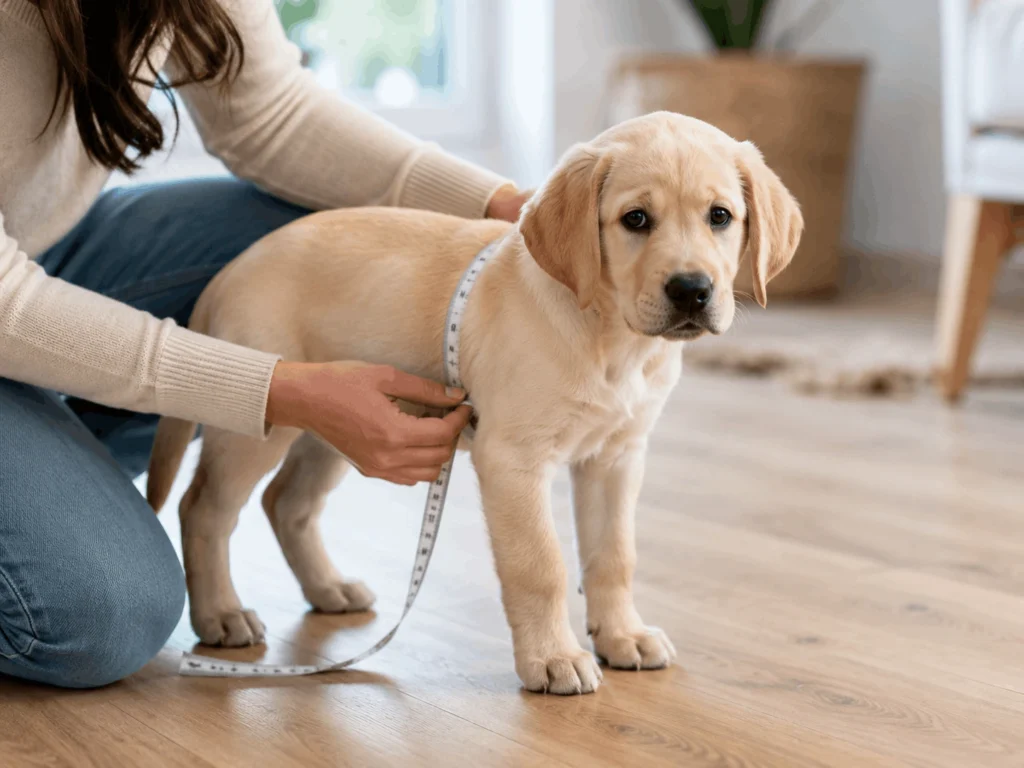
Step-by-Step: How to Measure Your Puppy for a Harness
Buying the right size starts with accurate measurements. While many owners estimate based on breed or age, puppies grow at different rates, and two puppies from the same litter can have noticeably different body shapes.
Taking a few measurements before you shop greatly improves your chances of getting a harness that fits comfortably from day one.
What You’ll Need
- A soft measuring tape
- A few treats
- Someone to help (optional but useful)
- Your puppy standing naturally
If you don’t have a flexible tape measure, wrap a piece of string around your puppy, then measure the string with a ruler.
Step 1: Measure the Neck
Wrap the measuring tape around the base of your puppy’s neck, where a collar naturally rests.
The tape should lie flat without squeezing the fur.
You should be able to slide a finger under the tape while measuring.
Step 2: Measure the Chest Girth
The chest girth is the most important measurement for nearly every harness.
Wrap the tape around the widest part of your puppy’s chest, usually just behind the front legs.
Keep the tape level all the way around.
Avoid measuring too close to the armpits, where the chest becomes narrower.
Step 3: Measure the Back Length (If Required)
Some harnesses with larger back panels or adventure-style designs ask for back length.
Measure from the base of the neck to the base of the tail.
Not every harness requires this measurement, but it’s worth taking if you’re comparing different styles.
Step 4: Compare Your Measurements
Every manufacturer uses slightly different sizing.
Never assume your puppy wears a “Small” or “Medium” across all brands.
Instead, compare your measurements with the manufacturer’s size chart before purchasing.
If your puppy falls between two sizes, choose the size that provides enough room for adjustment while still allowing a secure fit.
How to Fit a Puppy Harness Correctly
A high-quality harness won’t perform well if it doesn’t fit properly.
Fortunately, checking the fit only takes a few minutes.
Use the Two-Finger Rule
The easiest way to judge the fit is the two-finger rule.
After fastening the harness, slide two fingers between the strap and your puppy’s body.
- One finger or less = too tight
- More than two fingers = too loose
- Two fingers = just right
This simple check helps balance comfort with security.
Check the Chest Strap
The chest strap should sit about an inch behind the front legs.
If it rests directly in the armpit, it can rub during every step.
Even a short walk can lead to irritation if the harness shifts repeatedly.
Watch Your Puppy Move
Ask your puppy to:
- Walk
- Sit
- Lie down
- Turn around
- Climb a small step
The harness should stay in place without twisting, sliding, or restricting movement.
A properly fitted harness should almost disappear into your puppy’s natural movement.
Perform an Escape Test
Before your first outdoor walk, gently apply backward pressure on the leash indoors.
A correctly fitted harness should remain secure without slipping over the shoulders.
This simple test can prevent frightening escape situations outside.
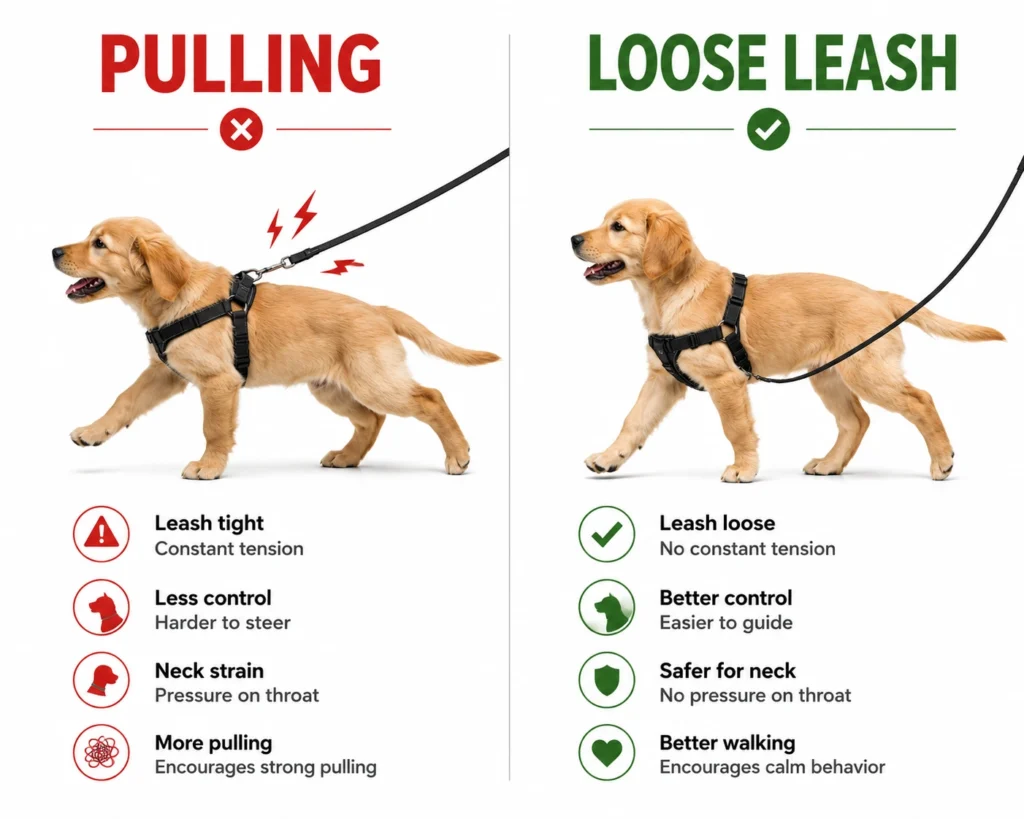
How to Introduce a Harness Without Stress
Many puppies freeze the first time they wear a harness.
This reaction is completely normal.
They’re simply adjusting to a new sensation.
The key is to create positive associations from the beginning.
Step 1: Let Your Puppy Investigate
Place the harness on the floor.
Allow your puppy to sniff it freely.
Reward curiosity with treats and praise.
There’s no need to rush.
Step 2: Practice Wearing It Indoors
Fasten the harness for just a few minutes.
Play games.
Offer treats.
Keep the experience fun.
Repeat this over several days before adding a leash.
Step 3: Attach the Leash Indoors
Once your puppy seems comfortable wearing the harness, clip on a lightweight leash.
Let them drag it around under supervision for a few minutes.
This helps them get used to the extra sensation before their first walk.
Step 4: Keep the First Walk Short
Your puppy doesn’t need a long adventure.
A five- or ten-minute walk around the yard or quiet street is enough.
End the session while your puppy is still relaxed and enjoying themselves.
Short, successful experiences build confidence much faster than long, overwhelming walks.
Benefits of Choosing the Right Puppy Harness
The right harness does much more than make walks easier.
It also supports your puppy’s long-term comfort and safety.
Some of the biggest benefits include:
- Reduces pressure on the neck and throat
- Distributes force across the chest and shoulders
- Helps prevent accidental escapes
- Improves control during leash training
- Makes walks more comfortable
- Encourages better leash manners
- Reduces the risk of rubbing when fitted correctly
- Builds positive associations with walking
- Gives owners more confidence when handling energetic puppies
Many owners notice that their puppies become calmer on walks once they switch from a collar to a properly fitted harness.
Common Harness Problems (and How to Fix Them)
Even the best harness can cause problems if it isn’t adjusted correctly.
Fortunately, most issues have simple solutions.
Problem: Chafing Under the Front Legs
Possible Causes
- Harness too loose
- Chest strap positioned too far back
- Poor-quality material
- Harness shifting during movement
Solution
Tighten the adjustment points.
Ensure the chest strap sits behind the legs instead of inside the armpits.
If irritation continues, choose a softer, padded harness.
Problem: Puppy Slips Out
Possible Causes
- Neck opening too large
- Harness oversized
- Incorrect adjustment
Solution
Re-measure your puppy.
Tighten the neck and chest straps.
If necessary, move down one size.
Problem: Puppy Refuses to Walk
This is extremely common during the first few wears.
Solution
Don’t pull your puppy forward.
Instead:
- Use treats
- Encourage play
- Keep sessions short
- Practice indoors
Confidence grows quickly with positive experiences.
Problem: Harness Twists Sideways
Possible Causes
- Poor fit
- Uneven strap adjustment
- Incorrect size
Solution
Readjust every strap.
Check that the harness sits evenly across the shoulders.
If twisting continues, try a different design better suited to your puppy’s body shape.
Expert Tips
Experienced trainers and veterinarians often recommend these simple habits:
✔ Introduce the harness indoors before the first walk.
✔ Reward calm behavior every time the harness comes out.
✔ Recheck the fit every month during the first year.
✔ Keep a slightly larger harness ready during rapid growth phases.
✔ Inspect buckles and stitching before walks.
✔ Remove the harness after walks instead of leaving it on all day.
✔ Wash the harness regularly to remove dirt, sweat, and bacteria. While you’re at it, check whether your puppy is due for a bath too a mild puppy shampoo keeps skin healthy under the straps.
✔ Replace damaged hardware immediately.
Small habits like these improve both safety and comfort over the life of the harness.
Common Mistakes to Avoid
Many harness problems are completely preventable.
Avoid these common mistakes.
Buying by Breed Alone
Not every Labrador puppy has the same chest size.
Always measure.
Choosing Fashion Over Fit
Cute colors are fun, but comfort and safety matter much more.
A plain harness that fits well is better than a stylish one that rubs or slips.
Ignoring Growth Spurts
Young puppies can outgrow a harness surprisingly quickly.
Check the fit every few weeks during the first year.
Leaving the Harness On All Day
Harnesses are designed for walks and supervised activities.
Leaving one on for extended periods can trap moisture, collect dirt, and increase the chance of skin irritation.
Remove it once you’re home unless your veterinarian advises otherwise.
Skipping Training
No harness teaches loose-leash walking on its own.
The best results come from combining a properly fitted harness with patience, positive reinforcement, and consistent practice.
When Should You Replace a Puppy Harness?
Even a high-quality harness won’t last forever.
Replace it if you notice:
- Frayed stitching
- Cracked buckles
- Bent D-rings
- Torn fabric
- Loose adjustment straps
- Your puppy has outgrown the fit
- Signs of rubbing that adjustments can’t fix
Most puppies will need at least one or two larger harnesses during their first year because of rapid growth.
Frequently Asked Questions
Is a harness better than a collar for a puppy?
For walks, yes. A harness spreads pressure across the chest and shoulders instead of concentrating it on the throat. Collars remain important for carrying identification tags but are generally better suited for everyday wear than leash walking.
What age can a puppy start wearing a harness?
Most puppies can begin wearing a lightweight, well-fitted harness around 8 to 10 weeks of age. Start with short indoor sessions using treats and praise before progressing to leash training.
Should my puppy wear a harness all day?
No. Harnesses are designed for walks, training, and supervised outings. Removing the harness afterward helps prevent rubbing, overheating, and trapped moisture while also giving your puppy’s skin and coat a chance to breathe.
How often should I check the fit?
During the first year, check the fit every two to four weeks. Rapid growth can quickly turn a comfortable harness into one that feels too tight or becomes unsafe.
Can a harness stop my puppy from pulling?
A front-clip or no-pull harness can make pulling easier to manage by redirecting your puppy’s movement. However, lasting improvement comes from consistent reward-based loose-leash training rather than relying on the harness alone.
What if my puppy freezes when wearing a harness?
This is a common reaction. Keep sessions short, use treats and praise, and let your puppy wear the harness indoors before attaching a leash. Most puppies adjust within a few days of positive practice.
How do I know if the harness is too tight?
Use the two-finger rule. You should be able to comfortably slide two fingers between the straps and your puppy’s body. Also check for redness, hair loss, or signs of discomfort after walks.
Is it okay to buy a larger harness for my growing puppy?
Only if it can be adjusted securely. A harness that’s too loose is easier to escape from and may rub against the skin. A snug, adjustable fit is always safer than buying several sizes too large.
Final Thoughts
Choosing the best puppy harness isn’t about finding the most expensive model or the trendiest design. It’s about selecting a harness that matches your puppy’s size, walking style, and stage of development while providing a secure, comfortable fit.
For most puppies, an adjustable back-clip or dual-clip harness offers the ideal balance of comfort, safety, and flexibility. If your puppy tends to pull, a front-clip design can provide additional control while you work on loose-leash training.
Remember to measure your puppy before buying, use the two-finger rule every time you adjust the straps, and check the fit regularly as your puppy grows. A well-fitted harness not only makes walks safer but also helps build positive habits that can last a lifetime.
By taking the time to choose and fit the right harness, you’re setting your puppy up for happier, more comfortable adventures one walk at a time.

Muzammil Khan is a certified canine behaviorist and the founder of Puppywhisper. With 8+ years of experience in positive reinforcement training, Muzammil has helped over 1,000 puppies transition smoothly into their new homes. All health advice is reviewed in collaboration with licensed veterinarians.