Introduction
You finally brought your puppy home. The excitement is real but so is the overwhelm.
Within the first 24 hours, most new owners face the same wall: the puppy won’t sleep, has already had 3 accidents on the carpet, and cries every time you leave the room.
Nobody told you it would feel this chaotic.
Here’s the truth: the first week with a new puppy is the most important week of your dog’s life. The habits, routines, and boundaries you set right now will shape your dog’s behavior for years. Get this week right, and everything else becomes dramatically easier.
This guide walks you through every single day with a clear structure, real examples, and zero fluff.
Quick Answer
The first week with a new puppy requires 4 core priorities: establish a safe space (crate), start a consistent potty routine, create a feeding schedule, and keep the environment calm. Avoid overwhelming your puppy with too many people, too much freedom, or too many changes at once. Consistency in the first 7 days builds trust and prevents 80% of common behavior problems.
Why This First Week Is Critically Important
Puppies between 8 and 16 weeks are in what behaviorists call the socialization window the single most powerful period of their entire life for learning, trust-building, and habit formation. The American Kennel Club notes that positive exposure during this window can permanently shape adult temperament.
What happens during this window sticks.
A puppy that experiences calm, structured, loving routines in week one is far easier to train, less anxious, and more confident as an adult dog. A puppy left to figure things out alone with no structure often develops fear, separation anxiety, and destructive behaviors that take months to correct.
You have 7 days to lay the right foundation. Here’s exactly how to use them.
Before Your Puppy Arrives 3 Must-Do Preparations
Don’t wait until your puppy is home to prepare. These 3 steps will save you hours of stress.
1. Puppy-Proof One Room First
Don’t give your puppy access to the whole house immediately. Pick one room usually the kitchen or living room and remove electrical cords, toxic plants, small objects they could swallow, and anything you don’t want chewed.
2. Set Up the Crate Before Day 1
Place the crate in a quiet area, away from high-traffic zones. Add a soft blanket, a worn t-shirt with your scent, and a safe chew toy. The crate should feel like a den cozy, enclosed, and calm.
3. Buy the Right Supplies in Advance
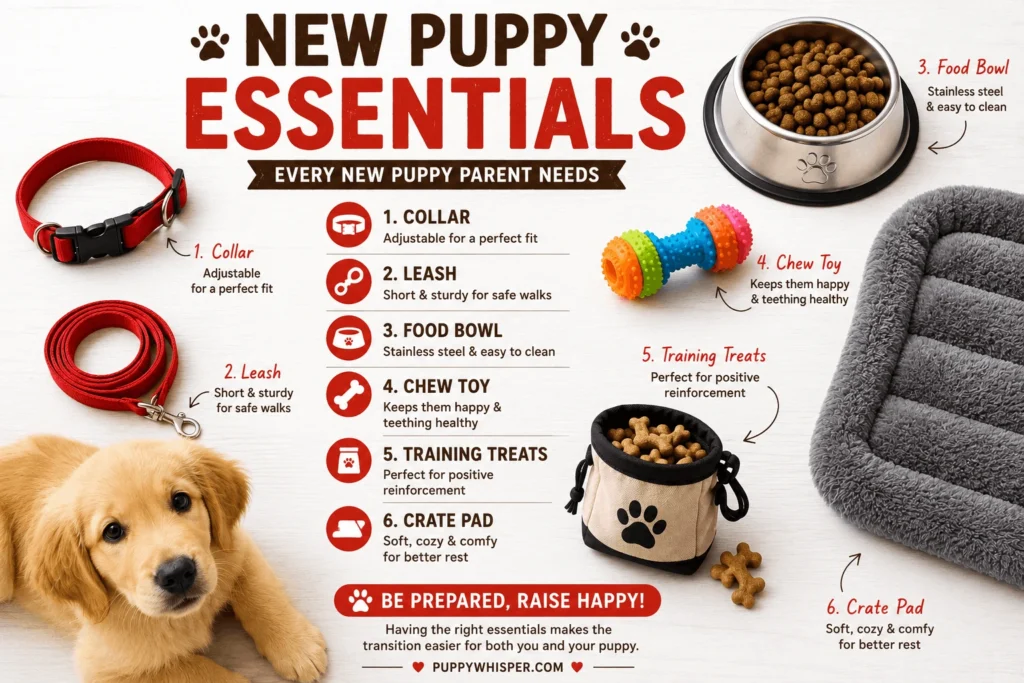
You’ll need: appropriately-sized crate, enzymatic cleaner (essential for potty accidents), food and water bowls, age-appropriate puppy food, collar with ID tag, leash, and puppy pads if needed. Having these ready on Day 1 removes chaos. Not sure you’ve covered everything? Check our complete new puppy checklist to make sure nothing slips through before pickup day..

Day 1 — The 5 Rules of a Calm First Arrival
The single biggest mistake owners make on Day 1 is overstimulation. Here’s how to avoid it.
Rule 1: Keep the welcome quiet. Resist the urge to invite friends and family over immediately. Your puppy’s nervous system is flooded with new smells, sounds, and faces. One or two calm people max. Our guide on how to introduce a puppy to family walks through exactly how to stagger the rest of the household over the following days..
Rule 2: Let the puppy explore on their own terms. Place them in your puppy-proofed area and let them sniff around without being followed or handled constantly. Exploration builds confidence.
Rule 3: Take them outside immediately. The moment you arrive home, take your puppy to the designated potty spot before going inside. This begins the potty training process on the very first minute.
Rule 4: Introduce the crate positively. Toss a treat inside. Let them walk in voluntarily. Don’t close the door yet. You’re building a positive association.
Rule 5: Keep Day 1 short on stimulation. No long play sessions, no loud TV, no roughhousing. Give your puppy 2–3 hours of calm exploration, then encourage a nap. If you haven’t gone room by room yet, our puppy proofing guide covers every hazard you need to remove before your puppy starts exploring..
Setting Up a Powerful Daily Routine — Your 7-Day Schedule Blueprint
Puppies thrive on predictability. A consistent schedule reduces anxiety, speeds up potty training, and helps your puppy understand what comes next.
Here is a proven daily routine for an 8–10 week old puppy:
| Time | Activity |
|---|---|
| 7:00 AM | Wake up → Immediately outside for potty |
| 7:15 AM | Breakfast |
| 7:45 AM | Short play session (10–15 min) |
| 8:00 AM | Crate nap (45–90 min) |
| 9:30 AM | Outside for potty → Short training session (5 min) |
| 10:00 AM | Crate nap |
| 12:00 PM | Lunch → Outside for potty |
| 12:30 PM | Supervised exploration or play |
| 1:00 PM | Crate nap |
| 3:00 PM | Outside → Play |
| 5:00 PM | Dinner |
| 5:30 PM | Outside for potty → Calm interaction |
| 8:00 PM | Final outdoor potty trip |
| 8:30 PM | Settle in crate for the night |
Young puppies need 16–18 hours of sleep per day. If your puppy seems hyperactive and out of control, they are almost certainly overtired — not undertrained.
Potty Training — Start Strong in the First 48 Hours
Potty training success is built on one rule: prevent accidents before they happen.
Step 1: Take your puppy outside every 30–60 minutes during waking hours no exceptions.
Step 2: Always go to the same spot. The familiar smell triggers the potty reflex faster.
Step 3: Use a consistent command word. Say “go potty” or “outside” each time. Say it calmly and once.
Step 4: The moment they finish, praise immediately and reward with a small treat. The reward must happen within 3 seconds of the behavior.
Step 5: If you catch an accident happening inside, calmly say “outside” and take them out do not punish. Punishment after the fact confuses puppies completely and creates fear, not learning.
Step 6: Use enzymatic cleaner on all accident spots. Regular cleaners leave a scent trace that attracts the puppy back to the same spot.
Realistic expectation: Most puppies are not reliably potty trained until 4–6 months old. The first week is about building the habit, not achieving perfection.

Crate Training Done Right From Night One
The crate is not a punishment. It is your puppy’s bedroom their safe, quiet personal space.
Night 1 is often the hardest. Your puppy has just left their mother and littermates for the first time. Crying is normal and expected.
Here’s how to handle it without creating bad habits:
- Place the crate in your bedroom for the first week. Your presence is calming.
- Do not take the puppy out of the crate because they are crying this teaches them that crying works.
- If your puppy cries, wait for a pause in the crying, then calmly take them outside for a quick potty trip (no play, no talking, lights low), then back into the crate.
- A ticking clock or a heartbeat toy near the crate can reduce anxiety significantly. For the full night-by-night breakdown, see our puppy sleep schedule guide.
By nights 3–5, most puppies begin settling faster. By the end of week one, many sleep 4–5 hour stretches.
Feeding Schedule What, When, and How Much
At 8–12 weeks old, puppies need 3 meals per day, evenly spaced. Avoid free-feeding (leaving food out all day) because it makes potty training nearly impossible you need to predict when they’ll need to go.
General guideline: Follow the portion instructions on your chosen puppy food based on your puppy’s expected adult weight. Your vet will refine this at the first checkup.
Always feed the same food the breeder or shelter used for the first week. If you want to switch foods, do it gradually over 7–10 days (25% new food, 75% old, then slowly shift the ratio) to avoid digestive upset.
Vet note: Schedule your puppy’s first veterinary checkup within the first 48–72 hours of bringing them home. This confirms health status, vaccination needs, and deworming schedule.
6 Common First-Week Mistakes That Cost You Weeks of Progress
Mistake 1: Giving too much freedom too soon. Full house access in week one leads to accidents everywhere and destructive chewing. Limit space until trust is built.
Mistake 2: Skipping the schedule. Even one chaotic day resets progress. Consistency is everything.
Mistake 3: Punishing accidents. Puppies cannot connect punishment to something that happened 10 seconds ago. It only teaches fear of you, not of the behavior.
Mistake 4: Letting the puppy sleep in your bed immediately. This isn’t about rules — it’s about the fact that a puppy who never learns to be alone will develop severe separation anxiety. Build independence from day one.
Mistake 5: Over-handling and over-stimulating. Puppies need more rest than play. Too much stimulation causes biting, barking, and erratic behavior.
Mistake 6: Skipping the vet visit. Some puppies carry parasites or illnesses that aren’t visible. A vet check in the first 72 hours protects your puppy and your family.
Expert Tips From Experienced Dog Owners and Trainers
Tip 1 — Use a leash indoors. Attaching a short leash to your puppy indoors lets you guide them gently without grabbing or chasing. It builds calm walking habits early.
Tip 2 — Capture good behavior. Every time your puppy sits quietly, lies down calmly, or chews their own toy — mark it with a calm “yes” and a treat. This teaches them what earns rewards without a formal training session.
Tip 3 — Keep training sessions to 3–5 minutes maximum. Puppies have a very short attention span. Five focused minutes is more effective than 30 frustrated minutes.
Tip 4 — Start one command this week. Don’t try to teach sit, stay, come, and leave it all at once. Pick “sit” and practice it 5–10 times per session, 2–3 times per day. Mastering one command builds your puppy’s confidence and your own.
Tip 5 — Journal your puppy’s schedule. Track potty times, meals, naps, and accidents for the first week. Patterns appear quickly and help you predict needs before accidents happen.
FAQ Section
Q1: How long does it take for a puppy to adjust to a new home?
Most puppies begin settling into a new home within 3–7 days. Full adjustment, where the puppy feels fully secure and shows their real personality, typically happens around 3 weeks. Some puppies take up to 3 months. This is commonly called the “3-3-3 rule” in rescue and adoption communities.
Q2: Should I let my puppy cry it out at night?
Short-term crying is normal and expected. However, completely ignoring a puppy for hours is not recommended. Check for genuine needs (potty, water, discomfort) and respond calmly. The goal is teaching them that nighttime is quiet time not that they are completely alone.
Q3: My puppy won’t eat on the first day. Is that normal?
Yes, completely normal. Stress and environmental change suppress appetite in puppies. Offer the same food from their previous home, keep the environment calm, and do not force-feed. If the puppy hasn’t eaten after 24 hours, contact your vet.
Q4: When should I start puppy training?
You can begin basic training on Day 1 — not formal obedience class, but simple things like name recognition, sit, and potty routine. The earlier you start, the faster the results. Formal group puppy classes are typically recommended from 7–8 weeks old, once vaccinations begin.
Q5: How often do puppies need to go potty?
At 8 weeks, puppies need to go outside every 30–60 minutes during waking hours. A general rule: puppies can hold their bladder for approximately 1 hour per month of age, plus one. So an 8-week-old (2 months) can hold it for approximately 3 hours maximum and that’s when they’re sleeping.
Q6: Is it OK to hold and cuddle my puppy a lot in the first week?
Gentle handling and cuddling is great for bonding. The key is balance also give your puppy time to rest independently and explore on their own. Constant holding can make them overly dependent and increase separation anxiety later.
Q7: What vaccinations does my puppy need in the first week?
Your vet will confirm the exact schedule. Generally, puppies start their vaccination series at 6–8 weeks (often done by the breeder), with follow-up shots at 10–12 weeks and 14–16 weeks. Your vet visit in the first 72 hours will map out the full schedule for your specific puppy.
Q8: My puppy bites everything. What do I do?
Biting and mouthing is completely normal puppy behavior it’s how they explore the world and relieve teething discomfort. Redirect to appropriate chew toys immediately when biting happens. Say “ouch” calmly if bitten hard, then stop play briefly. Avoid rough play that encourages biting.
Conclusion
The first week with a new puppy is genuinely challenging but it’s also one of the most rewarding experiences you’ll have as a dog owner.
These 7 days are your foundation. Every consistent potty trip, every calm crate introduction, every short training session, and every structured nap builds the confident, well-behaved dog your puppy is capable of becoming.
You don’t need to be perfect. You need to be consistent.
Stick to the schedule, respond calmly to mistakes, celebrate every small win, and get your vet checkup done in the first 72 hours. By Day 7, you’ll already notice the difference and so will your puppy.

Muzammil Khan is a certified canine behaviorist and the founder of Puppywhisper. With 8+ years of experience in positive reinforcement training, Muzammil has helped over 1,000 puppies transition smoothly into their new homes. All health advice is reviewed in collaboration with licensed veterinarians.